
Yo, crypto fam! 😎
Moving averages are a bit like your car’s rear-view mirror — they won’t tell you what’s about to happen, but they’re great at showing you where you’ve been. Whether you’re a seasoned pro or just starting out, understanding how MAs work can give you the edge in identifying trends and making smarter trades. But like anything in trading, they come with their nuances. Let’s dive into the core of moving averages: lag, trend, and perception.
The Lag of Moving Averages
First things first — moving averages lag. Simple as that. They’re lagging indicators by design because they’re built on past price data. A moving average doesn’t predict where price is going; it just smooths out historical moves so the trend is easier to read.
Whether you’re using a simple moving average (SMA) or an exponential moving average (EMA), both are doing price smoothing — cutting through noise, not forecasting the future. The difference is speed. An SMA averages a fixed set of past prices, which makes it slower when the market snaps or flips fast. An EMA gives more weight to recent candles, so it reacts quicker — but it still lags behind real-time price action.
Moving Averages and Trends
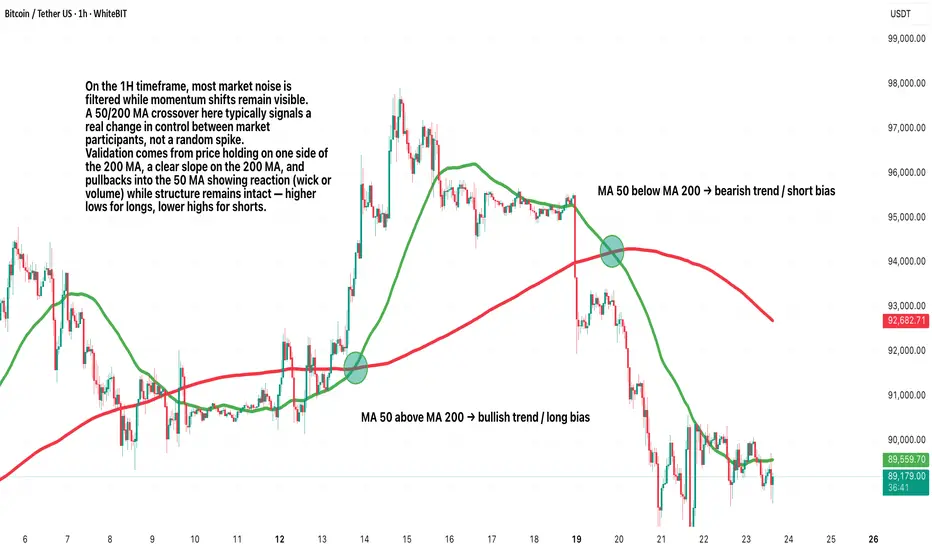
Moving averages are trend indicators, plain and simple. They help you see where the market is actually heading by filtering out the noise and focusing on the bigger move. If price is holding above the moving average, you’re dealing with an uptrend. If it’s stuck below, that’s a downtrend. 📊
But here’s the catch: how well moving averages work depends a lot on market conditions. In clean, trending markets, moving averages trend like champs. They help you stay in trades longer and often act as dynamic support or resistance while price pulls back and pushes higher or lower. In sideways or choppy markets, though, they start to betray you — price keeps slicing through the MA, crossovers pile up, and false signals show up fast.
Moving Averages and Perception
When it comes to moving averages perception, it’s all about how you read them. Because they smooth out price, they make the market’s direction look cleaner and more obvious. But don’t get fooled — price smoothing always comes with a trade-off. The smoother the line, the later it reacts. ⏳
That’s why moving average calculation actually matters. How much weight is given to past prices decides how fast the MA responds to new moves. Heavier smoothing means fewer fake-outs, but more delay. Less smoothing means quicker signals — and more noise.
How to Use Moving Averages Effectively?
Now that you get the lag, the trend, and the perception, let’s talk about how traders actually use moving averages in real trading.
The Takeaway
Moving averages are a solid analytical tool, but like any indicator, they’re not magic. They help point out the trend, cut through market noise, and give context to momentum — but they’re still lagging and always based on past price action. That’s why MAs work best as part of a bigger setup, not as standalone signals. Traders who backed them up with RSI, MACD, or volume usually caught the warning signs early. Those who didn’t… paid for it.
Remember, this is just an analysis tool, not a recommendation. Always consider your own strategy and risk tolerance.
Moving averages are a bit like your car’s rear-view mirror — they won’t tell you what’s about to happen, but they’re great at showing you where you’ve been. Whether you’re a seasoned pro or just starting out, understanding how MAs work can give you the edge in identifying trends and making smarter trades. But like anything in trading, they come with their nuances. Let’s dive into the core of moving averages: lag, trend, and perception.
The Lag of Moving Averages
First things first — moving averages lag. Simple as that. They’re lagging indicators by design because they’re built on past price data. A moving average doesn’t predict where price is going; it just smooths out historical moves so the trend is easier to read.
Whether you’re using a simple moving average (SMA) or an exponential moving average (EMA), both are doing price smoothing — cutting through noise, not forecasting the future. The difference is speed. An SMA averages a fixed set of past prices, which makes it slower when the market snaps or flips fast. An EMA gives more weight to recent candles, so it reacts quicker — but it still lags behind real-time price action.
Moving Averages and Trends
Moving averages are trend indicators, plain and simple. They help you see where the market is actually heading by filtering out the noise and focusing on the bigger move. If price is holding above the moving average, you’re dealing with an uptrend. If it’s stuck below, that’s a downtrend. 📊
But here’s the catch: how well moving averages work depends a lot on market conditions. In clean, trending markets, moving averages trend like champs. They help you stay in trades longer and often act as dynamic support or resistance while price pulls back and pushes higher or lower. In sideways or choppy markets, though, they start to betray you — price keeps slicing through the MA, crossovers pile up, and false signals show up fast.
Moving Averages and Perception
When it comes to moving averages perception, it’s all about how you read them. Because they smooth out price, they make the market’s direction look cleaner and more obvious. But don’t get fooled — price smoothing always comes with a trade-off. The smoother the line, the later it reacts. ⏳
That’s why moving average calculation actually matters. How much weight is given to past prices decides how fast the MA responds to new moves. Heavier smoothing means fewer fake-outs, but more delay. Less smoothing means quicker signals — and more noise.
How to Use Moving Averages Effectively?
Now that you get the lag, the trend, and the perception, let’s talk about how traders actually use moving averages in real trading.
- Use MAs with other indicators: A single MA is fine, but it’s way more useful when it’s backed up by something else. Pair moving averages with RSI, MACD, or volume to filter bad signals. If price is holding above an SMA and RSI is showing bullish momentum, that setup already looks a lot cleaner than an MA signal on its own.
- Choose the right type of MA: SMA vs EMA usually comes down to market speed and personal style. EMAs fit fast, volatile markets like crypto because they react quicker to price. SMAs move slower, which makes them better for cleaner, more established trends where you want stability, not speed.
- Adjust the timeframe: The MA length you use changes everything. Short-period MAs (like 5 or 10) react fast and suit scalping or day trading. Longer ones (50 or 200) smooth things out and give you the bigger trend picture. There’s no “best” setting — you dial it in based on how you trade and how much noise you’re willing to deal with.
The Takeaway
Moving averages are a solid analytical tool, but like any indicator, they’re not magic. They help point out the trend, cut through market noise, and give context to momentum — but they’re still lagging and always based on past price action. That’s why MAs work best as part of a bigger setup, not as standalone signals. Traders who backed them up with RSI, MACD, or volume usually caught the warning signs early. Those who didn’t… paid for it.
Remember, this is just an analysis tool, not a recommendation. Always consider your own strategy and risk tolerance.

Rate us & share your experience.
Thanks for being part of our community 🚀
👉 Leave your review here: tradingview.com/broker/WhiteBIT/reviews/
Thanks for being part of our community 🚀
👉 Leave your review here: tradingview.com/broker/WhiteBIT/reviews/
Haftungsausschluss
Die Informationen und Veröffentlichungen sind nicht als Finanz-, Anlage-, Handels- oder andere Arten von Ratschlägen oder Empfehlungen gedacht, die von TradingView bereitgestellt oder gebilligt werden, und stellen diese nicht dar. Lesen Sie mehr in den Nutzungsbedingungen.