
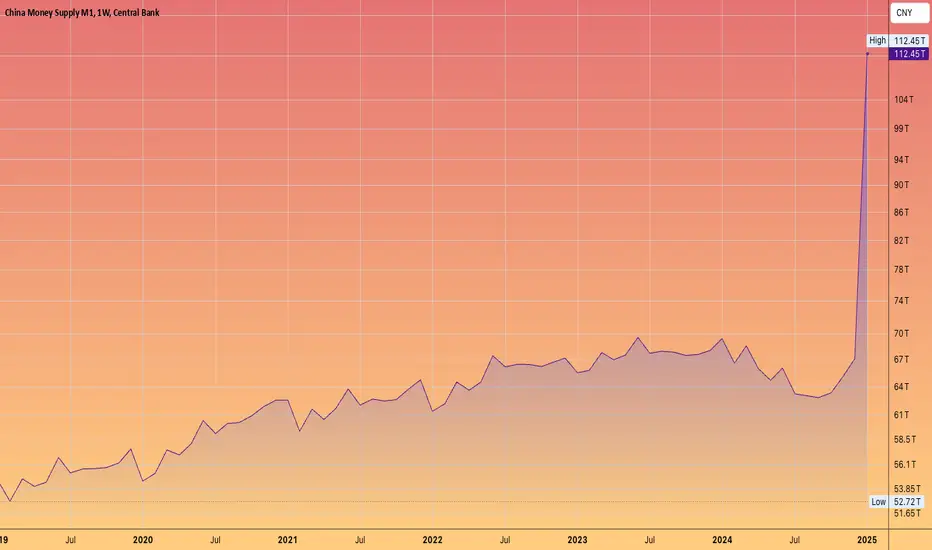
China's revision of its M1 money supply calculation in January 2025, which now encompasses individual checking accounts and assets held in non-bank financial institutions, seeks to deliver a clearer understanding of liquidity within its economy. The reported surge from $67 trillion in December 2024 to $112 trillion in January 2025 has ignited discussions, with some viewing it as a strategy to obscure underlying economic issues, such as a potential deflationary debt spiral.
The People's Bank of China has declared a "moderately loose" monetary policy for 2025, aiming to boost the money supply and lower interest rates to foster economic growth, a move that may be connected to the M1 recalibration. This shift takes place against a backdrop of broader macroeconomic adjustments, including a 5% GDP growth target and initiatives to stabilize the real estate sector, as detailed in China's 14th Five-Year Plan for 2025.
The People's Bank of China has declared a "moderately loose" monetary policy for 2025, aiming to boost the money supply and lower interest rates to foster economic growth, a move that may be connected to the M1 recalibration. This shift takes place against a backdrop of broader macroeconomic adjustments, including a 5% GDP growth target and initiatives to stabilize the real estate sector, as detailed in China's 14th Five-Year Plan for 2025.
Anmerkung
The Hang Seng Index #HSI on the quarterly chart is (I Believe) in a wyckoff accumulation range building for a breakout to the upside. Note the bullish engulfing that is forming.
Haftungsausschluss
Die Informationen und Veröffentlichungen sind nicht als Finanz-, Anlage-, Handels- oder andere Arten von Ratschlägen oder Empfehlungen gedacht, die von TradingView bereitgestellt oder gebilligt werden, und stellen diese nicht dar. Lesen Sie mehr in den Nutzungsbedingungen.
Haftungsausschluss
Die Informationen und Veröffentlichungen sind nicht als Finanz-, Anlage-, Handels- oder andere Arten von Ratschlägen oder Empfehlungen gedacht, die von TradingView bereitgestellt oder gebilligt werden, und stellen diese nicht dar. Lesen Sie mehr in den Nutzungsbedingungen.