
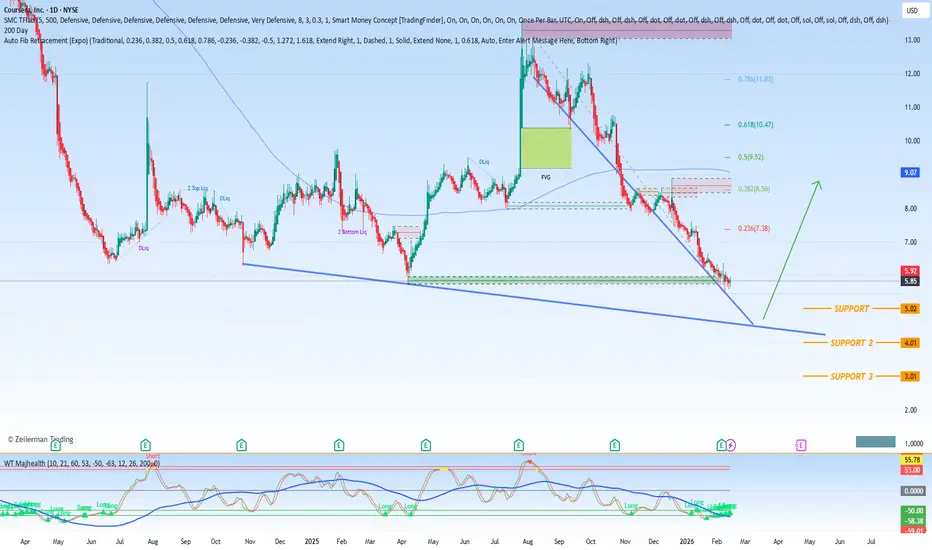
Coursera, Inc. (COUR): A Comprehensive Bull Case Analysis
This analysis is based on a bullish thesis originally published on Thanh’s Value Investing Blog (Substack) by Thanh. It outlines a compelling investment case for Coursera, Inc. (COUR), a company operating in a deeply out-of-favor EdTech sector. As of a recent analysis, Coursera's stock was trading at approximately $8.40, and at $6.07 as of February 4th. The forward P/E ratio stood at 13.33 according to Yahoo Finance, signaling a potentially undervalued position that the market has yet to recognize.
The Market's Misplaced Pessimism
The broader EdTech landscape is currently besieged by investor skepticism, primarily fueled by the rapid ascent of generative AI. The prevailing fear is that AI, with its ability to generate instant answers and synthesize information, has rendered the original Massive Open Online Course (MOOC) model obsolete. This concern has been amplified by the struggles and high-profile failures of other educational technology companies, most notably Chegg, which has seen its business model severely disrupted by free AI tools.
However, Thanh's thesis argues that this pervasive pessimism is a case of the market painting an entire sector with the same broad brush, failing to appreciate Coursera’s unique and differentiated market positioning. To lump Coursera in with other, more vulnerable skill-based learning platforms is, according to this analysis, a significant mispricing of the company's intrinsic value and long-term potential. While generative AI presents a dual threat and opportunity, the net impact for Coursera is skewed heavily in a positive direction, placing the company at a pivotal inflection point.
A Differentiated Business Model: Credentials Over Quick Fixes
Coursera operates a sophisticated two-sided marketplace that connects world-class educational content from leading universities and industry giants like Google, IBM, and Microsoft with two primary customer segments: individual learners and enterprise clients (businesses, governments, and campuses). The core of Coursera’s value proposition is built around structured learning pathways and, most importantly, recognized credentials. Its target audience consists primarily of "Career Switchers"—individuals looking to fundamentally change their professional trajectory—and "Academic Supplementers"—those seeking to augment their formal education with practical, in-demand skills. These users are not looking for quick, five-minute answers; they are investing time and money in comprehensive, project-based learning that culminates in a verifiable and employer-recognized certification.
This credential-led focus is the critical differentiator that insulates Coursera from the existential threat posed by AI. Platforms like Udemy, which cater to just-in-time problem solvers looking for a quick tutorial to fix a specific coding bug or learn a software shortcut, are highly vulnerable. If an AI chatbot can provide that same solution instantly and for free, the value of that type of content plummets.
Coursera's offerings, however, are not easily replicated. Generative AI cannot provide a university-backed curriculum, nor can it issue a formal, accredited certificate that holds weight with employers. In fact, far from being a substitute, AI serves as a powerful complement to Coursera's model. It can enhance the learning experience by offering personalized tutoring, summarizing complex topics, providing instant feedback on coding assignments, and improving overall course completion rates. For the serious, career-focused learner, AI is a tool that enhances the value of a Coursera credential, not one that replaces it.
Financial Health and a Compelling Valuation
Financially, the bull case is anchored by Coursera's strong balance sheet. The company trades at a low enterprise value to free cash flow (EV/FCF) multiple, a valuation made even more attractive by its substantial net cash position. This cash pile acts as a significant valuation floor, providing a margin of safety for investors and limiting the downside risk. Management is acutely aware of the shifting landscape and is actively executing on a strategy to capitalize on it. Key initiatives include:
AI-Native Product Development: Integrating AI throughout the platform to personalize learning paths, improve content discovery, and create new AI-powered educational tools.
Accelerated Content Creation: Leveraging AI to help partners create and update course content more efficiently, keeping the catalog fresh and relevant.
Pricing Optimization: Refining its pricing strategy to better capture the value of its premium credentials, particularly for enterprise clients.
Enterprise Segment Fixes: Addressing past execution issues in the enterprise business to improve sales efficiency and client retention.
The Long-Term Catalyst: AI-Driven Reskilling
The ultimate catalyst for Coursera's growth lies in the very technology that has spooked the market. As generative AI continues to automate routine cognitive tasks, it will inevitably displace workers across numerous industries. This disruption will create a new, massive wave of "Career Switchers"—individuals who need to reskill and upskill to remain relevant in the evolving job market. They will need more than just fragmented knowledge; they will need structured, comprehensive programs that lead to credible, verifiable credentials. This is precisely the need that Coursera is built to fulfill.
Therefore, Coursera is positioned not as a casualty of the AI revolution, but as a primary beneficiary. The company is the infrastructure for the reskilling economy. As this narrative shifts from fear of disruption to recognition of opportunity, the market’s perception of Coursera is likely to undergo a dramatic transformation. This potential for a powerful narrative shift, combined with the company's solid execution, differentiated model, and attractive valuation, sets the stage for what Thanh believes is a compelling long-term investment with meaningful upside from current levels.
Context and Previous Analysis
This is not the first time a bullish thesis on Coursera has been presented. In a previous analysis covered in November 2024, Unemployed Value Degen highlighted similar themes of undervaluation, strong user growth, and a resilient cash position, also emphasizing the opportunity in AI-driven credentials. Since that coverage, COUR's stock price has depreciated by approximately 23.16%, a decline that arguably makes the value proposition even more compelling. Thanh's thesis shares this optimistic outlook but places a sharper emphasis on Coursera’s distinct positioning against AI disruption, the defensibility of its credential-led model, and the resulting long-term risk/reward profile that is currently being overlooked by a pessimistic and undifferentiated market.
This analysis is based on a bullish thesis originally published on Thanh’s Value Investing Blog (Substack) by Thanh. It outlines a compelling investment case for Coursera, Inc. (COUR), a company operating in a deeply out-of-favor EdTech sector. As of a recent analysis, Coursera's stock was trading at approximately $8.40, and at $6.07 as of February 4th. The forward P/E ratio stood at 13.33 according to Yahoo Finance, signaling a potentially undervalued position that the market has yet to recognize.
The Market's Misplaced Pessimism
The broader EdTech landscape is currently besieged by investor skepticism, primarily fueled by the rapid ascent of generative AI. The prevailing fear is that AI, with its ability to generate instant answers and synthesize information, has rendered the original Massive Open Online Course (MOOC) model obsolete. This concern has been amplified by the struggles and high-profile failures of other educational technology companies, most notably Chegg, which has seen its business model severely disrupted by free AI tools.
However, Thanh's thesis argues that this pervasive pessimism is a case of the market painting an entire sector with the same broad brush, failing to appreciate Coursera’s unique and differentiated market positioning. To lump Coursera in with other, more vulnerable skill-based learning platforms is, according to this analysis, a significant mispricing of the company's intrinsic value and long-term potential. While generative AI presents a dual threat and opportunity, the net impact for Coursera is skewed heavily in a positive direction, placing the company at a pivotal inflection point.
A Differentiated Business Model: Credentials Over Quick Fixes
Coursera operates a sophisticated two-sided marketplace that connects world-class educational content from leading universities and industry giants like Google, IBM, and Microsoft with two primary customer segments: individual learners and enterprise clients (businesses, governments, and campuses). The core of Coursera’s value proposition is built around structured learning pathways and, most importantly, recognized credentials. Its target audience consists primarily of "Career Switchers"—individuals looking to fundamentally change their professional trajectory—and "Academic Supplementers"—those seeking to augment their formal education with practical, in-demand skills. These users are not looking for quick, five-minute answers; they are investing time and money in comprehensive, project-based learning that culminates in a verifiable and employer-recognized certification.
This credential-led focus is the critical differentiator that insulates Coursera from the existential threat posed by AI. Platforms like Udemy, which cater to just-in-time problem solvers looking for a quick tutorial to fix a specific coding bug or learn a software shortcut, are highly vulnerable. If an AI chatbot can provide that same solution instantly and for free, the value of that type of content plummets.
Coursera's offerings, however, are not easily replicated. Generative AI cannot provide a university-backed curriculum, nor can it issue a formal, accredited certificate that holds weight with employers. In fact, far from being a substitute, AI serves as a powerful complement to Coursera's model. It can enhance the learning experience by offering personalized tutoring, summarizing complex topics, providing instant feedback on coding assignments, and improving overall course completion rates. For the serious, career-focused learner, AI is a tool that enhances the value of a Coursera credential, not one that replaces it.
Financial Health and a Compelling Valuation
Financially, the bull case is anchored by Coursera's strong balance sheet. The company trades at a low enterprise value to free cash flow (EV/FCF) multiple, a valuation made even more attractive by its substantial net cash position. This cash pile acts as a significant valuation floor, providing a margin of safety for investors and limiting the downside risk. Management is acutely aware of the shifting landscape and is actively executing on a strategy to capitalize on it. Key initiatives include:
AI-Native Product Development: Integrating AI throughout the platform to personalize learning paths, improve content discovery, and create new AI-powered educational tools.
Accelerated Content Creation: Leveraging AI to help partners create and update course content more efficiently, keeping the catalog fresh and relevant.
Pricing Optimization: Refining its pricing strategy to better capture the value of its premium credentials, particularly for enterprise clients.
Enterprise Segment Fixes: Addressing past execution issues in the enterprise business to improve sales efficiency and client retention.
The Long-Term Catalyst: AI-Driven Reskilling
The ultimate catalyst for Coursera's growth lies in the very technology that has spooked the market. As generative AI continues to automate routine cognitive tasks, it will inevitably displace workers across numerous industries. This disruption will create a new, massive wave of "Career Switchers"—individuals who need to reskill and upskill to remain relevant in the evolving job market. They will need more than just fragmented knowledge; they will need structured, comprehensive programs that lead to credible, verifiable credentials. This is precisely the need that Coursera is built to fulfill.
Therefore, Coursera is positioned not as a casualty of the AI revolution, but as a primary beneficiary. The company is the infrastructure for the reskilling economy. As this narrative shifts from fear of disruption to recognition of opportunity, the market’s perception of Coursera is likely to undergo a dramatic transformation. This potential for a powerful narrative shift, combined with the company's solid execution, differentiated model, and attractive valuation, sets the stage for what Thanh believes is a compelling long-term investment with meaningful upside from current levels.
Context and Previous Analysis
This is not the first time a bullish thesis on Coursera has been presented. In a previous analysis covered in November 2024, Unemployed Value Degen highlighted similar themes of undervaluation, strong user growth, and a resilient cash position, also emphasizing the opportunity in AI-driven credentials. Since that coverage, COUR's stock price has depreciated by approximately 23.16%, a decline that arguably makes the value proposition even more compelling. Thanh's thesis shares this optimistic outlook but places a sharper emphasis on Coursera’s distinct positioning against AI disruption, the defensibility of its credential-led model, and the resulting long-term risk/reward profile that is currently being overlooked by a pessimistic and undifferentiated market.

Haftungsausschluss
Die Informationen und Veröffentlichungen sind nicht als Finanz-, Anlage-, Handels- oder andere Arten von Ratschlägen oder Empfehlungen gedacht, die von TradingView bereitgestellt oder gebilligt werden, und stellen diese nicht dar. Lesen Sie mehr in den Nutzungsbedingungen.
Haftungsausschluss
Die Informationen und Veröffentlichungen sind nicht als Finanz-, Anlage-, Handels- oder andere Arten von Ratschlägen oder Empfehlungen gedacht, die von TradingView bereitgestellt oder gebilligt werden, und stellen diese nicht dar. Lesen Sie mehr in den Nutzungsbedingungen.