
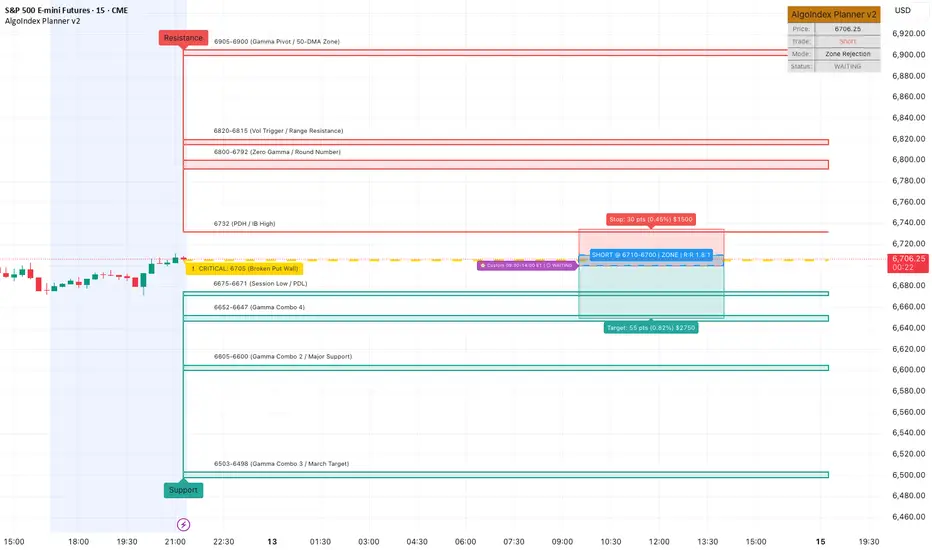
Brent crude topped $100 for the first time since 2022 and that pretty much tells you everything about today. The Strait of Hormuz is effectively closed, tankers are getting hit, and Iran's new supreme leader has zero interest in de-escalating. ES dropped over 100 points from the prior day's highs, breaking cleanly through the 200-day moving average and the options-derived put wall at 6,705. The S&P 500 is at its lowest level since November. On top of the energy chaos, private credit market cracks are showing up: Morgan Stanley and Cliffwater capped fund redemptions, and Deutsche Bank flagged $30 billion in exposure. Megacap stocks are nearing correction territory.
The 30-year bond auction came in ugly: 4.871% yield (vs 4.750% prior) with a weak bid-to-cover at 2.450 (vs 2.660 prior). Short-dated Treasuries sold off as markets stopped fully pricing in a Fed rate cut in 2026. The 2-year yield jumped 9 basis points to 3.74%. Gold declined despite risk-off. The dollar climbed to a near two-month high. Everything is pointing one direction.
News & Sentiment Analysis:
Starting with what's driving everything right now: Iran, Day 13 of the conflict. Three ships were attacked near the Strait of Hormuz today, two oil tankers south of Basra in Iraq and a container ship near Jebel Ali in Dubai. Iran's supreme leader Khamenei is signaling no intention of reopening the Strait, and Tehran's spokesman told markets to "prepare for $200 per barrel oil." Trump said "Iran is paying a big price right now" and "the situation is moving along rapidly," but also made clear that preventing Iran from getting nuclear weapons is "of far greater interest and importance" than oil costs. Crude hit 104 overnight before settling back near 96. Institutional analysis from a major European bank is sobering: the crisis likely gets worse before it gets better. They see Iran intensifying regional pressure through proxy actions, cyberattacks, and attacks on commercial entities tied to the US and Israel. The goal is to keep the Strait under enough threat to endanger supply even with US naval escorts.
The Trump administration is considering waiving the Jones Act, a century-old maritime law requiring US ships for port-to-port transport, to help move goods between American ports. Energy Secretary Wright said the US Navy could begin escorting tankers through Hormuz by the end of March. And 32 countries voted unanimously to release 400 million barrels from strategic reserves. None of this is calming the market. When supply-side interventions of this magnitude can't hold prices down, that's the market telling you something.
A leading institutional bank released an updated economic forecast tied to the war: Brent at $98 average through March and April, up 40% from the 2025 average, falling back to $71 by late 2026. In an upside risk scenario where Hormuz flows are disrupted for a full month, they see Brent averaging $110. Their rules of thumb suggest a sustained 10% oil increase adds 0.2pp to headline inflation and shaves 0.1pp off GDP. They raised their 2026 headline PCE inflation forecast by 0.8 percentage points to 2.9%, cut GDP growth by 0.3pp to 2.2%, raised the unemployment forecast to 4.6%, and bumped the 12-month recession probability to 25%. Most critically, they pushed their first Fed cut forecast from June to September, with a second in December to a terminal rate of 3-3.25%. The upside scenario is even worse: headline PCE at 3.3%, peaking at 4.5% in the spring.
Yesterday's CPI was benign on the surface: headline 2.41% YoY, core 2.46% YoY, both slightly below consensus. Core goods only +0.08% MoM with no tariff re-acceleration yet. Housing disinflation is continuing. But here's the catch: the read-through to tomorrow's PCE report, which is what the Fed actually targets, suggests core PCE at 3.1% YoY. PCE has been sideways for over 18 months now. One bank's analysis was blunt: this CPI "does not change much for the Fed." They expect the Fed to remain on hold through year-end. Markets are now pricing only about 35 basis points of easing by year-end, with the first full cut not until October.
The risk indicator from premium institutional analysis reads "mild risk off," which feels generous. Interest rate futures are continuing to price in less Fed easing. The private credit market situation is a new wrinkle: the $1.8 trillion sector is showing stress from redemption requests, and bank exposure numbers are getting flagged. This has the potential to become a secondary narrative if the oil crisis persists.
Options positioning remains deeply put-bid across the board. Put volume outpaced call volume at a 1.31 ratio on the index, with put open interest running at 1.52 times call OI. The gamma index sits at -1.98, deep in negative territory, meaning dealer hedging amplifies moves in both directions. The implied 1-day move from options pricing puts the expected range at roughly 6,685 to 6,769 (ES equivalent). Gamma notional is -$500M. The risk reversal is -0.094, confirming heavy put skew. Real-time hedging flow plunged to -1.2 billion during the session before recovering to +800 million, showing heavy institutional put buying followed by flow exhaustion near the close. Separately, an options flow report flagged SPX negative gamma at -$1,351 million (71st percentile), with extreme bearish positioning in ORCL and TSLA, and surging VIX hedging demand.
The options flow research thesis is clear: "play the range" between 6,600 and 6,820. Full vol premium contraction is unlikely this week. Negative gamma still dominates. Prices will remain unstable with no pinning expected, meaning large swings over the next several sessions. The medium-term target is a 6,500 low into March OPEX on 3/20 through quarter-end OPEX on 3/31. After March, that 6,500 floor drops out. Vol premiums are about 20 points wide, which is massive, so violent bounces are possible when premium contracts, but the core message remains: rips should be sold until the Iran situation resolves, specifically until the Strait of Hormuz reopens.
An energy market analyst noted that the oil market is shifting from "shock to attrition." Markets are still underestimating the duration and compounding risk. By late March, operational constraints are likely to force temporary well shut-ins, turning short-term disruption into persistent production declines. Even without further escalation, persistent insecurity raises the cost of operating fields and maintaining export infrastructure.
There's a supply chain angle that isn't getting enough attention yet: helium. Qatar accounts for roughly a third of global helium production, and it all comes out of Ras Laffan Industrial City, which halted production after Iranian drone strikes. Helium has no viable substitute in semiconductor manufacturing, it's used to cool silicon wafers and in lithography for etching chip circuitry. South Korea, which produces about two-thirds of global memory chips, sourced 64.7% of its helium imports from Qatar in 2025. SK Hynix says it has diversified and secured sufficient inventory, and TSMC says it doesn't anticipate a notable impact yet, but experts estimate a minimum 2-3 month production shutdown and 4-6 months before the helium supply chain normalizes. If the disruption persists, chipmakers may be forced to deprioritize lower-margin product lines and tilt allocation further toward AI memory, deepening an already severe memory shortage. With Alphabet, Amazon, Microsoft, and Meta collectively spending roughly $650 billion on AI infrastructure in 2026, any constraint on memory chip output would be felt across the entire AI build-out.
Other notable headlines: Meta's massive undersea cable project in the Persian Gulf has been stalled by the war, with the contractor sending force majeure notices. Meta also postponed the rollout of its new AI model due to performance concerns. The US decided not to issue duties on battery material imports from China, a minor positive. Critical mineral talks are advancing with the EU and Japan.
Late-breaking Iran headlines add to the pressure: CNN is reporting that top Trump officials recognized they did not plan for Iran closing the Strait in response to strikes, and that the Pentagon and NSC significantly underestimated Iran's willingness to shut Hormuz. Separately, the US fired at an Iranian vessel that approached the USS Abraham Lincoln aircraft carrier, and the Financial Times is reporting the US has depleted years of munitions since the start of the conflict. The rapid depletion of tomahawk stockpiles is increasing pressure on the administration over the cost of this war. None of this suggests de-escalation is close.
Market internals confirmed the risk-off tone. The advance-decline line closed at -1,586, deeply negative and worsening through the session. The VIX closed at 27.28, well above the 25 threshold where protection costs start compressing speculative positioning, though it has since eased to around 25.5 in the globex session. Oil at 96.28 at the RTH close, up over 10% on the day, has since pulled back slightly to around 95 but remains the primary driver of everything else.
Forecast:
• Overnight: Choppy with a downside lean. Price has bounced back to test the broken put wall at 6,700-6,710 in the globex session, which now becomes resistance. VIX has eased to around 25.5 and crude has pulled back slightly to 95, but the late CNN and FT headlines on Iran (Pentagon underestimated Strait closure, munitions depleted) suggest this relief is fragile. Any bounce into 6,710-6,720 is likely to get sold.
• Morning Session: MASSIVE data drop at 08:30 ET: GDP (Q4), Core PCE (Jan), Personal Income/Spending, Durable Goods. Core PCE is the big one, expected at 0.4% MoM and 3.1% YoY. A hot print would crush any remaining rate cut hopes and push prices lower. Weak GDP would reinforce the stagflation narrative. Michigan Consumer Sentiment and JOLTs Job Openings both at 10:00 ET add a second wave of volatility. This morning session will be highly volatile.
• Afternoon: After the morning data fireworks settle, expect positioning ahead of the weekend. No one wants to hold long over a weekend when Iran is escalating daily, so I'd look for afternoon selling pressure as traders de-risk into the close.
• Daily Close: Bearish. Between negative gamma, oil still above $95, private credit stress, hot PCE expectations, the Pentagon admitting it underestimated Iran, and munitions depletion headlines, there's no reason for this to reverse. Expecting a close near session lows.
• Expected Range: 6,590 to 6,730 (based on 14-day ATR of 110 points and implied 1-day move of 0.62%, skewed to the downside given momentum and trend strength)
• Most Likely Path: Gap down or flat open, morning data at 08:30 determines the rest. If Core PCE prints hot at 3.1%+ YoY, expect a sharp sell-off toward 6,650-6,600 by midday. If data is benign, range-bound between 6,660-6,710 with afternoon weakness into the close. Weekend risk keeps a lid on any recovery.
Friday Events:
• 03:00 ET: UK GDP (MoM, YoY, 3M), UK Manufacturing/Industrial Production, UK Trade Balance
• 03:45 ET: French CPI (MoM, YoY), French HICP (MoM Final, YoY Final)
• 06:00 ET: Eurozone Industrial Production (MoM, YoY)
• 08:30 ET: US GDP Growth Rate QoQ (Q4)
• 08:30 ET: US Core PCE Price Index MoM (exp 0.4%, prior 0.4%)
• 08:30 ET: US Core PCE Price Index YoY (exp 3.1%, prior 3.0%)
• 08:30 ET: US Personal Income MoM (Jan)
• 08:30 ET: US Consumer Spending MoM (Jan, exp 0.3%, prior 0.4%)
• 08:30 ET: US Durable Goods Orders MoM (Jan, exp 1.1%, prior -1.4%)
• 10:00 ET: US JOLTs Job Openings (Jan)
• 10:00 ET: Michigan Consumer Sentiment (Mar, prelim)
• Earnings: None market-moving. Next up: MU on 3/18, BABA and FDX on 3/19
Resistance:
• 6,700-6,710 – Broken Put Wall / Round Number – The options-derived put wall at 6,705 was broken to the downside today. What was support is now the first overhead resistance. This is where shorts should be looking to add if price reclaims briefly. Heavy gamma concentration here.
• 6,732 – Prior Day High (PDH) / IB High – Today's session high at 6,732 also marks the initial balance high. VWAP sits at 6,702 and yesterday's value area high is around 6,718. A full reclaim of PDH would be needed to suggest any momentum shift.
• 6,792-6,800 – Zero Gamma / Round Number – The critical gamma inflection point at 6,792 (ES). Above here, dealer hedging dampens moves. Below, it amplifies them. We're over 100 points below this right now, so it's a distant target, but it's THE level that changes the regime.
• 6,815-6,820 – Vol Trigger / Range Resistance – The volatility trigger at 6,815 marks the boundary of the high-vol regime. Also aligns with the top of the "play the range" thesis (6,600-6,820). Getting above here would be a significant structural shift.
• 6,900-6,905 – Gamma Pivot / 50-DMA Zone – The options flow pivot level at 6,900 (bearish below, bullish above). Also near the 50-DMA at 6,961 and 20-DMA at 6,894. This would require a ceasefire or Hormuz reopening headline to reach.
Support:
• 6,675-6,671 – Session Low / PDL – Today's low at 6,671 (Asian session low) and the prior day low at 6,675.25 create a thin zone of immediate support. The 99th percentile 0DTE GEX strike at 6,670 provided support at this level today. A break below here opens the door to the next gamma level.
• 6,647-6,652 – Gamma Combo 4 – The next gamma-derived support below the put wall. This is the first significant options concentration on the way down. Watch for a bounce attempt here.
• 6,631 – 1-Month Low – The lowest price in the past 30 days. A clean break below here would signal new monthly lows and likely trigger momentum selling from systematic strategies.
• 6,600-6,605 – Gamma Combo 2 / Major Support – The bottom of the "play the range" thesis. Major gamma-derived support at 6,603 (ES). This is where the options flow analysis expects buying interest to emerge. A break here opens the door to the March OPEX target.
• 6,498-6,503 – Gamma Combo 3 / March Target – The March OPEX low target (6,500 on SPX). If the sell-off accelerates through 6,600, this is the next major structural target. 4H chart Fibonacci extension at 6,449 sits below.
How I'm seeing it:
• Strongly bearish, no change in thesis from Wednesday. The 200-DMA has been broken, the put wall has been broken, and we're now rolling through the trough of negative gamma. Every bounce is getting sold.
• Tomorrow's Core PCE at 08:30 ET is the biggest risk event. If it prints at 3.1% YoY or higher (as institutional analysis expects), that's the nail in the coffin for rate cut hopes and could trigger a flush toward 6,650-6,600. The Fed meets next Wednesday, and a hot PCE would cement the "on hold indefinitely" narrative.
• The weekend risk factor is huge. No one wants to be holding long over a weekend when Iran is getting hit daily and oil tankers are being attacked. I'd expect afternoon selling pressure as traders de-risk ahead of Saturday/Sunday headline risk.
• Bounces toward 6,700-6,710 (broken put wall) are opportunities to fade. The risk/reward on shorts is still favorable as long as price stays below the zero gamma level at 6,792.
• A break of 6,600 would unlock the path to the 6,500 target area that options flow research has been calling for as the March OPEX low. With OPEX on 3/20 and the Fed on 3/18, the next 8 days are loaded with catalysts that all skew bearish.
• The helium supply chain disruption is a sleeper risk for tech. Qatar's Ras Laffan shutdown takes a third of global helium offline, and chip manufacturers need it for wafer cooling and lithography. If this drags on 2-3 months (the minimum expert estimate), memory chip supply tightens right as AI capex is peaking. That's a stagflationary input for the entire tech complex.
• The only bullish wild card remains an Iran de-escalation headline: ceasefire, Strait of Hormuz reopening, a Trump "mission accomplished" declaration. But evening reports that the Pentagon and NSC underestimated Iran's willingness to close the Strait, and the FT's report on rapid munitions depletion, suggest de-escalation is further away, not closer. The vol premiums are so wide (~20 points) that any such headline would still trigger a violent squeeze higher. But until it comes, sell the rips.
• Composite technical indicators are at 80% sell with strengthening bearish momentum. Trend strength is extreme and still accelerating, with the 14-day ADX at 42.73 and the 9-day ADX surging to 49.96, that's about as strong a trend reading as you'll ever see. Negative directional index (-DI) at 30.97 vs positive (+DI) at just 6.76 confirms overwhelming bearish dominance. Price is below every single moving average from 5-day (6,798) through 200-day (6,748). The stochastic is deeply oversold at 33.33% (%K), which means a technical bounce is overdue, but oversold can stay oversold in a strong trend.
• Primary Setup: Short from 6,700-6,710, stop 6,735, targeting 6,650 first, then 6,600 (fade of broken put wall, negative gamma amplification, Iran weekend risk, hot PCE catalyst)
Tomorrow is the kind of session where the data does the talking. PCE at 08:30 will set the tone, Michigan Sentiment at 10:00 adds to it, and then the weekend de-risk trade takes over in the afternoon. The path of least resistance is still lower until Iran resolves or vol premiums fully contract.
Good Luck !!!
The 30-year bond auction came in ugly: 4.871% yield (vs 4.750% prior) with a weak bid-to-cover at 2.450 (vs 2.660 prior). Short-dated Treasuries sold off as markets stopped fully pricing in a Fed rate cut in 2026. The 2-year yield jumped 9 basis points to 3.74%. Gold declined despite risk-off. The dollar climbed to a near two-month high. Everything is pointing one direction.
News & Sentiment Analysis:
Starting with what's driving everything right now: Iran, Day 13 of the conflict. Three ships were attacked near the Strait of Hormuz today, two oil tankers south of Basra in Iraq and a container ship near Jebel Ali in Dubai. Iran's supreme leader Khamenei is signaling no intention of reopening the Strait, and Tehran's spokesman told markets to "prepare for $200 per barrel oil." Trump said "Iran is paying a big price right now" and "the situation is moving along rapidly," but also made clear that preventing Iran from getting nuclear weapons is "of far greater interest and importance" than oil costs. Crude hit 104 overnight before settling back near 96. Institutional analysis from a major European bank is sobering: the crisis likely gets worse before it gets better. They see Iran intensifying regional pressure through proxy actions, cyberattacks, and attacks on commercial entities tied to the US and Israel. The goal is to keep the Strait under enough threat to endanger supply even with US naval escorts.
The Trump administration is considering waiving the Jones Act, a century-old maritime law requiring US ships for port-to-port transport, to help move goods between American ports. Energy Secretary Wright said the US Navy could begin escorting tankers through Hormuz by the end of March. And 32 countries voted unanimously to release 400 million barrels from strategic reserves. None of this is calming the market. When supply-side interventions of this magnitude can't hold prices down, that's the market telling you something.
A leading institutional bank released an updated economic forecast tied to the war: Brent at $98 average through March and April, up 40% from the 2025 average, falling back to $71 by late 2026. In an upside risk scenario where Hormuz flows are disrupted for a full month, they see Brent averaging $110. Their rules of thumb suggest a sustained 10% oil increase adds 0.2pp to headline inflation and shaves 0.1pp off GDP. They raised their 2026 headline PCE inflation forecast by 0.8 percentage points to 2.9%, cut GDP growth by 0.3pp to 2.2%, raised the unemployment forecast to 4.6%, and bumped the 12-month recession probability to 25%. Most critically, they pushed their first Fed cut forecast from June to September, with a second in December to a terminal rate of 3-3.25%. The upside scenario is even worse: headline PCE at 3.3%, peaking at 4.5% in the spring.
Yesterday's CPI was benign on the surface: headline 2.41% YoY, core 2.46% YoY, both slightly below consensus. Core goods only +0.08% MoM with no tariff re-acceleration yet. Housing disinflation is continuing. But here's the catch: the read-through to tomorrow's PCE report, which is what the Fed actually targets, suggests core PCE at 3.1% YoY. PCE has been sideways for over 18 months now. One bank's analysis was blunt: this CPI "does not change much for the Fed." They expect the Fed to remain on hold through year-end. Markets are now pricing only about 35 basis points of easing by year-end, with the first full cut not until October.
The risk indicator from premium institutional analysis reads "mild risk off," which feels generous. Interest rate futures are continuing to price in less Fed easing. The private credit market situation is a new wrinkle: the $1.8 trillion sector is showing stress from redemption requests, and bank exposure numbers are getting flagged. This has the potential to become a secondary narrative if the oil crisis persists.
Options positioning remains deeply put-bid across the board. Put volume outpaced call volume at a 1.31 ratio on the index, with put open interest running at 1.52 times call OI. The gamma index sits at -1.98, deep in negative territory, meaning dealer hedging amplifies moves in both directions. The implied 1-day move from options pricing puts the expected range at roughly 6,685 to 6,769 (ES equivalent). Gamma notional is -$500M. The risk reversal is -0.094, confirming heavy put skew. Real-time hedging flow plunged to -1.2 billion during the session before recovering to +800 million, showing heavy institutional put buying followed by flow exhaustion near the close. Separately, an options flow report flagged SPX negative gamma at -$1,351 million (71st percentile), with extreme bearish positioning in ORCL and TSLA, and surging VIX hedging demand.
The options flow research thesis is clear: "play the range" between 6,600 and 6,820. Full vol premium contraction is unlikely this week. Negative gamma still dominates. Prices will remain unstable with no pinning expected, meaning large swings over the next several sessions. The medium-term target is a 6,500 low into March OPEX on 3/20 through quarter-end OPEX on 3/31. After March, that 6,500 floor drops out. Vol premiums are about 20 points wide, which is massive, so violent bounces are possible when premium contracts, but the core message remains: rips should be sold until the Iran situation resolves, specifically until the Strait of Hormuz reopens.
An energy market analyst noted that the oil market is shifting from "shock to attrition." Markets are still underestimating the duration and compounding risk. By late March, operational constraints are likely to force temporary well shut-ins, turning short-term disruption into persistent production declines. Even without further escalation, persistent insecurity raises the cost of operating fields and maintaining export infrastructure.
There's a supply chain angle that isn't getting enough attention yet: helium. Qatar accounts for roughly a third of global helium production, and it all comes out of Ras Laffan Industrial City, which halted production after Iranian drone strikes. Helium has no viable substitute in semiconductor manufacturing, it's used to cool silicon wafers and in lithography for etching chip circuitry. South Korea, which produces about two-thirds of global memory chips, sourced 64.7% of its helium imports from Qatar in 2025. SK Hynix says it has diversified and secured sufficient inventory, and TSMC says it doesn't anticipate a notable impact yet, but experts estimate a minimum 2-3 month production shutdown and 4-6 months before the helium supply chain normalizes. If the disruption persists, chipmakers may be forced to deprioritize lower-margin product lines and tilt allocation further toward AI memory, deepening an already severe memory shortage. With Alphabet, Amazon, Microsoft, and Meta collectively spending roughly $650 billion on AI infrastructure in 2026, any constraint on memory chip output would be felt across the entire AI build-out.
Other notable headlines: Meta's massive undersea cable project in the Persian Gulf has been stalled by the war, with the contractor sending force majeure notices. Meta also postponed the rollout of its new AI model due to performance concerns. The US decided not to issue duties on battery material imports from China, a minor positive. Critical mineral talks are advancing with the EU and Japan.
Late-breaking Iran headlines add to the pressure: CNN is reporting that top Trump officials recognized they did not plan for Iran closing the Strait in response to strikes, and that the Pentagon and NSC significantly underestimated Iran's willingness to shut Hormuz. Separately, the US fired at an Iranian vessel that approached the USS Abraham Lincoln aircraft carrier, and the Financial Times is reporting the US has depleted years of munitions since the start of the conflict. The rapid depletion of tomahawk stockpiles is increasing pressure on the administration over the cost of this war. None of this suggests de-escalation is close.
Market internals confirmed the risk-off tone. The advance-decline line closed at -1,586, deeply negative and worsening through the session. The VIX closed at 27.28, well above the 25 threshold where protection costs start compressing speculative positioning, though it has since eased to around 25.5 in the globex session. Oil at 96.28 at the RTH close, up over 10% on the day, has since pulled back slightly to around 95 but remains the primary driver of everything else.
Forecast:
• Overnight: Choppy with a downside lean. Price has bounced back to test the broken put wall at 6,700-6,710 in the globex session, which now becomes resistance. VIX has eased to around 25.5 and crude has pulled back slightly to 95, but the late CNN and FT headlines on Iran (Pentagon underestimated Strait closure, munitions depleted) suggest this relief is fragile. Any bounce into 6,710-6,720 is likely to get sold.
• Morning Session: MASSIVE data drop at 08:30 ET: GDP (Q4), Core PCE (Jan), Personal Income/Spending, Durable Goods. Core PCE is the big one, expected at 0.4% MoM and 3.1% YoY. A hot print would crush any remaining rate cut hopes and push prices lower. Weak GDP would reinforce the stagflation narrative. Michigan Consumer Sentiment and JOLTs Job Openings both at 10:00 ET add a second wave of volatility. This morning session will be highly volatile.
• Afternoon: After the morning data fireworks settle, expect positioning ahead of the weekend. No one wants to hold long over a weekend when Iran is escalating daily, so I'd look for afternoon selling pressure as traders de-risk into the close.
• Daily Close: Bearish. Between negative gamma, oil still above $95, private credit stress, hot PCE expectations, the Pentagon admitting it underestimated Iran, and munitions depletion headlines, there's no reason for this to reverse. Expecting a close near session lows.
• Expected Range: 6,590 to 6,730 (based on 14-day ATR of 110 points and implied 1-day move of 0.62%, skewed to the downside given momentum and trend strength)
• Most Likely Path: Gap down or flat open, morning data at 08:30 determines the rest. If Core PCE prints hot at 3.1%+ YoY, expect a sharp sell-off toward 6,650-6,600 by midday. If data is benign, range-bound between 6,660-6,710 with afternoon weakness into the close. Weekend risk keeps a lid on any recovery.
Friday Events:
• 03:00 ET: UK GDP (MoM, YoY, 3M), UK Manufacturing/Industrial Production, UK Trade Balance
• 03:45 ET: French CPI (MoM, YoY), French HICP (MoM Final, YoY Final)
• 06:00 ET: Eurozone Industrial Production (MoM, YoY)
• 08:30 ET: US GDP Growth Rate QoQ (Q4)
• 08:30 ET: US Core PCE Price Index MoM (exp 0.4%, prior 0.4%)
• 08:30 ET: US Core PCE Price Index YoY (exp 3.1%, prior 3.0%)
• 08:30 ET: US Personal Income MoM (Jan)
• 08:30 ET: US Consumer Spending MoM (Jan, exp 0.3%, prior 0.4%)
• 08:30 ET: US Durable Goods Orders MoM (Jan, exp 1.1%, prior -1.4%)
• 10:00 ET: US JOLTs Job Openings (Jan)
• 10:00 ET: Michigan Consumer Sentiment (Mar, prelim)
• Earnings: None market-moving. Next up: MU on 3/18, BABA and FDX on 3/19
Resistance:
• 6,700-6,710 – Broken Put Wall / Round Number – The options-derived put wall at 6,705 was broken to the downside today. What was support is now the first overhead resistance. This is where shorts should be looking to add if price reclaims briefly. Heavy gamma concentration here.
• 6,732 – Prior Day High (PDH) / IB High – Today's session high at 6,732 also marks the initial balance high. VWAP sits at 6,702 and yesterday's value area high is around 6,718. A full reclaim of PDH would be needed to suggest any momentum shift.
• 6,792-6,800 – Zero Gamma / Round Number – The critical gamma inflection point at 6,792 (ES). Above here, dealer hedging dampens moves. Below, it amplifies them. We're over 100 points below this right now, so it's a distant target, but it's THE level that changes the regime.
• 6,815-6,820 – Vol Trigger / Range Resistance – The volatility trigger at 6,815 marks the boundary of the high-vol regime. Also aligns with the top of the "play the range" thesis (6,600-6,820). Getting above here would be a significant structural shift.
• 6,900-6,905 – Gamma Pivot / 50-DMA Zone – The options flow pivot level at 6,900 (bearish below, bullish above). Also near the 50-DMA at 6,961 and 20-DMA at 6,894. This would require a ceasefire or Hormuz reopening headline to reach.
Support:
• 6,675-6,671 – Session Low / PDL – Today's low at 6,671 (Asian session low) and the prior day low at 6,675.25 create a thin zone of immediate support. The 99th percentile 0DTE GEX strike at 6,670 provided support at this level today. A break below here opens the door to the next gamma level.
• 6,647-6,652 – Gamma Combo 4 – The next gamma-derived support below the put wall. This is the first significant options concentration on the way down. Watch for a bounce attempt here.
• 6,631 – 1-Month Low – The lowest price in the past 30 days. A clean break below here would signal new monthly lows and likely trigger momentum selling from systematic strategies.
• 6,600-6,605 – Gamma Combo 2 / Major Support – The bottom of the "play the range" thesis. Major gamma-derived support at 6,603 (ES). This is where the options flow analysis expects buying interest to emerge. A break here opens the door to the March OPEX target.
• 6,498-6,503 – Gamma Combo 3 / March Target – The March OPEX low target (6,500 on SPX). If the sell-off accelerates through 6,600, this is the next major structural target. 4H chart Fibonacci extension at 6,449 sits below.
How I'm seeing it:
• Strongly bearish, no change in thesis from Wednesday. The 200-DMA has been broken, the put wall has been broken, and we're now rolling through the trough of negative gamma. Every bounce is getting sold.
• Tomorrow's Core PCE at 08:30 ET is the biggest risk event. If it prints at 3.1% YoY or higher (as institutional analysis expects), that's the nail in the coffin for rate cut hopes and could trigger a flush toward 6,650-6,600. The Fed meets next Wednesday, and a hot PCE would cement the "on hold indefinitely" narrative.
• The weekend risk factor is huge. No one wants to be holding long over a weekend when Iran is getting hit daily and oil tankers are being attacked. I'd expect afternoon selling pressure as traders de-risk ahead of Saturday/Sunday headline risk.
• Bounces toward 6,700-6,710 (broken put wall) are opportunities to fade. The risk/reward on shorts is still favorable as long as price stays below the zero gamma level at 6,792.
• A break of 6,600 would unlock the path to the 6,500 target area that options flow research has been calling for as the March OPEX low. With OPEX on 3/20 and the Fed on 3/18, the next 8 days are loaded with catalysts that all skew bearish.
• The helium supply chain disruption is a sleeper risk for tech. Qatar's Ras Laffan shutdown takes a third of global helium offline, and chip manufacturers need it for wafer cooling and lithography. If this drags on 2-3 months (the minimum expert estimate), memory chip supply tightens right as AI capex is peaking. That's a stagflationary input for the entire tech complex.
• The only bullish wild card remains an Iran de-escalation headline: ceasefire, Strait of Hormuz reopening, a Trump "mission accomplished" declaration. But evening reports that the Pentagon and NSC underestimated Iran's willingness to close the Strait, and the FT's report on rapid munitions depletion, suggest de-escalation is further away, not closer. The vol premiums are so wide (~20 points) that any such headline would still trigger a violent squeeze higher. But until it comes, sell the rips.
• Composite technical indicators are at 80% sell with strengthening bearish momentum. Trend strength is extreme and still accelerating, with the 14-day ADX at 42.73 and the 9-day ADX surging to 49.96, that's about as strong a trend reading as you'll ever see. Negative directional index (-DI) at 30.97 vs positive (+DI) at just 6.76 confirms overwhelming bearish dominance. Price is below every single moving average from 5-day (6,798) through 200-day (6,748). The stochastic is deeply oversold at 33.33% (%K), which means a technical bounce is overdue, but oversold can stay oversold in a strong trend.
• Primary Setup: Short from 6,700-6,710, stop 6,735, targeting 6,650 first, then 6,600 (fade of broken put wall, negative gamma amplification, Iran weekend risk, hot PCE catalyst)
Tomorrow is the kind of session where the data does the talking. PCE at 08:30 will set the tone, Michigan Sentiment at 10:00 adds to it, and then the weekend de-risk trade takes over in the afternoon. The path of least resistance is still lower until Iran resolves or vol premiums fully contract.
Good Luck !!!

info@algoindex.com, algoindex.com | Join our free trading community: facebook.com/groups/1256769122661043
Haftungsausschluss
Die Informationen und Veröffentlichungen sind nicht als Finanz-, Anlage-, Handels- oder andere Arten von Ratschlägen oder Empfehlungen gedacht, die von TradingView bereitgestellt oder gebilligt werden, und stellen diese nicht dar. Lesen Sie mehr in den Nutzungsbedingungen.
info@algoindex.com, algoindex.com | Join our free trading community: facebook.com/groups/1256769122661043
Haftungsausschluss
Die Informationen und Veröffentlichungen sind nicht als Finanz-, Anlage-, Handels- oder andere Arten von Ratschlägen oder Empfehlungen gedacht, die von TradingView bereitgestellt oder gebilligt werden, und stellen diese nicht dar. Lesen Sie mehr in den Nutzungsbedingungen.