
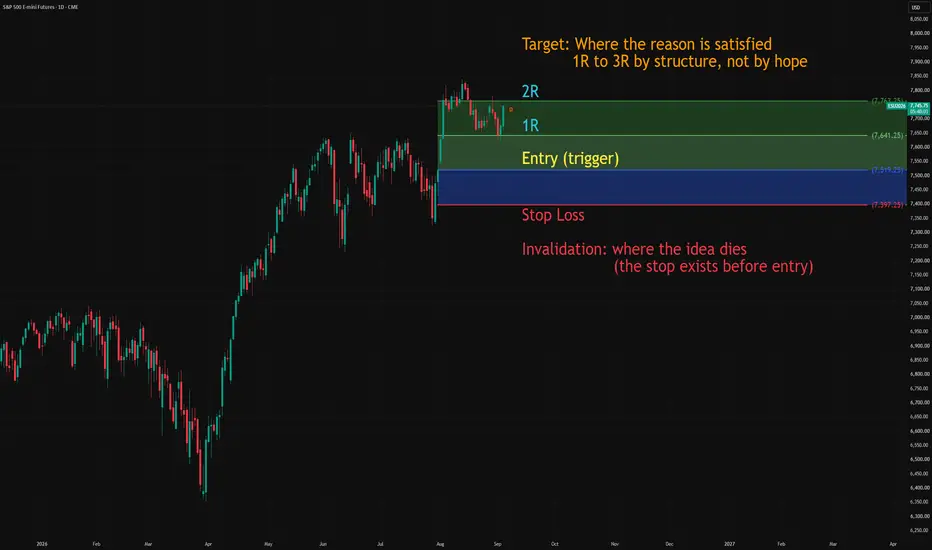
🔵 THE PLAN BEFORE THE TRADE
A trade without a written plan is a guess with leverage. The plan answers four questions before the position exists: where do I enter, where does the idea die, where do I take profit, and how much am I willing to lose? Written down — not in the head. The head rewrites history; the paper does not.
🔵 THE FOUR FIELDS
Entry: the trigger, not the zone — the exact price condition that gets you in. Invalidation: the level where the setup's idea is wrong — that is the stop, and it exists before entry. Target: the level where the reason for the trade is satisfied — 1R to 3R, defined by structure, not by hope. Risk: the fixed budget that converts the stop distance into size.
🔵 WHY WRITING CHANGES BEHAVIOR
Writing forces precision. "Buy near support" is not a plan — "buy on a rejection close above 4,320, stop below 4,290, first target 4,390" is. The act of writing exposes the gaps you would otherwise fill in mid-trade, when the price is moving and the judgment is worst.
🔵 THE PRE-TRADE CHECKLIST
Before entry, four questions, in order: is the setup still valid? Is the invalidation exactly where I wrote it? Does the size match the risk budget? Would I take this trade if I were flat and calm right now? One "no" — no trade.
Next lesson: backtesting — how to test the plan honestly before risking money on it.
Educational content only. Not investment advice.

Full multi-TF zones + COT + Macro Bias + Seasonality → confluenceedge.net
Haftungsausschluss
Die Informationen und Veröffentlichungen sind nicht als Finanz-, Anlage-, Handels- oder andere Arten von Ratschlägen oder Empfehlungen gedacht, die von TradingView bereitgestellt oder gebilligt werden, und stellen diese nicht dar. Lesen Sie mehr in den Nutzungsbedingungen.