

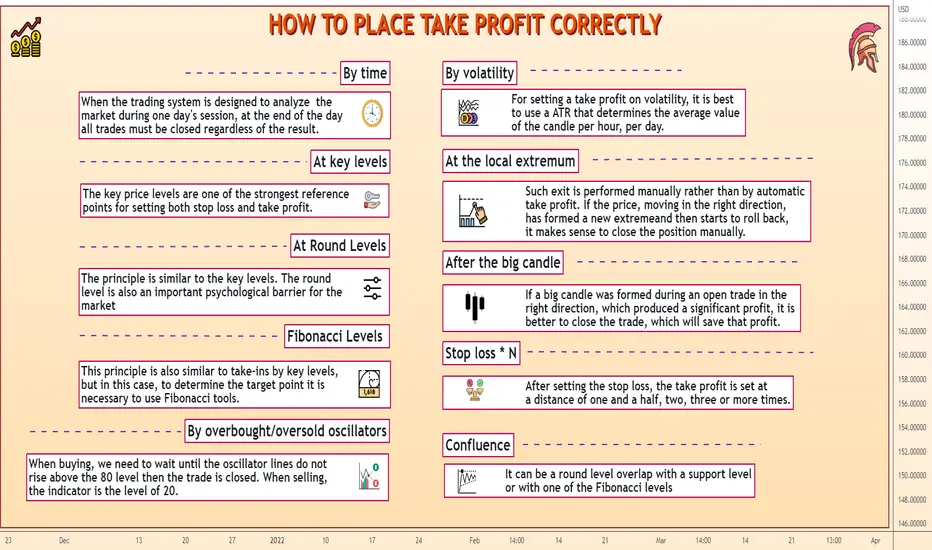
Exit from a position is often more important than entering. We all constantly hear that trading without stops is impossible, but too little attention is paid to taking profit. It's time to correct this misunderstanding. Today's article will discuss the importance of take profit.
Take Profit Methods
There are many different methods of taking profit. They may vary depending on the trader's trading style and the rules of his trading strategy.
By time
This method is effective, for instance, in intraday trading. When the trading system is designed to analyze the market during one day's session, at the end of the day all trades must be closed regardless of the result. For example, if a trader opens a sell position in the morning, at 9 o'clock, then at 23 o'clock, when the American session comes to an end and trading slows down, he/she should exit the market.
At key levels
The key price levels are one of the strongest reference points for setting both stop loss and take profit. The level, at which the price slowed down or turned around earlier, may become a strong support or resistance, depending on which side of the open position it happened to be on. That is why setting the Take Profit at this level is the most reasonable: if the price moves in the necessary direction, it will most likely reach the key level, but whether it will succeed in breaking it is a big question. That's why it is better to take your profit when the price reaches the important level, and if it breaks it later, open a new trade.
At Round Levels
The principle is similar to the key levels. The round level is also an important psychological barrier for the market, but not always break at the first time. For scalpers and intraday traders, except for round levels (1.2500, 1.2600, etc.) the levels, ending at 20, 50 and 80 (1.3420, 1.3780, etc.) are important.
Fibonacci Levels
This principle is also similar to take-ins by key levels, but in this case, to determine the target point it is necessary to use Fibonacci tools. Fibonacci lines extend on the basis of the previous trend, and give a reference point for the price movement in the opposite direction (correction). When opening a trade after a trend reversal, a good target will be the 61.8 level.
The mark where the Fibonacci level coincides with the round level or support/resistance will be the best option for taking profit.
Confluence
The optimal Take Profit target will be confluence (overlapping) of several levels. For example, it can be a round level overlap with a support level or with one of the Fibonacci levels, or with all of them at once. The more levels are combined at one mark, the stronger it becomes and the more effective the Take Profit will be.
By volatility
For setting a take profit on volatility, it is best to use a special service that determines the average value of the candle per hour, per day and other statistical indicators. The take profit will be set on their basis. When trading intraday, the trader will be interested in the average value of the daily candle. If, for example, a GBPUSD price moves 100 pips on average during the day, and a trade is opened when the price has already moved 20 pips in the direction you want, you should not expect more than 80 pips from this trade. Taking profit on volatility is a common option, but it makes sense when the trader has no other reference points, such as key levels.
At the local extremum
Such exit is performed manually rather than by automatic take profit. If the price, moving in the right direction, has formed a new extreme and then starts to roll back, it makes sense to close the position manually. A new extreme shows that the movement has currently exhausted itself and it is unknown whether the trend will resume. In this case, a new level has already been formed in the price path, which will complicate further movement. Even if the take profit was set earlier and the price did not reach it, in such a situation, it is better to close the position manually and take the profit that is available at the moment.
After the big candle
One more variant of closing the position manually. As a rule, after the formation of a large candle there is a slowdown and correction, sometimes quite strong. If a big candle was formed during an open trade in the right direction, which produced a significant profit, it is better to close the trade, which will save that profit.
By overbought/oversold oscillators
This method of exiting the trade is also done manually and will require the personal presence of the trader at the terminal. One of the oscillators must be installed on the chart of the asset most often Stochastic is used to determine the overbought/oversold condition, but you can also work with the RSI or Bill Williams indicators. When buying, we need to wait until the oscillator lines do not rise above the 80 level then the trade is closed. When selling, the indicator is the level of 20. On other oscillators, levels may be different (sometimes you have to set them yourself), but the principle is the same everywhere. The disadvantage of this method is that in a long trend the oscillator gets into the overbought/oversold area rather quickly and stays there, or starts oscillating up and down as the price moves in one direction. As a result, the trader closes the deal at the beginning of the trend, taking only a small part of the possible profit. This drawback can be compensated by adjusting the sensitivity of the indicator.
Stop loss * N
One of the easiest ways of setting a take profit, but it requires the proper setting of stop loss. After setting the stop loss, the take profit is set at a distance of one and a half, two, three or more times. Thus, a positive mathematical expectation of trade is provided. But the market is not bound to such ratios. The factors that really influence the price at the moment are not taken into consideration when taking a take profit. In some cases (for example in scalping) take profit can be even less than stop loss value. However, this is rather an exception to the rule, and in order to ensure a positive result in the long term, you need to ensure that the potential profit is greater than the loss, even setting a take on the levels or volatility.
There are many ways of taking profit, and each of them has its advantages and disadvantages. Taking profit on levels, and in those places where they coincide, for example, with round price values or Fibonacci levels, is an optimal variant according to a number of factors. However, you should also remember about the ratio of stop loss and take profit and positive mathematical expectation.
If you trade on a specific trading system, it is likely that it will already have specific rules for taking profit. If there are no rigid frameworks in this regard, it is necessary to choose the method that best suits this TS, taking into account all the general recommendations, as well as the need to comply with the rules of money management.
Take Profit Methods
There are many different methods of taking profit. They may vary depending on the trader's trading style and the rules of his trading strategy.
By time
This method is effective, for instance, in intraday trading. When the trading system is designed to analyze the market during one day's session, at the end of the day all trades must be closed regardless of the result. For example, if a trader opens a sell position in the morning, at 9 o'clock, then at 23 o'clock, when the American session comes to an end and trading slows down, he/she should exit the market.
At key levels
The key price levels are one of the strongest reference points for setting both stop loss and take profit. The level, at which the price slowed down or turned around earlier, may become a strong support or resistance, depending on which side of the open position it happened to be on. That is why setting the Take Profit at this level is the most reasonable: if the price moves in the necessary direction, it will most likely reach the key level, but whether it will succeed in breaking it is a big question. That's why it is better to take your profit when the price reaches the important level, and if it breaks it later, open a new trade.
At Round Levels
The principle is similar to the key levels. The round level is also an important psychological barrier for the market, but not always break at the first time. For scalpers and intraday traders, except for round levels (1.2500, 1.2600, etc.) the levels, ending at 20, 50 and 80 (1.3420, 1.3780, etc.) are important.
Fibonacci Levels
This principle is also similar to take-ins by key levels, but in this case, to determine the target point it is necessary to use Fibonacci tools. Fibonacci lines extend on the basis of the previous trend, and give a reference point for the price movement in the opposite direction (correction). When opening a trade after a trend reversal, a good target will be the 61.8 level.
The mark where the Fibonacci level coincides with the round level or support/resistance will be the best option for taking profit.
Confluence
The optimal Take Profit target will be confluence (overlapping) of several levels. For example, it can be a round level overlap with a support level or with one of the Fibonacci levels, or with all of them at once. The more levels are combined at one mark, the stronger it becomes and the more effective the Take Profit will be.
By volatility
For setting a take profit on volatility, it is best to use a special service that determines the average value of the candle per hour, per day and other statistical indicators. The take profit will be set on their basis. When trading intraday, the trader will be interested in the average value of the daily candle. If, for example, a GBPUSD price moves 100 pips on average during the day, and a trade is opened when the price has already moved 20 pips in the direction you want, you should not expect more than 80 pips from this trade. Taking profit on volatility is a common option, but it makes sense when the trader has no other reference points, such as key levels.
At the local extremum
Such exit is performed manually rather than by automatic take profit. If the price, moving in the right direction, has formed a new extreme and then starts to roll back, it makes sense to close the position manually. A new extreme shows that the movement has currently exhausted itself and it is unknown whether the trend will resume. In this case, a new level has already been formed in the price path, which will complicate further movement. Even if the take profit was set earlier and the price did not reach it, in such a situation, it is better to close the position manually and take the profit that is available at the moment.
After the big candle
One more variant of closing the position manually. As a rule, after the formation of a large candle there is a slowdown and correction, sometimes quite strong. If a big candle was formed during an open trade in the right direction, which produced a significant profit, it is better to close the trade, which will save that profit.
By overbought/oversold oscillators
This method of exiting the trade is also done manually and will require the personal presence of the trader at the terminal. One of the oscillators must be installed on the chart of the asset most often Stochastic is used to determine the overbought/oversold condition, but you can also work with the RSI or Bill Williams indicators. When buying, we need to wait until the oscillator lines do not rise above the 80 level then the trade is closed. When selling, the indicator is the level of 20. On other oscillators, levels may be different (sometimes you have to set them yourself), but the principle is the same everywhere. The disadvantage of this method is that in a long trend the oscillator gets into the overbought/oversold area rather quickly and stays there, or starts oscillating up and down as the price moves in one direction. As a result, the trader closes the deal at the beginning of the trend, taking only a small part of the possible profit. This drawback can be compensated by adjusting the sensitivity of the indicator.
Stop loss * N
One of the easiest ways of setting a take profit, but it requires the proper setting of stop loss. After setting the stop loss, the take profit is set at a distance of one and a half, two, three or more times. Thus, a positive mathematical expectation of trade is provided. But the market is not bound to such ratios. The factors that really influence the price at the moment are not taken into consideration when taking a take profit. In some cases (for example in scalping) take profit can be even less than stop loss value. However, this is rather an exception to the rule, and in order to ensure a positive result in the long term, you need to ensure that the potential profit is greater than the loss, even setting a take on the levels or volatility.
There are many ways of taking profit, and each of them has its advantages and disadvantages. Taking profit on levels, and in those places where they coincide, for example, with round price values or Fibonacci levels, is an optimal variant according to a number of factors. However, you should also remember about the ratio of stop loss and take profit and positive mathematical expectation.
If you trade on a specific trading system, it is likely that it will already have specific rules for taking profit. If there are no rigid frameworks in this regard, it is necessary to choose the method that best suits this TS, taking into account all the general recommendations, as well as the need to comply with the rules of money management.

Haftungsausschluss
Die Informationen und Veröffentlichungen sind nicht als Finanz-, Anlage-, Handels- oder andere Arten von Ratschlägen oder Empfehlungen gedacht, die von TradingView bereitgestellt oder gebilligt werden, und stellen diese nicht dar. Lesen Sie mehr in den Nutzungsbedingungen.
Haftungsausschluss
Die Informationen und Veröffentlichungen sind nicht als Finanz-, Anlage-, Handels- oder andere Arten von Ratschlägen oder Empfehlungen gedacht, die von TradingView bereitgestellt oder gebilligt werden, und stellen diese nicht dar. Lesen Sie mehr in den Nutzungsbedingungen.