
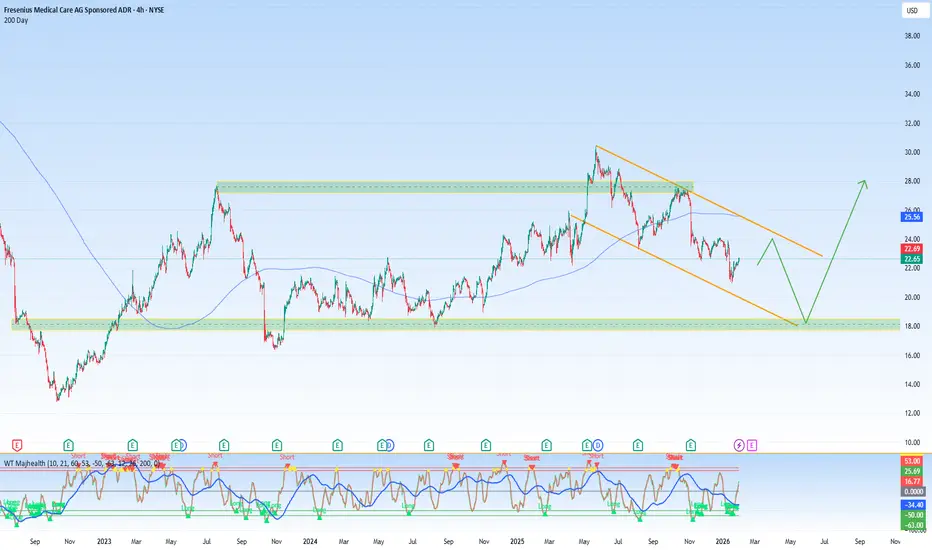
Synthesized Investment Thesis for Fresenius Medical Care (FMS): A High-Conviction Value Play with Executed Turnover
Fresenius Medical Care (FMS) presents a compelling case as a deep-value, contrarian investment for the long-term investor. The thesis hinges on its irreplaceable market position in a non-discretionary healthcare sector, a clear and financially quantified multi-year transformation plan, and a valuation that appears to price in perpetual distress. However, this opportunity is not without substantial risk, requiring investors to have a strong stomach for volatility and a firm belief in management's execution capabilities.
Part 1: The Foundation of Value – A Defensive Business at a Discounted Price
Non-Discretionary Demand & Global Scale: As the world's leading integrated dialysis provider, FMS operates in a sector underpinned by chronic, life-sustaining care. With over 308,000 patients across 3,624 clinics globally, the company benefits from recurring, predictable revenue streams that are largely insulated from economic cycles. This provides a defensive bedrock often sought during market uncertainty, as evidenced by its +13.3% YTD performance against steep market declines.
Exceptionally Attractive Valuation Metrics: The primary driver of the value thesis is FMS's valuation, which trades at a forward P/E of ~9x. This is a significant discount to both the broader market and many healthcare peers, suggesting the market is pricing in continued stagnation or decline. Coupled with a Zacks Value Style Score of 'A', this creates a classic "Graham-and-Dodd" value screen scenario where the price appears disconnected from the intrinsic value of the underlying cash-generative assets.
Part 2: The Growth & Transformation Catalysts – More Than Just a Static Asset
Beyond a cheap stock, FMS is actively engineering a corporate turnaround and pursuing strategic growth.
The FME25 Transformation Program: A Path to Profitability: This is the centerpiece of management's strategy. The program aims to deliver €1.05 billion in annualized savings by the end of 2027, with €180 million targeted for 2025 alone. The Q2 2025 update (€58 million in new savings) demonstrates the plan is on track. Successful execution is critical to offsetting inflationary costs and improving margins, directly impacting the bottom line.
Strategic Portfolio Reshaping: Management is proactively optimizing its business mix:
Divestitures: Exiting low-margin, non-core, or "less profitable acute care contracts" (Legacy Portfolio Optimization). This hurts short-term revenue but is designed to improve long-term profitability and capital efficiency.
Acquisitions & Partnerships: Strategic moves like the merger of Fresenius Health Partners with InterWell Health and Cricket Health (creating a value-based care giant managing $11B in medical costs) and expansion in markets like India and Japan are aimed at capturing higher-growth segments in home dialysis and integrated care.
Earnings Momentum & Analyst Sentiment: The upward revision in earnings estimates (Consensus up $0.06 to $2.26 for FY25) and a history of beating estimates (average surprise of +7.6% over four quarters) indicate that operational improvements may be starting to outpace challenges. A Zacks Rank #2 (Buy) reflects this positive earnings revision trend.
Part 3: The Substantial Headwinds – Why the Stock is Cheap
The discounted valuation exists for concrete reasons, which constitute the primary investment risks:
Persistent Cost Inflation: The company faces a "perfect storm" of labor and supply chain inflation, with a combined impact of €250-350 million. While labor markets may be stabilizing, these are structural cost increases that the FME25 program must fully offset to show net profit growth.
Volume & Revenue Headwinds: The deliberate portfolio optimization leads to treatment volume declines (e.g., -0.2% Same Market Treatment Growth in 2024). Investors must discern between bad volume (losing profitable patients) and good volume (shedding unprofitable contracts). The market often punishes top-line shrinkage initially, testing investor patience.
Operational Complexity & Execution Risk: Integrating large partnerships (the InterWell Health merger) and delivering hundreds of millions in cost savings across a global organization is a highly complex endeavor. Any stumble in execution could derail the profitability timeline and shatter market confidence.
Integrated Final Judgment & Strategic Recommendation
Fresenius Medical Care is a "show-me" deep value story with a defined catalyst path. It is not a low-risk, stable dividend stock, but rather a corporate turnaround bet on a essential-service provider.
The Bull Case (Why it's a Top Value Pick):
You are buying a global market leader in a defensive industry at a fire-sale valuation (P/E ~9x).
Management has a clear, quantified plan (FME25) to restore profitability, with early signs of success.
Strategic moves position the company for the future of value-based and home-based care.
Positive earnings estimate revisions suggest the turnaround is gaining recognition.
The Investor Profile Required:
Long-Term Horizon: The FME25 program runs through 2027. Full benefits will take time.
High Risk Tolerance: The stock will be volatile, reacting to quarterly cost/volume metrics.
Contrarian Mindset: Willing to buy when headlines are dominated by cost pressures and divestitures.
Verdict:
For the value-oriented investor who believes in management's execution and can look through 12-24 months of noisy financials, FMS represents a high-potential, asymmetric opportunity. The €1.05 billion savings target by 2027 provides a tangible benchmark for success. The current price offers a significant margin of safety if the transformation is even moderately successful. However, it should be sized appropriately within a portfolio as a high-conviction, higher-risk value holding, not a core stable position.
In summary, FMS is a compelling long-term value stock precisely because its deep valuation discounts severe challenges that management is actively—and measurably—working to solve. The investment is a vote of confidence in the FME25 program's execution.
Fresenius Medical Care (FMS) presents a compelling case as a deep-value, contrarian investment for the long-term investor. The thesis hinges on its irreplaceable market position in a non-discretionary healthcare sector, a clear and financially quantified multi-year transformation plan, and a valuation that appears to price in perpetual distress. However, this opportunity is not without substantial risk, requiring investors to have a strong stomach for volatility and a firm belief in management's execution capabilities.
Part 1: The Foundation of Value – A Defensive Business at a Discounted Price
Non-Discretionary Demand & Global Scale: As the world's leading integrated dialysis provider, FMS operates in a sector underpinned by chronic, life-sustaining care. With over 308,000 patients across 3,624 clinics globally, the company benefits from recurring, predictable revenue streams that are largely insulated from economic cycles. This provides a defensive bedrock often sought during market uncertainty, as evidenced by its +13.3% YTD performance against steep market declines.
Exceptionally Attractive Valuation Metrics: The primary driver of the value thesis is FMS's valuation, which trades at a forward P/E of ~9x. This is a significant discount to both the broader market and many healthcare peers, suggesting the market is pricing in continued stagnation or decline. Coupled with a Zacks Value Style Score of 'A', this creates a classic "Graham-and-Dodd" value screen scenario where the price appears disconnected from the intrinsic value of the underlying cash-generative assets.
Part 2: The Growth & Transformation Catalysts – More Than Just a Static Asset
Beyond a cheap stock, FMS is actively engineering a corporate turnaround and pursuing strategic growth.
The FME25 Transformation Program: A Path to Profitability: This is the centerpiece of management's strategy. The program aims to deliver €1.05 billion in annualized savings by the end of 2027, with €180 million targeted for 2025 alone. The Q2 2025 update (€58 million in new savings) demonstrates the plan is on track. Successful execution is critical to offsetting inflationary costs and improving margins, directly impacting the bottom line.
Strategic Portfolio Reshaping: Management is proactively optimizing its business mix:
Divestitures: Exiting low-margin, non-core, or "less profitable acute care contracts" (Legacy Portfolio Optimization). This hurts short-term revenue but is designed to improve long-term profitability and capital efficiency.
Acquisitions & Partnerships: Strategic moves like the merger of Fresenius Health Partners with InterWell Health and Cricket Health (creating a value-based care giant managing $11B in medical costs) and expansion in markets like India and Japan are aimed at capturing higher-growth segments in home dialysis and integrated care.
Earnings Momentum & Analyst Sentiment: The upward revision in earnings estimates (Consensus up $0.06 to $2.26 for FY25) and a history of beating estimates (average surprise of +7.6% over four quarters) indicate that operational improvements may be starting to outpace challenges. A Zacks Rank #2 (Buy) reflects this positive earnings revision trend.
Part 3: The Substantial Headwinds – Why the Stock is Cheap
The discounted valuation exists for concrete reasons, which constitute the primary investment risks:
Persistent Cost Inflation: The company faces a "perfect storm" of labor and supply chain inflation, with a combined impact of €250-350 million. While labor markets may be stabilizing, these are structural cost increases that the FME25 program must fully offset to show net profit growth.
Volume & Revenue Headwinds: The deliberate portfolio optimization leads to treatment volume declines (e.g., -0.2% Same Market Treatment Growth in 2024). Investors must discern between bad volume (losing profitable patients) and good volume (shedding unprofitable contracts). The market often punishes top-line shrinkage initially, testing investor patience.
Operational Complexity & Execution Risk: Integrating large partnerships (the InterWell Health merger) and delivering hundreds of millions in cost savings across a global organization is a highly complex endeavor. Any stumble in execution could derail the profitability timeline and shatter market confidence.
Integrated Final Judgment & Strategic Recommendation
Fresenius Medical Care is a "show-me" deep value story with a defined catalyst path. It is not a low-risk, stable dividend stock, but rather a corporate turnaround bet on a essential-service provider.
The Bull Case (Why it's a Top Value Pick):
You are buying a global market leader in a defensive industry at a fire-sale valuation (P/E ~9x).
Management has a clear, quantified plan (FME25) to restore profitability, with early signs of success.
Strategic moves position the company for the future of value-based and home-based care.
Positive earnings estimate revisions suggest the turnaround is gaining recognition.
The Investor Profile Required:
Long-Term Horizon: The FME25 program runs through 2027. Full benefits will take time.
High Risk Tolerance: The stock will be volatile, reacting to quarterly cost/volume metrics.
Contrarian Mindset: Willing to buy when headlines are dominated by cost pressures and divestitures.
Verdict:
For the value-oriented investor who believes in management's execution and can look through 12-24 months of noisy financials, FMS represents a high-potential, asymmetric opportunity. The €1.05 billion savings target by 2027 provides a tangible benchmark for success. The current price offers a significant margin of safety if the transformation is even moderately successful. However, it should be sized appropriately within a portfolio as a high-conviction, higher-risk value holding, not a core stable position.
In summary, FMS is a compelling long-term value stock precisely because its deep valuation discounts severe challenges that management is actively—and measurably—working to solve. The investment is a vote of confidence in the FME25 program's execution.

Haftungsausschluss
Die Informationen und Veröffentlichungen sind nicht als Finanz-, Anlage-, Handels- oder andere Arten von Ratschlägen oder Empfehlungen gedacht, die von TradingView bereitgestellt oder gebilligt werden, und stellen diese nicht dar. Lesen Sie mehr in den Nutzungsbedingungen.
Haftungsausschluss
Die Informationen und Veröffentlichungen sind nicht als Finanz-, Anlage-, Handels- oder andere Arten von Ratschlägen oder Empfehlungen gedacht, die von TradingView bereitgestellt oder gebilligt werden, und stellen diese nicht dar. Lesen Sie mehr in den Nutzungsbedingungen.