
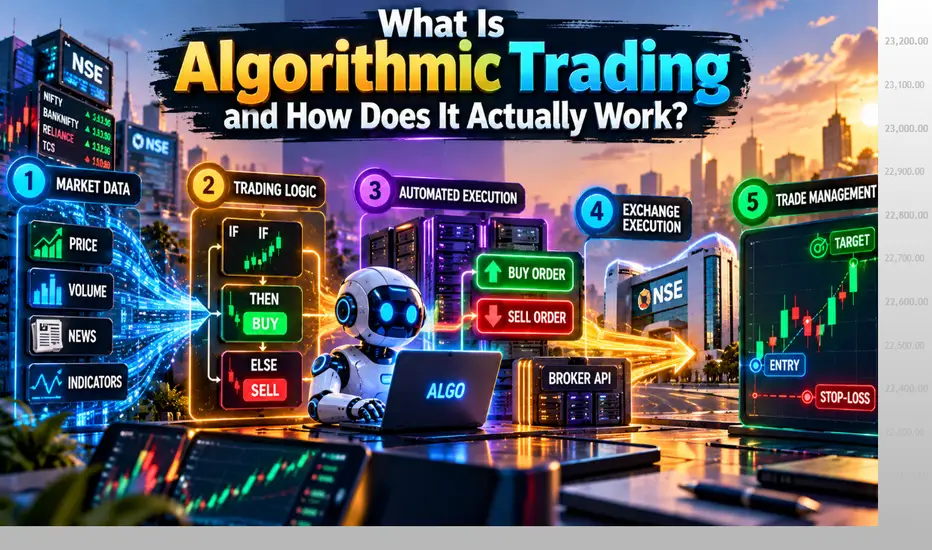
🤖 What Is Algorithmic Trading and How Does It Actually Work?
Algorithmic trading simply means using a computer program to follow predefined trading rules.
Instead of manually thinking:
“Price is above VWAP, breakout confirmed, volume is strong — I should buy.”
the same logic can be programmed:
IF Price > VWAP
AND Breakout = Confirmed
AND Volume > Average
THEN Generate Long Signal
The computer follows the rules consistently.
---------------------------------
📊 Algo Trading Is Not Automatically AI
An algorithm can be very simple.
It may use:
• Price action
• VWAP
• Moving averages
• Volume
• Breakouts
• OI
• Volatility
AI and machine learning are only more advanced forms of algorithmic decision-making. A simple tested system can still be very effective.
---------------------------------
⚙️ How Does an Algo Actually Work?
The basic flow is:
**Market Data → Trading Rules → Signal → Risk Check → Order → Broker → Exchange → Trade Management**
First, the algo receives live market data.
Then it checks:
“Are my setup conditions true?”
If yes, a signal is generated.
But before an order is placed, the risk engine should verify:
• Position size
• Stop-loss
• Daily loss limit
• Available margin
• Maximum exposure
Only then should the trade be sent.
---------------------------------
📈 Example
Suppose the strategy says:
Buy only when:
✅ Price is above VWAP
✅ 20 EMA > 50 EMA
✅ Resistance breaks
✅ Volume expands
✅ Candle closes above resistance
If all conditions are satisfied:
Long Signal → Risk Check → Order
The computer does not “feel bullish.”
It simply follows the rules.
---------------------------------
🛡️ Risk Management Is Part of the Algo
A professional algo is not just an entry engine.
It should also control:
• Maximum risk per trade
• Maximum daily loss
• Position size
• Number of open trades
• Stop-loss
• Target
• Trailing logic
A signal without risk control is incomplete.
---------------------------------
🔌 How Is the Order Placed?
Conceptually:
Algo
↓
Broker API
↓
Exchange
The broker sends the order to the market. Once executed, the algo receives confirmation and begins managing the position.
It may automatically:
• Place SL
• Book targets
• Trail the stop
• Exit at session end
---------------------------------
🧪 Backtesting Comes Before Live Automation
Before deploying real money, the strategy should be tested.
Important statistics include:
• Win rate
• Average winner
• Average loser
• Expectancy
• Drawdown
• Losing streaks
But remember:
A good backtest does not guarantee future profit. Overfitting, slippage and unrealistic fills can make historical results look better than reality.
---------------------------------
⚠️ Automation Does Not Remove Risk
An algo can still lose because of:
• Poor strategy
• Bad market regime
• Excessive leverage
• Slippage
• Data failure
• API failure
• Coding errors
• Duplicate orders
A computer can execute a bad idea faster than a human. That is why monitoring and a kill switch are important.
---------------------------------
📊 For Option Traders
Options automation may need to select:
• CE or PE
• Strike
• Expiry
• ATM / ITM / OTM
• Liquidity
• IV
• Premium structure
The underlying may generate the directional setup. The option engine then selects the instrument.
---------------------------------
📊 Simple Formula
Trading Idea + Clear Rules + Risk Management + Execution Engine
= Algorithmic Trading System
But:
Automation + Bad Strategy + Poor Risk Control
= Faster Losses
---------------------------------
📊 Finally, the important point to note is:
Algorithmic trading is not magic.
It is simply:
**Turning a trading process into rules a computer can follow.**
A good algo still needs:
Do not ask only:
“Can this strategy be automated?”
Ask:
“Is this strategy clear, testable and worth automating?”
---------------------------------
Educational Purpose Only.
Algorithmic trading simply means using a computer program to follow predefined trading rules.
Instead of manually thinking:
“Price is above VWAP, breakout confirmed, volume is strong — I should buy.”
the same logic can be programmed:
IF Price > VWAP
AND Breakout = Confirmed
AND Volume > Average
THEN Generate Long Signal
The computer follows the rules consistently.
---------------------------------
📊 Algo Trading Is Not Automatically AI
An algorithm can be very simple.
It may use:
• Price action
• VWAP
• Moving averages
• Volume
• Breakouts
• OI
• Volatility
AI and machine learning are only more advanced forms of algorithmic decision-making. A simple tested system can still be very effective.
---------------------------------
⚙️ How Does an Algo Actually Work?
The basic flow is:
**Market Data → Trading Rules → Signal → Risk Check → Order → Broker → Exchange → Trade Management**
First, the algo receives live market data.
Then it checks:
“Are my setup conditions true?”
If yes, a signal is generated.
But before an order is placed, the risk engine should verify:
• Position size
• Stop-loss
• Daily loss limit
• Available margin
• Maximum exposure
Only then should the trade be sent.
---------------------------------
📈 Example
Suppose the strategy says:
Buy only when:
✅ Price is above VWAP
✅ 20 EMA > 50 EMA
✅ Resistance breaks
✅ Volume expands
✅ Candle closes above resistance
If all conditions are satisfied:
Long Signal → Risk Check → Order
The computer does not “feel bullish.”
It simply follows the rules.
---------------------------------
🛡️ Risk Management Is Part of the Algo
A professional algo is not just an entry engine.
It should also control:
• Maximum risk per trade
• Maximum daily loss
• Position size
• Number of open trades
• Stop-loss
• Target
• Trailing logic
A signal without risk control is incomplete.
---------------------------------
🔌 How Is the Order Placed?
Conceptually:
Algo
↓
Broker API
↓
Exchange
The broker sends the order to the market. Once executed, the algo receives confirmation and begins managing the position.
It may automatically:
• Place SL
• Book targets
• Trail the stop
• Exit at session end
---------------------------------
🧪 Backtesting Comes Before Live Automation
Before deploying real money, the strategy should be tested.
Important statistics include:
• Win rate
• Average winner
• Average loser
• Expectancy
• Drawdown
• Losing streaks
But remember:
A good backtest does not guarantee future profit. Overfitting, slippage and unrealistic fills can make historical results look better than reality.
---------------------------------
⚠️ Automation Does Not Remove Risk
An algo can still lose because of:
• Poor strategy
• Bad market regime
• Excessive leverage
• Slippage
• Data failure
• API failure
• Coding errors
• Duplicate orders
A computer can execute a bad idea faster than a human. That is why monitoring and a kill switch are important.
---------------------------------
📊 For Option Traders
Options automation may need to select:
• CE or PE
• Strike
• Expiry
• ATM / ITM / OTM
• Liquidity
• IV
• Premium structure
The underlying may generate the directional setup. The option engine then selects the instrument.
---------------------------------
📊 Simple Formula
Trading Idea + Clear Rules + Risk Management + Execution Engine
= Algorithmic Trading System
But:
Automation + Bad Strategy + Poor Risk Control
= Faster Losses
---------------------------------
📊 Finally, the important point to note is:
Algorithmic trading is not magic.
It is simply:
**Turning a trading process into rules a computer can follow.**
A good algo still needs:
- A real edge.
- Clear logic.
- Testing.
- Risk management.
- Monitoring.
Do not ask only:
“Can this strategy be automated?”
Ask:
“Is this strategy clear, testable and worth automating?”
---------------------------------
Educational Purpose Only.

⭐For Live Trading Courses And Trading Community 📈
Contact ⬇️
📱wa.me/919322295961
📱t.me/+UgF9lES_XxA0MTk9
⭐Advanced courses
⭐Fully Automated Algo Trading
⭐Daily F&O Trade tips
📱 t.me/+UgF9lES_XxA0MTk9
Contact ⬇️
📱wa.me/919322295961
📱t.me/+UgF9lES_XxA0MTk9
⭐Advanced courses
⭐Fully Automated Algo Trading
⭐Daily F&O Trade tips
📱 t.me/+UgF9lES_XxA0MTk9
Verbundene Veröffentlichungen
Haftungsausschluss
Die Informationen und Veröffentlichungen sind nicht als Finanz-, Anlage-, Handels- oder andere Arten von Ratschlägen oder Empfehlungen gedacht, die von TradingView bereitgestellt oder gebilligt werden, und stellen diese nicht dar. Lesen Sie mehr in den Nutzungsbedingungen.