
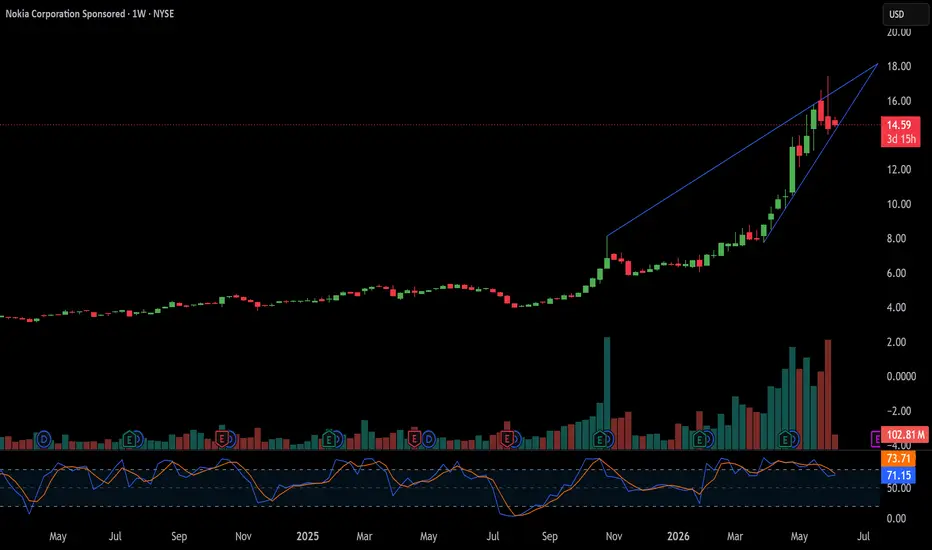
Nokia Corporation (NYSE: NOK) is orchestrating a silent revolution in digital infrastructure. Forget legacy mobile phones. The Finnish powerhouse now dictates the future of global connectivity under CEO Justin Hotard's aggressive AI pivot.
By fusing artificial intelligence with telecommunications, Nokia positions itself as an indispensable asset. Nokia stock surged 11.87% in premarket trading to $11.03 following the Q1 2026 results on April 23, 2026. The pivot redefines its market value and strategic importance through 2030.
Geopolitics and Geostrategy
Nokia operates at the center of global technological sovereignty. Nations race to secure reliable, homegrown infrastructure. Nokia provides a trusted European alternative to contested state-backed vendors. The geostrategic positioning secures highly lucrative government defense and enterprise contracts. Q1 2026 Mission-Critical Enterprise and Defense sales surged 19% year-over-year.
Speculation continues that SpaceX could integrate Nokia's terrestrial radio access networks (RAN) into its broader connectivity stack. A SpaceX-Nokia alliance would forge a closed-loop, global sovereign AI network combining satellite and terrestrial assets.
The combination would alter the geopolitical balance of power in telecommunications. SpaceX already deploys Nokia's lunar 4G/LTE network on previous missions, providing technical foundation for deeper terrestrial integration.
Furthermore, the dynamic shifts as US hyperscaler capex past $700 billion concentrates outside Europe. Microsoft announced $18 billion of AI infrastructure investment in Australia rather than Europe. Nokia's European base offers a critical sovereignty alternative for democracies seeking trusted vendors.
Macroeconomics and Economics
Nokia delivered formidable financial metrics in early 2026. Q1 2026 net sales reached €4.5 billion, representing 4% year-over-year growth on a constant currency and portfolio basis. The company achieved a solid comparable operating margin of 6.2%, expanding 200 basis points year-over-year.
The AI and Cloud segment surged 49% year-over-year in Q1 2026. Strong AI and Cloud design wins drove book-to-bill above one across multiple quarters.
Optical Networks revenue grew 20% in the quarter on AI and cloud customer demand. IP Network sales grew 3%, while Fixed Networks declined 13% due to deliberate portfolio strategy.
Furthermore, Nokia raised 2026 Network Infrastructure growth guidance to 12-14% (up from prior 6-8%). The Optical and IP Networks combined growth target rose to 18-20%. Comparable operating profit is tracking above the midpoint of Nokia's €2.0-2.5 billion full-year range. Mission-Critical Enterprise and Defense sales rose 19%.
Management and Business Models
CEO Justin Hotard executes a decisive, forward-looking business model under steady execution. The company shifted focus from consumer hardware to enterprise digital infrastructure years ago.
The $2.3 billion Infinera acquisition (completed in 2025) anchors Nokia's AI infrastructure positioning. Nokia now sees its AI and Cloud addressable market growing at 27% compound annual growth rate through 2028. The broader Network Infrastructure addressable market tracks to 14% CAGR.
The executive team heavily prioritizes high-margin optical networks and AI-RAN solutions. Management raised 2026 Network Infrastructure growth guidance to 12-14% during Q1 2026 results.
Furthermore, the proactive management style captures surging demand from hyperscalers. Consequently, the company enjoys expanding gross margins and improved operational discipline. Hotard noted machine-to-machine AI traffic will overtake human use and drive a multi-year leap in network volume.
Technology, Cybersecurity, and Science
Scientific innovation drives Nokia's roadmap. The company pioneers the transition from 5G-Advanced to 6G technology. Nokia is partnering with Nvidia on AI-RAN to decouple network performance from hardware refresh cycles.
Nokia integrates "security by design" into its core architecture. The company actively develops quantum-safe networking technologies to combat future cyber threats.
The proactive cybersecurity stance protects critical global infrastructure. The recent CVE-2026-0300 PAN-OS firewall zero-day exposed ongoing infrastructure vulnerabilities across telecom networks.
Furthermore, Nokia leverages AI-native networks to optimize real-time data flows. This reduces latency to sub-millisecond levels and dramatically improves energy efficiency. AI-driven traffic currently makes up about 20% of total network traffic (roughly 80 exabytes per month), with massive growth ahead.
High-Tech and Patent Analysis
Nokia dominates the intellectual property landscape. The company commands over 7,000 standard-essential patent families for 5G technology as of early 2025, with Nokia.com indicating over 8,000 families today. Nokia consistently tops global rankings for ETSI patent declarations.
The total patent portfolio exceeds 20,000 patent families, built on more than €150 billion invested in R&D and standardization since 2000.
The research and development division now aggressively files AI-related network patents. They secure exclusive rights to AI-enabled air interfaces and automated network optimization.
Moreover, over 250 companies have secured licenses to Nokia's patented technologies. Major licensing agreements with Apple, Samsung, Oppo, and Honor provide multi-year recurring revenue streams. The impenetrable patent moat ensures steady, high-margin licensing revenue through 2030 and beyond. Nokia's pre-standardization work positions it to lead 6G standardization beginning later in 2026.
Investor Catalysts and Risks
Key catalysts and risks investors must monitor include:
* Q2 2026 earnings (next major update)
* Network Infrastructure 12-14% growth execution
* Optical and IP Networks combined 18-20% target
* AI-RAN partnership with Nvidia commercialization
* Hyperscaler capex trajectory above $700B
* 6G standardization milestones (starting 2026)
* Semiconductor ecosystem supply constraints
* Mobile Networks gross margin pressure in Q2/Q3
* Stock at stretched P/E ratio of 84.87
* Mobile Infrastructure growth versus Ericsson competition
* Potential SpaceX or other hyperscaler partnership announcements
Conclusion
The combination of CEO Justin Hotard's leadership, the $2.3 billion Infinera acquisition, AI-RAN partnership with Nvidia, raised 2026 guidance, and patent moat creates a compelling structural thesis. Nokia ultimately controls the foundational DNA of modern communication infrastructure across both terrestrial and increasingly non-terrestrial networks. Investors should monitor Q2 2026 earnings, 6G standardization progress, and potential satellite-terrestrial integration announcements through the second half of 2026.
By fusing artificial intelligence with telecommunications, Nokia positions itself as an indispensable asset. Nokia stock surged 11.87% in premarket trading to $11.03 following the Q1 2026 results on April 23, 2026. The pivot redefines its market value and strategic importance through 2030.
Geopolitics and Geostrategy
Nokia operates at the center of global technological sovereignty. Nations race to secure reliable, homegrown infrastructure. Nokia provides a trusted European alternative to contested state-backed vendors. The geostrategic positioning secures highly lucrative government defense and enterprise contracts. Q1 2026 Mission-Critical Enterprise and Defense sales surged 19% year-over-year.
Speculation continues that SpaceX could integrate Nokia's terrestrial radio access networks (RAN) into its broader connectivity stack. A SpaceX-Nokia alliance would forge a closed-loop, global sovereign AI network combining satellite and terrestrial assets.
The combination would alter the geopolitical balance of power in telecommunications. SpaceX already deploys Nokia's lunar 4G/LTE network on previous missions, providing technical foundation for deeper terrestrial integration.
Furthermore, the dynamic shifts as US hyperscaler capex past $700 billion concentrates outside Europe. Microsoft announced $18 billion of AI infrastructure investment in Australia rather than Europe. Nokia's European base offers a critical sovereignty alternative for democracies seeking trusted vendors.
Macroeconomics and Economics
Nokia delivered formidable financial metrics in early 2026. Q1 2026 net sales reached €4.5 billion, representing 4% year-over-year growth on a constant currency and portfolio basis. The company achieved a solid comparable operating margin of 6.2%, expanding 200 basis points year-over-year.
The AI and Cloud segment surged 49% year-over-year in Q1 2026. Strong AI and Cloud design wins drove book-to-bill above one across multiple quarters.
Optical Networks revenue grew 20% in the quarter on AI and cloud customer demand. IP Network sales grew 3%, while Fixed Networks declined 13% due to deliberate portfolio strategy.
Furthermore, Nokia raised 2026 Network Infrastructure growth guidance to 12-14% (up from prior 6-8%). The Optical and IP Networks combined growth target rose to 18-20%. Comparable operating profit is tracking above the midpoint of Nokia's €2.0-2.5 billion full-year range. Mission-Critical Enterprise and Defense sales rose 19%.
Management and Business Models
CEO Justin Hotard executes a decisive, forward-looking business model under steady execution. The company shifted focus from consumer hardware to enterprise digital infrastructure years ago.
The $2.3 billion Infinera acquisition (completed in 2025) anchors Nokia's AI infrastructure positioning. Nokia now sees its AI and Cloud addressable market growing at 27% compound annual growth rate through 2028. The broader Network Infrastructure addressable market tracks to 14% CAGR.
The executive team heavily prioritizes high-margin optical networks and AI-RAN solutions. Management raised 2026 Network Infrastructure growth guidance to 12-14% during Q1 2026 results.
Furthermore, the proactive management style captures surging demand from hyperscalers. Consequently, the company enjoys expanding gross margins and improved operational discipline. Hotard noted machine-to-machine AI traffic will overtake human use and drive a multi-year leap in network volume.
Technology, Cybersecurity, and Science
Scientific innovation drives Nokia's roadmap. The company pioneers the transition from 5G-Advanced to 6G technology. Nokia is partnering with Nvidia on AI-RAN to decouple network performance from hardware refresh cycles.
Nokia integrates "security by design" into its core architecture. The company actively develops quantum-safe networking technologies to combat future cyber threats.
The proactive cybersecurity stance protects critical global infrastructure. The recent CVE-2026-0300 PAN-OS firewall zero-day exposed ongoing infrastructure vulnerabilities across telecom networks.
Furthermore, Nokia leverages AI-native networks to optimize real-time data flows. This reduces latency to sub-millisecond levels and dramatically improves energy efficiency. AI-driven traffic currently makes up about 20% of total network traffic (roughly 80 exabytes per month), with massive growth ahead.
High-Tech and Patent Analysis
Nokia dominates the intellectual property landscape. The company commands over 7,000 standard-essential patent families for 5G technology as of early 2025, with Nokia.com indicating over 8,000 families today. Nokia consistently tops global rankings for ETSI patent declarations.
The total patent portfolio exceeds 20,000 patent families, built on more than €150 billion invested in R&D and standardization since 2000.
The research and development division now aggressively files AI-related network patents. They secure exclusive rights to AI-enabled air interfaces and automated network optimization.
Moreover, over 250 companies have secured licenses to Nokia's patented technologies. Major licensing agreements with Apple, Samsung, Oppo, and Honor provide multi-year recurring revenue streams. The impenetrable patent moat ensures steady, high-margin licensing revenue through 2030 and beyond. Nokia's pre-standardization work positions it to lead 6G standardization beginning later in 2026.
Investor Catalysts and Risks
Key catalysts and risks investors must monitor include:
* Q2 2026 earnings (next major update)
* Network Infrastructure 12-14% growth execution
* Optical and IP Networks combined 18-20% target
* AI-RAN partnership with Nvidia commercialization
* Hyperscaler capex trajectory above $700B
* 6G standardization milestones (starting 2026)
* Semiconductor ecosystem supply constraints
* Mobile Networks gross margin pressure in Q2/Q3
* Stock at stretched P/E ratio of 84.87
* Mobile Infrastructure growth versus Ericsson competition
* Potential SpaceX or other hyperscaler partnership announcements
Conclusion
The combination of CEO Justin Hotard's leadership, the $2.3 billion Infinera acquisition, AI-RAN partnership with Nvidia, raised 2026 guidance, and patent moat creates a compelling structural thesis. Nokia ultimately controls the foundational DNA of modern communication infrastructure across both terrestrial and increasingly non-terrestrial networks. Investors should monitor Q2 2026 earnings, 6G standardization progress, and potential satellite-terrestrial integration announcements through the second half of 2026.

Haftungsausschluss
Die Informationen und Veröffentlichungen sind nicht als Finanz-, Anlage-, Handels- oder andere Arten von Ratschlägen oder Empfehlungen gedacht, die von TradingView bereitgestellt oder gebilligt werden, und stellen diese nicht dar. Lesen Sie mehr in den Nutzungsbedingungen.
Haftungsausschluss
Die Informationen und Veröffentlichungen sind nicht als Finanz-, Anlage-, Handels- oder andere Arten von Ratschlägen oder Empfehlungen gedacht, die von TradingView bereitgestellt oder gebilligt werden, und stellen diese nicht dar. Lesen Sie mehr in den Nutzungsbedingungen.