
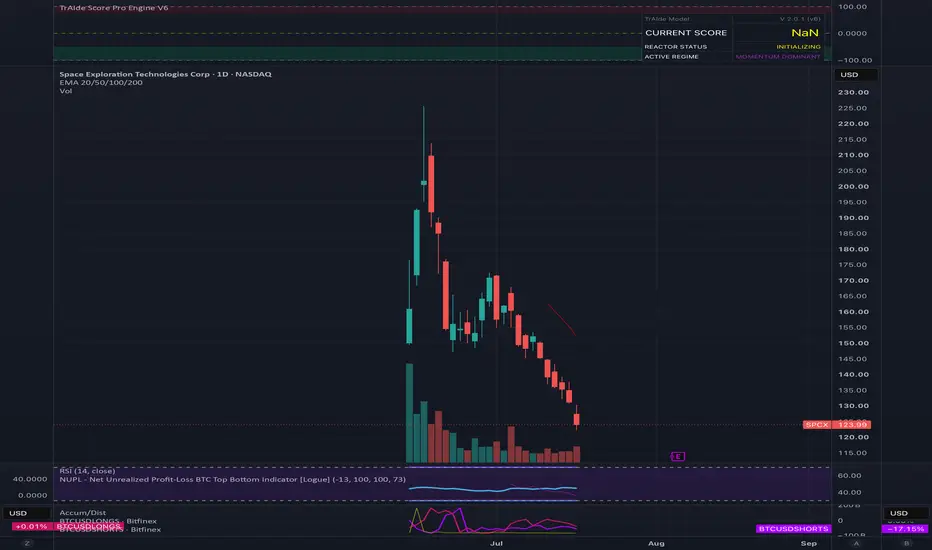
The historical market debut of SpaceX (SPCX) on the Nasdaq has quickly transformed from an artificial intelligence-fueled frenzy into a dangerous structural overhang. While momentum algorithms initially pushed the stock to a peak of $225.64, the subsequent 45% plunge straight through its $135 IPO floor exposes a catastrophic vulnerability in the company's valuation framework. Wall Street investment banks priced the public listing at a staggering $1.77 trillion enterprise value, a multiple predicated heavily on an astronomical $26.5 trillion total addressable market (TAM) claimed by its recently absorbed xAI subsidiary. By attempting to justify a forward price-to-sales multiple exceeding 30x on multi-billion dollar trailing net losses, the market has manufactured a massive speculative bubble that lacks standard fundamental support. As institutional investors execute a ruthless reality check on these multi-trillion dollar assumptions, the air is rapidly escaping the balloon, paving a clear technical path toward a deeper macro correction.
The primary structural anchor dragging down SPCX is the fundamental divergence across its core business segments. Sum-of-the-parts modeling by institutional realists places the baseline value of the operational launch business and the Starlink satellite network closer to a combined $700 billion to $900 billion, which mathematically translates to roughly $55 to $69 per share. The remaining trillion-dollar premium was entirely driven by hyped-up expectations for orbital AI data centers and unverified computing infrastructure run rates. However, the underlying unit economics of the connectivity segment are actively deteriorating; Starlink’s average revenue per user (ARPU) has plummeted from $99 down to $66, signaling that the company is sacrificing its profit margins to capture volume in less affluent global markets. Combined with a massive $4.27 billion net loss in the first quarter alone, SpaceX's balance sheet cannot sustain a multi-trillion dollar public capitalization without severe, continuous share dilution.
The immediate catalyst that will break the local support levels and accelerate the descent to the sub-$50 range is the impending expiration of the initial IPO lock-up period. Because the initial listing floated only a minuscule 5% of the company's total equity to the public, the daily trading volume has been highly artificial, leaving the price hypersensitive to selling pressure. As early corporate insiders, heavy-weight institutional backers, and employee pools become eligible to liquidate their positions, a massive wave of secondary supply will overwhelm the thinning order book. On the charts, breaking below the psychological $100 threshold will trigger systematic stop-loss liquidations and forced institutional de-risking. With an unhedged options chain and a debt market already punishing SpaceX bonds by pushing their yields up to 7.4%, a breach of local structural support will open up a massive volume vacuum, gravity-pulling the stock directly down into its $35 to $45 true fundamental fair-value pocket.
The primary structural anchor dragging down SPCX is the fundamental divergence across its core business segments. Sum-of-the-parts modeling by institutional realists places the baseline value of the operational launch business and the Starlink satellite network closer to a combined $700 billion to $900 billion, which mathematically translates to roughly $55 to $69 per share. The remaining trillion-dollar premium was entirely driven by hyped-up expectations for orbital AI data centers and unverified computing infrastructure run rates. However, the underlying unit economics of the connectivity segment are actively deteriorating; Starlink’s average revenue per user (ARPU) has plummeted from $99 down to $66, signaling that the company is sacrificing its profit margins to capture volume in less affluent global markets. Combined with a massive $4.27 billion net loss in the first quarter alone, SpaceX's balance sheet cannot sustain a multi-trillion dollar public capitalization without severe, continuous share dilution.
The immediate catalyst that will break the local support levels and accelerate the descent to the sub-$50 range is the impending expiration of the initial IPO lock-up period. Because the initial listing floated only a minuscule 5% of the company's total equity to the public, the daily trading volume has been highly artificial, leaving the price hypersensitive to selling pressure. As early corporate insiders, heavy-weight institutional backers, and employee pools become eligible to liquidate their positions, a massive wave of secondary supply will overwhelm the thinning order book. On the charts, breaking below the psychological $100 threshold will trigger systematic stop-loss liquidations and forced institutional de-risking. With an unhedged options chain and a debt market already punishing SpaceX bonds by pushing their yields up to 7.4%, a breach of local structural support will open up a massive volume vacuum, gravity-pulling the stock directly down into its $35 to $45 true fundamental fair-value pocket.

Haftungsausschluss
Die Informationen und Veröffentlichungen sind nicht als Finanz-, Anlage-, Handels- oder andere Arten von Ratschlägen oder Empfehlungen gedacht, die von TradingView bereitgestellt oder gebilligt werden, und stellen diese nicht dar. Lesen Sie mehr in den Nutzungsbedingungen.
Haftungsausschluss
Die Informationen und Veröffentlichungen sind nicht als Finanz-, Anlage-, Handels- oder andere Arten von Ratschlägen oder Empfehlungen gedacht, die von TradingView bereitgestellt oder gebilligt werden, und stellen diese nicht dar. Lesen Sie mehr in den Nutzungsbedingungen.