
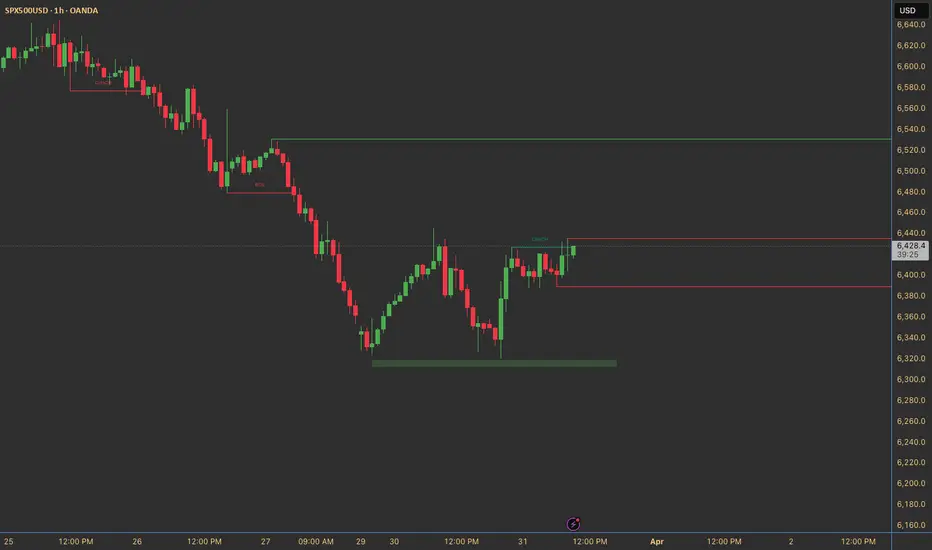
Going into NY open, price is sitting inside the premarket high/low range on the 1H timeframe.
Higher timeframe structure is still bearish — lower highs, continuation legs, and price trading below key EMAs. That gives us a directional lean, but not a reason to force a trade early.
Right now this is a compression phase. Liquidity is building inside the range.
The plan is simple: let price show its hand at the open, then react.
Scenario 1 (more likely):
Given the current structure, a break below the premarket low has higher probability. If we get a clean break and acceptance below, I’ll be looking for continuation into prior lows and liquidity below. Ideally, this comes with a small pullback or lower timeframe confirmation before entry.
Scenario 2:
If price breaks above the premarket high, I’m not chasing it immediately. Most of the time these become traps. I’ll be watching for weak continuation or a shift back below the range to look for shorts.
Scenario 3 (less likely but valid):
If price breaks above and actually holds — building higher lows above the range — then structure starts to shift. That’s when longs become valid targeting the next areas of liquidity above.
Key idea:
No trade inside the range. That’s where most get chopped.
We’re not predicting — we’re reacting.
Let the open create direction, then align with it.
Higher timeframe structure is still bearish — lower highs, continuation legs, and price trading below key EMAs. That gives us a directional lean, but not a reason to force a trade early.
Right now this is a compression phase. Liquidity is building inside the range.
The plan is simple: let price show its hand at the open, then react.
Scenario 1 (more likely):
Given the current structure, a break below the premarket low has higher probability. If we get a clean break and acceptance below, I’ll be looking for continuation into prior lows and liquidity below. Ideally, this comes with a small pullback or lower timeframe confirmation before entry.
Scenario 2:
If price breaks above the premarket high, I’m not chasing it immediately. Most of the time these become traps. I’ll be watching for weak continuation or a shift back below the range to look for shorts.
Scenario 3 (less likely but valid):
If price breaks above and actually holds — building higher lows above the range — then structure starts to shift. That’s when longs become valid targeting the next areas of liquidity above.
Key idea:
No trade inside the range. That’s where most get chopped.
We’re not predicting — we’re reacting.
Let the open create direction, then align with it.

Haftungsausschluss
Die Informationen und Veröffentlichungen sind nicht als Finanz-, Anlage-, Handels- oder andere Arten von Ratschlägen oder Empfehlungen gedacht, die von TradingView bereitgestellt oder gebilligt werden, und stellen diese nicht dar. Lesen Sie mehr in den Nutzungsbedingungen.
Haftungsausschluss
Die Informationen und Veröffentlichungen sind nicht als Finanz-, Anlage-, Handels- oder andere Arten von Ratschlägen oder Empfehlungen gedacht, die von TradingView bereitgestellt oder gebilligt werden, und stellen diese nicht dar. Lesen Sie mehr in den Nutzungsbedingungen.