
# The Math That Most Traders Ignore
Most traders spend years searching for a higher win rate.
They obsess over entries.
They obsess over confirmations.
They obsess over finding a setup that wins 70%, 80%, or even 90% of the time.
The assumption is simple:
**If I can win more often, I will make more money.**
It sounds logical.
It feels logical.
And yet, it is one of the biggest misconceptions in trading.
Because profitability is not determined by win rate alone.
Profitability is determined by the relationship between:
* Win Rate
* Risk-to-Reward Ratio
* Position Sizing
* Consistency
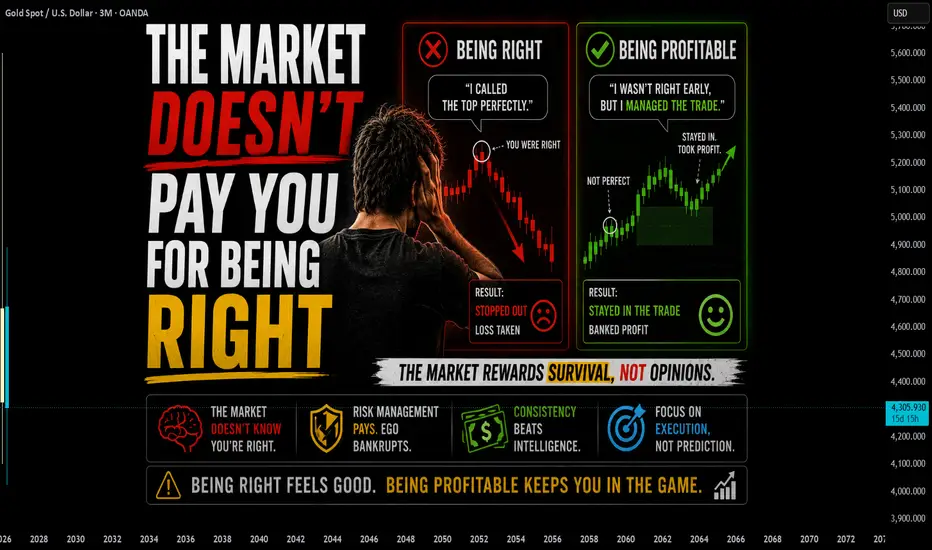
The market does not pay traders for being right.
The market pays traders for managing risk.
And once you understand the mathematics behind that statement, your entire perspective on trading begins to change.
---
## The Obsession With Accuracy
Ask most developing traders what they want.
The answer is almost always the same:
*"I want a higher win rate."*
Rarely do they say:
*"I want higher expectancy."*
That difference matters.
Because expectancy is what actually determines long-term profitability.
Imagine two traders.
### Trader A
* 70% Win Rate
* 1:1 Risk-to-Reward
* Risking 1% per trade
### Trader B
* 40% Win Rate
* 5:1 Risk-to-Reward
* Risking 1% per trade
Most people immediately choose Trader A.
The higher win rate feels safer.
More comfortable.
More reliable.
Yet the mathematics tell a completely different story.
---
## Consider The Numbers
Suppose both traders take 10 trades.
### Trader A
Wins:
* 7 trades
* +1R each
Profit:
+7R
Losses:
* 3 trades
* -1R each
Loss:
-3R
Net Result:
+4R
At 1% risk:
+4%
Good performance.
Nothing wrong with that.
---
Now consider Trader B.
### Trader B
Wins:
* 4 trades
* +5R each
Profit:
+20R
Losses:
* 6 trades
* -1R each
Loss:
-6R
Net Result:
+14R
At 1% risk:
+14%
The trader was wrong more often than right.
Yet generated over three times the return.
This is where many traders begin realizing that accuracy and profitability are not the same thing.
---
## Why Reward-To-Risk Changes Everything
A trader with a strong reward-to-risk profile has something extremely powerful:
Room for error.
Consider a strategy producing:
* 30% Win Rate
* 5:1 Risk-to-Reward
Out of 10 trades:
Wins:
3
Losses:
7
Average Win:
+5R
Average Loss:
-1R
Net Result:
(3 × 5R) - (7 × 1R)
= 15R - 7R
= +8R
Even while losing most trades.
The trader remains profitable.
This is the part many traders struggle to accept emotionally.
Because psychologically we want to be correct.
Mathematically we only need positive expectancy.
Those are not the same objective.
---
## The Hidden Advantage of Being Wrong
One of the strangest truths in trading is that you can build a highly profitable career while being wrong most of the time.
Imagine a trader operating at:
* 35% Win Rate
* 4:1 Reward-To-Risk
Over 100 trades:
Wins:
35
Losses:
65
Profit:
35 × 4R
= 140R
Loss:
65 × 1R
= 65R
Net:
+75R
The trader lost nearly twice as often as they won.
Yet still generated exceptional performance.
Why?
Because winners were significantly larger than losers.
The market rewards asymmetry.
Not ego.
---
## The Role of Position Sizing
Now let's add position sizing.
Suppose the account size is:
$5,000
Risk per trade:
1%
Maximum loss:
$50
Using a 5:1 Risk-to-Reward profile:
Average loss:
-$50
Average winner:
+$250
Now assume:
50% Win Rate
Over 10 trades:
Wins:
5
Profit:
5 × $250
= $1,250
Losses:
5
Loss:
5 × $50
= $250
Net:
+$1,000
Which equals:
20% return.
Just ten trades.
Not by increasing leverage.
Not by gambling.
Not by risking the account.
Simply by combining:
* Solid risk management
* Good reward-to-risk
* Consistent execution
---
## Why Most Traders Never Reach This Point
Because most traders sabotage the mathematics.
They enter a trade targeting:
5R
But once price reaches:
1R
Fear appears.
They begin thinking:
*"What if it reverses?"*
*"I should lock profits."*
*"I don't want to lose this gain."*
The trade closes early.
The 5R opportunity becomes:
1R
Repeated often enough, expectancy collapses.
The trader unknowingly destroys the very mathematics that made the strategy profitable.
The market didn't ruin the edge.
Execution did.
---
## The Power of Incremental Improvement
Now consider something fascinating.
Suppose the trader improves:
Win Rate:
30% → 40%
While maintaining:
5:1 Risk-To-Reward
Over 10 trades:
Wins:
4
Losses:
6
Profit:
4 × 5R
= 20R
Loss:
6 × 1R
= 6R
Net:
+14R
At 2% risk:
+28%
Notice what happened.
A relatively small increase in accuracy produced a dramatic increase in profitability.
This is where many professionals focus.
Not on perfection.
But on improving the interaction between:
* Accuracy
* Reward-To-Risk
* Risk Management
Even small improvements compound aggressively.
---
## Why Capital Preservation Comes First
There is another lesson hidden inside these numbers.
Every example assumes survival.
And survival depends on protecting capital.
A trader risking:
10% per trade
does not have the luxury of letting probability work.
Variance becomes dangerous.
Suppose a strategy has:
40% Win Rate.
The probability of four consecutive losses is:
0.60⁴
= 12.96%
That means losing streaks are normal.
A trader risking:
10%
per trade would experience:
Approximately 34% drawdown after four losses.
Psychology begins breaking down.
Rules begin changing.
Execution deteriorates.
Now compare that with:
1% risk per trade.
The exact same losing streak becomes manageable.
The trader survives.
And survival is what allows expectancy to eventually emerge.
---
## The Real Goal
Most traders have the wrong goal.
They believe the objective is:
* Higher win rate
* More trades
* Bigger positions
* Faster growth
The real objective is much simpler.
Build a system where:
* Winners are larger than losers.
* Risk remains controlled.
* Expectancy remains positive.
* Capital survives variance.
That is the foundation of professional trading.
Not prediction.
Not certainty.
Not perfection.
Mathematics.
---
## Why This Matters More Than Any Setup
Most traders spend thousands of hours studying:
* Market Structure
* Liquidity
* Order Blocks
* Fair Value Gaps
* Economic Data
* Indicators
Yet very few spend equal time studying expectancy.
This is ironic because expectancy determines whether any strategy can actually produce money.
A mediocre strategy with excellent risk management often outperforms a brilliant strategy with poor execution.
The market rewards consistency.
Not intelligence alone.
Not analysis alone.
And certainly not prediction alone.
---
## The Difference Between Amateurs and Professionals
Amateurs ask:
*"Will this trade win?"*
Professionals ask:
*"What is my expectancy over the next 100 trades?"*
Amateurs focus on outcomes.
Professionals focus on distributions.
Amateurs seek certainty.
Professionals manage probability.
That shift changes everything.
Because once you understand that trading is fundamentally a probability business, you stop trying to win every trade.
And start trying to execute every trade correctly.
---
## Conclusion
The most important numbers in trading are not:
* Pips
* Points
* Win Rate
The most important numbers are:
* Risk-To-Reward
* Expectancy
* Risk Per Trade
* Long-Term Probability
A trader with:
* 30% Win Rate
* 5:1 Reward-To-Risk
can outperform a trader with:
* 70% Win Rate
* 1:1 Reward-To-Risk
because profitability is determined by mathematics, not emotions.
The market does not care how often you are right.
It only cares about how much you make when you are right and how little you lose when you are wrong.
That is the game.
And once you truly understand that, you stop chasing accuracy and start building expectancy.
That is where consistency begins.
And that is where professional trading starts.
Happy Trading,
YCGH Capital
Most traders spend years searching for a higher win rate.
They obsess over entries.
They obsess over confirmations.
They obsess over finding a setup that wins 70%, 80%, or even 90% of the time.
The assumption is simple:
**If I can win more often, I will make more money.**
It sounds logical.
It feels logical.
And yet, it is one of the biggest misconceptions in trading.
Because profitability is not determined by win rate alone.
Profitability is determined by the relationship between:
* Win Rate
* Risk-to-Reward Ratio
* Position Sizing
* Consistency
The market does not pay traders for being right.
The market pays traders for managing risk.
And once you understand the mathematics behind that statement, your entire perspective on trading begins to change.
---
## The Obsession With Accuracy
Ask most developing traders what they want.
The answer is almost always the same:
*"I want a higher win rate."*
Rarely do they say:
*"I want higher expectancy."*
That difference matters.
Because expectancy is what actually determines long-term profitability.
Imagine two traders.
### Trader A
* 70% Win Rate
* 1:1 Risk-to-Reward
* Risking 1% per trade
### Trader B
* 40% Win Rate
* 5:1 Risk-to-Reward
* Risking 1% per trade
Most people immediately choose Trader A.
The higher win rate feels safer.
More comfortable.
More reliable.
Yet the mathematics tell a completely different story.
---
## Consider The Numbers
Suppose both traders take 10 trades.
### Trader A
Wins:
* 7 trades
* +1R each
Profit:
+7R
Losses:
* 3 trades
* -1R each
Loss:
-3R
Net Result:
+4R
At 1% risk:
+4%
Good performance.
Nothing wrong with that.
---
Now consider Trader B.
### Trader B
Wins:
* 4 trades
* +5R each
Profit:
+20R
Losses:
* 6 trades
* -1R each
Loss:
-6R
Net Result:
+14R
At 1% risk:
+14%
The trader was wrong more often than right.
Yet generated over three times the return.
This is where many traders begin realizing that accuracy and profitability are not the same thing.
---
## Why Reward-To-Risk Changes Everything
A trader with a strong reward-to-risk profile has something extremely powerful:
Room for error.
Consider a strategy producing:
* 30% Win Rate
* 5:1 Risk-to-Reward
Out of 10 trades:
Wins:
3
Losses:
7
Average Win:
+5R
Average Loss:
-1R
Net Result:
(3 × 5R) - (7 × 1R)
= 15R - 7R
= +8R
Even while losing most trades.
The trader remains profitable.
This is the part many traders struggle to accept emotionally.
Because psychologically we want to be correct.
Mathematically we only need positive expectancy.
Those are not the same objective.
---
## The Hidden Advantage of Being Wrong
One of the strangest truths in trading is that you can build a highly profitable career while being wrong most of the time.
Imagine a trader operating at:
* 35% Win Rate
* 4:1 Reward-To-Risk
Over 100 trades:
Wins:
35
Losses:
65
Profit:
35 × 4R
= 140R
Loss:
65 × 1R
= 65R
Net:
+75R
The trader lost nearly twice as often as they won.
Yet still generated exceptional performance.
Why?
Because winners were significantly larger than losers.
The market rewards asymmetry.
Not ego.
---
## The Role of Position Sizing
Now let's add position sizing.
Suppose the account size is:
$5,000
Risk per trade:
1%
Maximum loss:
$50
Using a 5:1 Risk-to-Reward profile:
Average loss:
-$50
Average winner:
+$250
Now assume:
50% Win Rate
Over 10 trades:
Wins:
5
Profit:
5 × $250
= $1,250
Losses:
5
Loss:
5 × $50
= $250
Net:
+$1,000
Which equals:
20% return.
Just ten trades.
Not by increasing leverage.
Not by gambling.
Not by risking the account.
Simply by combining:
* Solid risk management
* Good reward-to-risk
* Consistent execution
---
## Why Most Traders Never Reach This Point
Because most traders sabotage the mathematics.
They enter a trade targeting:
5R
But once price reaches:
1R
Fear appears.
They begin thinking:
*"What if it reverses?"*
*"I should lock profits."*
*"I don't want to lose this gain."*
The trade closes early.
The 5R opportunity becomes:
1R
Repeated often enough, expectancy collapses.
The trader unknowingly destroys the very mathematics that made the strategy profitable.
The market didn't ruin the edge.
Execution did.
---
## The Power of Incremental Improvement
Now consider something fascinating.
Suppose the trader improves:
Win Rate:
30% → 40%
While maintaining:
5:1 Risk-To-Reward
Over 10 trades:
Wins:
4
Losses:
6
Profit:
4 × 5R
= 20R
Loss:
6 × 1R
= 6R
Net:
+14R
At 2% risk:
+28%
Notice what happened.
A relatively small increase in accuracy produced a dramatic increase in profitability.
This is where many professionals focus.
Not on perfection.
But on improving the interaction between:
* Accuracy
* Reward-To-Risk
* Risk Management
Even small improvements compound aggressively.
---
## Why Capital Preservation Comes First
There is another lesson hidden inside these numbers.
Every example assumes survival.
And survival depends on protecting capital.
A trader risking:
10% per trade
does not have the luxury of letting probability work.
Variance becomes dangerous.
Suppose a strategy has:
40% Win Rate.
The probability of four consecutive losses is:
0.60⁴
= 12.96%
That means losing streaks are normal.
A trader risking:
10%
per trade would experience:
Approximately 34% drawdown after four losses.
Psychology begins breaking down.
Rules begin changing.
Execution deteriorates.
Now compare that with:
1% risk per trade.
The exact same losing streak becomes manageable.
The trader survives.
And survival is what allows expectancy to eventually emerge.
---
## The Real Goal
Most traders have the wrong goal.
They believe the objective is:
* Higher win rate
* More trades
* Bigger positions
* Faster growth
The real objective is much simpler.
Build a system where:
* Winners are larger than losers.
* Risk remains controlled.
* Expectancy remains positive.
* Capital survives variance.
That is the foundation of professional trading.
Not prediction.
Not certainty.
Not perfection.
Mathematics.
---
## Why This Matters More Than Any Setup
Most traders spend thousands of hours studying:
* Market Structure
* Liquidity
* Order Blocks
* Fair Value Gaps
* Economic Data
* Indicators
Yet very few spend equal time studying expectancy.
This is ironic because expectancy determines whether any strategy can actually produce money.
A mediocre strategy with excellent risk management often outperforms a brilliant strategy with poor execution.
The market rewards consistency.
Not intelligence alone.
Not analysis alone.
And certainly not prediction alone.
---
## The Difference Between Amateurs and Professionals
Amateurs ask:
*"Will this trade win?"*
Professionals ask:
*"What is my expectancy over the next 100 trades?"*
Amateurs focus on outcomes.
Professionals focus on distributions.
Amateurs seek certainty.
Professionals manage probability.
That shift changes everything.
Because once you understand that trading is fundamentally a probability business, you stop trying to win every trade.
And start trying to execute every trade correctly.
---
## Conclusion
The most important numbers in trading are not:
* Pips
* Points
* Win Rate
The most important numbers are:
* Risk-To-Reward
* Expectancy
* Risk Per Trade
* Long-Term Probability
A trader with:
* 30% Win Rate
* 5:1 Reward-To-Risk
can outperform a trader with:
* 70% Win Rate
* 1:1 Reward-To-Risk
because profitability is determined by mathematics, not emotions.
The market does not care how often you are right.
It only cares about how much you make when you are right and how little you lose when you are wrong.
That is the game.
And once you truly understand that, you stop chasing accuracy and start building expectancy.
That is where consistency begins.
And that is where professional trading starts.
Happy Trading,
YCGH Capital

For Daily LIVE Trades
Join FREE Telegram:t.me/+xavhcozoJexhZTVl
Join FREE Telegram:t.me/+xavhcozoJexhZTVl
Verbundene Veröffentlichungen
Haftungsausschluss
Die Informationen und Veröffentlichungen sind nicht als Finanz-, Anlage-, Handels- oder andere Arten von Ratschlägen oder Empfehlungen gedacht, die von TradingView bereitgestellt oder gebilligt werden, und stellen diese nicht dar. Lesen Sie mehr in den Nutzungsbedingungen.
For Daily LIVE Trades
Join FREE Telegram:t.me/+xavhcozoJexhZTVl
Join FREE Telegram:t.me/+xavhcozoJexhZTVl
Verbundene Veröffentlichungen
Haftungsausschluss
Die Informationen und Veröffentlichungen sind nicht als Finanz-, Anlage-, Handels- oder andere Arten von Ratschlägen oder Empfehlungen gedacht, die von TradingView bereitgestellt oder gebilligt werden, und stellen diese nicht dar. Lesen Sie mehr in den Nutzungsbedingungen.