
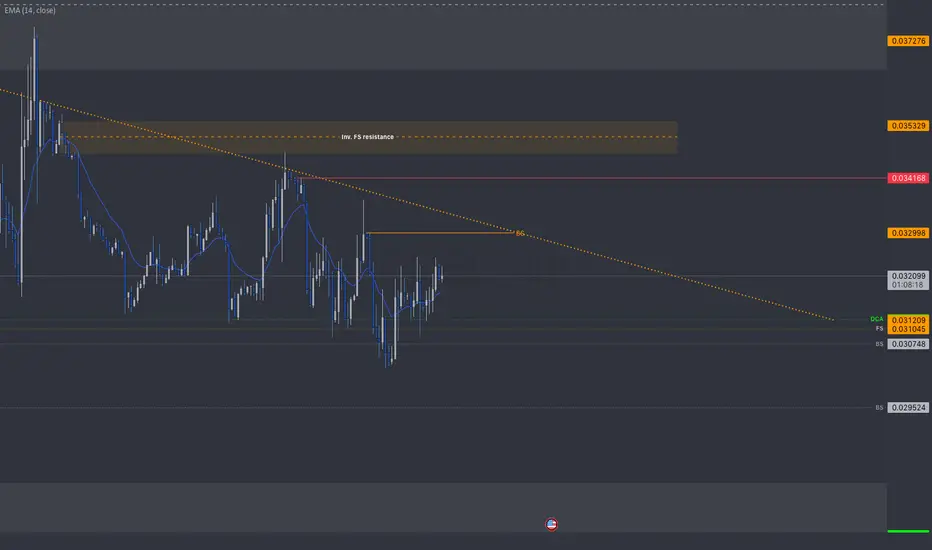
updated chart. tested levels changed from dashed to single point dotted lines.
New levels added @ $0.026 which are the final levels support the low angle accumulation trend.
If price is a good entry at 0.026 then what would get price down to that zone?
There is are a few 4hr areas of resistance locally. A 4hr timeframe level will have an expected strength to break lower timeframe levels and contend with / possible breaking of a daily timeframe level.
the tested levels currently supporting price at $0.0310 is a tested 4hr so it can break. The tested weekly levels in grey below that could also break being tested already. There is no expectation of liquidity at those area's since they are already tested and not candidates for trends to originate from them. We can look for Inv.BS candles to form and create an origin level for an accumulation trend to be created.
We can also look for BS levels to be tested 2x to become origin levels for distribution trends to be created and push price down to the final levels of supports.
- T.A explained -
Range = two or more consecutive color candles.
DISTRIBUTION RANGES DEFINED: BackSide (BS) Candle - First distribution candle in a distribution range. Expectation = strong reaction to price. long wicks reaching to or away from level.
FrontSide (FS) Candle - Last distribution candle in a distribution range. Expectation = reversal, create a trend in the opposite direction. Distribution candles are used as support.
ACCUMULATION RANGES DEFINED:
Inverse BS (Inv.BS) - First Accumulation candle in an accumulation range. Expectation. = strong reaction to price. long wicks reaching to or away from level.
Inverse FS (Inv.FS) - Last accumulation candle in an accumulation range. Expectation = reversal, create a trend in the opposite direction. Accumulation candles are used as resistance.
Horizontal Ray tool on BS & FS levels are default support levels when dashed lines, tested when dotted lines and resistance when solid lines.
Horizontal Ray tool on Inverse BS & Inverse FS levels default as resistance and shown with a dashed line, tested when 1x dotted line, and support when solid line.
The inverse is true for the Inv. BS Inv. FS levels, they are resistance as dashed lines, tested as dotted and support as solid lines.
Monthly timeframe is color pink
weekly grey
daily is red
4hr is orange
1hr is yellow
15min is blue
5min is green if they are shown.
strength favors the higher timeframe.
New levels added @ $0.026 which are the final levels support the low angle accumulation trend.
If price is a good entry at 0.026 then what would get price down to that zone?
There is are a few 4hr areas of resistance locally. A 4hr timeframe level will have an expected strength to break lower timeframe levels and contend with / possible breaking of a daily timeframe level.
the tested levels currently supporting price at $0.0310 is a tested 4hr so it can break. The tested weekly levels in grey below that could also break being tested already. There is no expectation of liquidity at those area's since they are already tested and not candidates for trends to originate from them. We can look for Inv.BS candles to form and create an origin level for an accumulation trend to be created.
We can also look for BS levels to be tested 2x to become origin levels for distribution trends to be created and push price down to the final levels of supports.
- T.A explained -
Range = two or more consecutive color candles.
DISTRIBUTION RANGES DEFINED: BackSide (BS) Candle - First distribution candle in a distribution range. Expectation = strong reaction to price. long wicks reaching to or away from level.
FrontSide (FS) Candle - Last distribution candle in a distribution range. Expectation = reversal, create a trend in the opposite direction. Distribution candles are used as support.
ACCUMULATION RANGES DEFINED:
Inverse BS (Inv.BS) - First Accumulation candle in an accumulation range. Expectation. = strong reaction to price. long wicks reaching to or away from level.
Inverse FS (Inv.FS) - Last accumulation candle in an accumulation range. Expectation = reversal, create a trend in the opposite direction. Accumulation candles are used as resistance.
Horizontal Ray tool on BS & FS levels are default support levels when dashed lines, tested when dotted lines and resistance when solid lines.
Horizontal Ray tool on Inverse BS & Inverse FS levels default as resistance and shown with a dashed line, tested when 1x dotted line, and support when solid line.
The inverse is true for the Inv. BS Inv. FS levels, they are resistance as dashed lines, tested as dotted and support as solid lines.
Monthly timeframe is color pink
weekly grey
daily is red
4hr is orange
1hr is yellow
15min is blue
5min is green if they are shown.
strength favors the higher timeframe.
Trade ist aktiv
the weekly BackSide support level was tested. BackSide support levels have an expectation to have a strong reaction to price relative to its timeframe. Was your expectation of the test of the weekly BackSide level met? did price gain the FrontSide candle that brought it down? Yes. Can an accumulation ladder be created on a lower timeframe? yes.
what area's of resistance now stand in the way of accumulation? a 4hr distribution trend.
is a 4hr less than a daily or weekly accumulation trend in strength? yes.
is the probability in favor of a 4hr trend break to test the 4hr BackSide/ Origin candle? yes.
lets see if expectations are met. If not, price wants to test those lower support levels and just wanted to see a dead cat bounce.

Haftungsausschluss
Die Informationen und Veröffentlichungen sind nicht als Finanz-, Anlage-, Handels- oder andere Arten von Ratschlägen oder Empfehlungen gedacht, die von TradingView bereitgestellt oder gebilligt werden, und stellen diese nicht dar. Lesen Sie mehr in den Nutzungsbedingungen.
Haftungsausschluss
Die Informationen und Veröffentlichungen sind nicht als Finanz-, Anlage-, Handels- oder andere Arten von Ratschlägen oder Empfehlungen gedacht, die von TradingView bereitgestellt oder gebilligt werden, und stellen diese nicht dar. Lesen Sie mehr in den Nutzungsbedingungen.