
How to Hedge Bear Markets Using Beta (Real case October 2026)
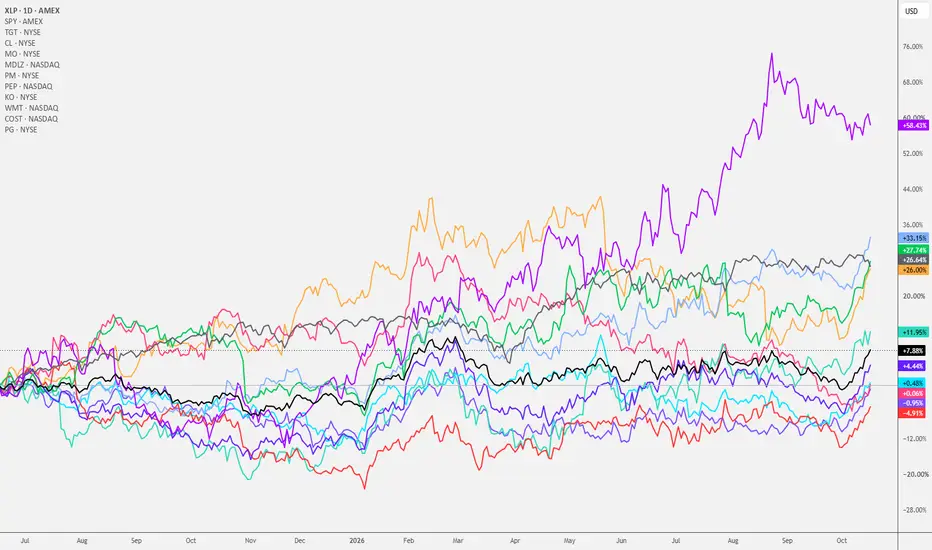
Description:
When market volatility spikes (VIX > 20) and benchmark yields remain elevated (US10Y > 5.0%), most retail traders make the mistake of either freezing or recklessly buying high-beta growth dips.
Institutional capital handles bear markets and sharp pullbacks using two core principles: Beta Allocation and Multi-Asset Performance Tracking.
🛡️ 1. What is Beta and How Does It Protect Your Portfolio?:
Beta measures an asset’s historical sensitivity relative to the broad market (S&P 500):
1.1) High Beta (beta > 1.0): Market Amplifiers (e.g., Semiconductors etf (SMH) beta approx 1.99). If the market drops -2%, high-beta assets can plunge -4% to -6%.
1.2) Low / Neutral Beta (beta < 0.10): Defensive Cushions (e.g., Consumer Staples etf (XLP) beta = 0.10, Coca-Cola (KO) beta = -0.01). These assets remain insulated during broader panics because their earnings depend on non-discretionary consumer needs.
💡 Tactical Takeaway:
When volatility surges, you don't need to exit the market completely. Rotating equity exposure toward Low/Neutral Beta provides an automatic hedge without incurring the time decay (Theta) associated with buying Put options.
📊 2. The Power of Comparative Performance Charts:
Tracking assets across isolated charts hides structural relative strength. Overlaying components on a single % Performance Chart reveals institutional flow instantly:
2.1) Set a Anchor Sector or Index: Use SPY or a broad sector ETF like XLP as a baseline.
2.2) Overlay Individual Holdings: Normalize performance from a shared starting date.
2.3 Visual Diagnosis:
2.3.1) Diverging Upper Curves: Highlight true institutional leaders (e.g., KO$,
 PM$) holding bid while indices decline.
2.3.2) Lagging Lower Curves: Signal weak structure or value traps undergoing forced liquidations.
📌3. Real-World Case Study (October 2026):
3.1) Macro Context: US10Y > 5.0%, VIX approx 20, and High-Beta Tech experiencing sharp liquidations (SMH -12.22% 1W).
3.2) Data Screening: KO displayed a near-zero Beta (beta = -0.01) alongside heavy institutional accumulation in Consumer Staples etf (XLP Rel Vol 1.98x).
3.3) Outcome: Holding neutral-beta leaders like KO delivered positive returns (+7.19% 1W / +34.43% YTD) while broad market indices suffered heavy drawdowns.
When market volatility spikes (VIX > 20) and benchmark yields remain elevated (US10Y > 5.0%), most retail traders make the mistake of either freezing or recklessly buying high-beta growth dips.
Institutional capital handles bear markets and sharp pullbacks using two core principles: Beta Allocation and Multi-Asset Performance Tracking.
🛡️ 1. What is Beta and How Does It Protect Your Portfolio?:
Beta measures an asset’s historical sensitivity relative to the broad market (S&P 500):
1.1) High Beta (beta > 1.0): Market Amplifiers (e.g., Semiconductors etf (SMH) beta approx 1.99). If the market drops -2%, high-beta assets can plunge -4% to -6%.
1.2) Low / Neutral Beta (beta < 0.10): Defensive Cushions (e.g., Consumer Staples etf (XLP) beta = 0.10, Coca-Cola (KO) beta = -0.01). These assets remain insulated during broader panics because their earnings depend on non-discretionary consumer needs.
💡 Tactical Takeaway:
When volatility surges, you don't need to exit the market completely. Rotating equity exposure toward Low/Neutral Beta provides an automatic hedge without incurring the time decay (Theta) associated with buying Put options.
📊 2. The Power of Comparative Performance Charts:
Tracking assets across isolated charts hides structural relative strength. Overlaying components on a single % Performance Chart reveals institutional flow instantly:
2.1) Set a Anchor Sector or Index: Use SPY or a broad sector ETF like XLP as a baseline.
2.2) Overlay Individual Holdings: Normalize performance from a shared starting date.
2.3 Visual Diagnosis:
2.3.1) Diverging Upper Curves: Highlight true institutional leaders (e.g.,
KO$, PM$) holding bid while indices decline.2.3.2) Lagging Lower Curves: Signal weak structure or value traps undergoing forced liquidations.
📌3. Real-World Case Study (October 2026):
3.1) Macro Context: US10Y > 5.0%, VIX approx 20, and High-Beta Tech experiencing sharp liquidations (SMH -12.22% 1W).
3.2) Data Screening: KO displayed a near-zero Beta (beta = -0.01) alongside heavy institutional accumulation in Consumer Staples etf (XLP Rel Vol 1.98x).
3.3) Outcome: Holding neutral-beta leaders like KO delivered positive returns (+7.19% 1W / +34.43% YTD) while broad market indices suffered heavy drawdowns.

Verbundene Veröffentlichungen
Haftungsausschluss
Die Informationen und Veröffentlichungen sind nicht als Finanz-, Anlage-, Handels- oder andere Arten von Ratschlägen oder Empfehlungen gedacht, die von TradingView bereitgestellt oder gebilligt werden, und stellen diese nicht dar. Lesen Sie mehr in den Nutzungsbedingungen.
Verbundene Veröffentlichungen
Haftungsausschluss
Die Informationen und Veröffentlichungen sind nicht als Finanz-, Anlage-, Handels- oder andere Arten von Ratschlägen oder Empfehlungen gedacht, die von TradingView bereitgestellt oder gebilligt werden, und stellen diese nicht dar. Lesen Sie mehr in den Nutzungsbedingungen.