EV Gap Acceptance
EV Gap Acceptance
Opening gap → closing-price response → partial or complete fill.
EV Gap Acceptance studies the difference between a selected session's opening price and the previous eligible completed session's close. It keeps the initial gap fixed, observes the first acceptance or rejection sequence, and continues tracking how much of that gap is filled. A rolling sample of completed qualified sessions puts those observations into historical context.
This is a session-opening gap study, distinct from a three-candle Fair Value Gap detector. It does not place trades or report strategy returns.
SESSION DEFINITION
The initial window is 09:30–16:00 America/New_York. Opening hour, minute, closing time and IANA timezone are configurable. The timezone handles its own seasonal clock changes. Overnight windows are not supported: closing time must follow opening time on the same local day.
Use standard intraday time-based candles of 30 minutes or less, aligned with both session boundaries. A session must start with an observed opening bar, remain contiguous and finish exactly at the configured close to enter the historical sample. Partial sessions, missing bars and misaligned boundaries are excluded rather than silently repaired.
There is no exchange holiday calendar. Early-close days are excluded under the standard 16:00 closing setting. A maximum calendar interval between eligible sessions defaults to seven days, allowing weekends and holidays. An entire session missing from a feed cannot always be distinguished from a holiday.
For a cash-session instrument such as SPY, the reference describes the regular-session opening gap. On continuously traded instruments such as gold or crypto, it instead describes the difference between your selected analysis windows; it does not imply that the whole market stopped trading.
READING THE CHART
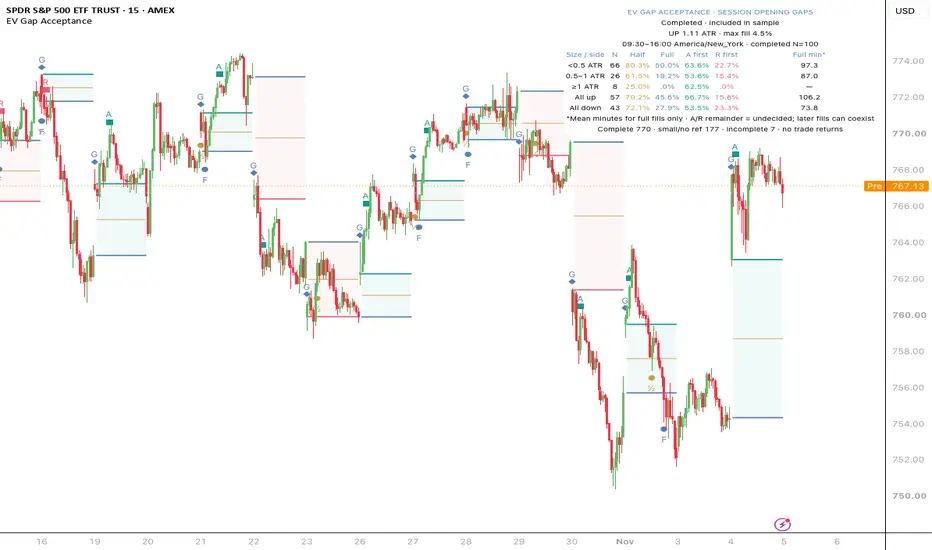
G — a qualified opening gap, observed when the first session candle closes.
Opening line — teal for an upward gap, rose for a downward gap.
Blue line — previous eligible session close, the full-fill reference.
Amber line — midpoint of the initial gap.
½ — the session's observed price range has reached halfway toward the previous close.
F — the session's observed price range has reached the previous close.
A — the first qualifying acceptance sequence.
R — the first qualifying rejection sequence.
The gap shading is subtle and configurable. Markers, colours and panel placement can also be changed. Separate sessions have separate reference segments.
ACCEPTANCE AND REJECTION RULES
Acceptance requires consecutive closes beyond the opening price in the direction of the gap, outside a volatility buffer. Rejection requires consecutive closes beyond the midpoint in the opposite direction, outside the same buffer.
Defaults are three consecutive closes within the first 12 session candles, including the opening candle, and a buffer of 0.05 reference ATR. Equality at the boundary does not count. Each interrupted sequence resets its count. The first completed classification wins; if neither qualifies in the window, that session remains undecided.
Classification and filling answer different questions. Acceptance can be followed by a full fill later in the same session. Once A or R is recorded, the classification stays fixed while fill tracking continues. These are observed price sequences, not claims about future continuation or reversal.
SIZE NORMALISATION
The default minimum gap is two ticks and 0.10 reference ATR. Both requirements must pass.
ATR is built from COMPLETED SELECTED SESSIONS, rather than from individual intraday candles. Session true range is the maximum of its high-low range and the distances of its extremes from the previous eligible session close. If that close is unavailable, high-low is used. After a 14-completed-session mean seed, Wilder smoothing continues. Today's gap uses the ATR stored at the previous completed session, so today's range does not enter its initial normalisation.
This session ATR is not necessarily identical to the provider's daily ATR. Incomplete sessions do not update it. Changing the session definition or available history can change the reference and sample.
HISTORICAL PANEL
The initial rolling sample retains the last 100 completed sessions with qualified gaps; the setting supports 10–500. The active session is excluded until complete.
Three size groups use the initial absolute gap divided by the prior session ATR:
• Below 0.5 ATR.
• From 0.5 to below 1 ATR.
• At least 1 ATR.
All-up and all-down rows provide a second partition of the same sample. They are not additional independent observations.
N is the number of qualified completed sessions in that row. Half and Full show the percentage reaching the respective fill references. A first and R first show the percentage classified first as acceptance or rejection. Their remainder is undecided. These percentages are descriptive sample frequencies, not calibrated forecasts or trading win rates.
Full min is the average elapsed time among sessions that fully filled only. Non-fills are excluded from that average. First-fill timing is recorded at the close of the first candle containing the touch, so it is a bar-resolution upper bound rather than the exact intrabar execution time. Different chart intervals also change the clock duration of the response window defined in bars.
Counters separately identify completed sessions, gaps excluded for size/reference availability, and incomplete sessions. The panel caps displayed fill progress at 100%.
CONFIRMATION AND ALERTS
Gap, fill and response events are processed on confirmed chart candles. No opening is retrospectively shifted to the first convenient candle when the exact opening is absent. Alert conditions are provided for a qualified gap, half fill, full fill, acceptance and rejection. Configure alerts for bar-close use.
VALIDATION AND LIMITS
The script was compiled and run on OANDA:XAUUSD 15-minute charts and AMEX:SPY 5- and 15-minute charts. A deliberate 09:31 opening on SPY five-minute bars produced no eligible sample rather than substituting the 09:35 candle. Embedded checks cover fill geometry, response boundaries and sample accounting.
The tool depends on the chart feed, adjusted prices, session hours, available history and complete bars. It does not use volume, identify resting orders, model brokerage fills or measure profitability. Historical fill frequencies do not guarantee the next session's outcome.
OPEN SOURCE
Published by EVLabs under the Mozilla Public License 2.0. The Pine source is available to inspect and adapt under that licence.
Opening gap → closing-price response → partial or complete fill.
EV Gap Acceptance studies the difference between a selected session's opening price and the previous eligible completed session's close. It keeps the initial gap fixed, observes the first acceptance or rejection sequence, and continues tracking how much of that gap is filled. A rolling sample of completed qualified sessions puts those observations into historical context.
This is a session-opening gap study, distinct from a three-candle Fair Value Gap detector. It does not place trades or report strategy returns.
SESSION DEFINITION
The initial window is 09:30–16:00 America/New_York. Opening hour, minute, closing time and IANA timezone are configurable. The timezone handles its own seasonal clock changes. Overnight windows are not supported: closing time must follow opening time on the same local day.
Use standard intraday time-based candles of 30 minutes or less, aligned with both session boundaries. A session must start with an observed opening bar, remain contiguous and finish exactly at the configured close to enter the historical sample. Partial sessions, missing bars and misaligned boundaries are excluded rather than silently repaired.
There is no exchange holiday calendar. Early-close days are excluded under the standard 16:00 closing setting. A maximum calendar interval between eligible sessions defaults to seven days, allowing weekends and holidays. An entire session missing from a feed cannot always be distinguished from a holiday.
For a cash-session instrument such as SPY, the reference describes the regular-session opening gap. On continuously traded instruments such as gold or crypto, it instead describes the difference between your selected analysis windows; it does not imply that the whole market stopped trading.
READING THE CHART
G — a qualified opening gap, observed when the first session candle closes.
Opening line — teal for an upward gap, rose for a downward gap.
Blue line — previous eligible session close, the full-fill reference.
Amber line — midpoint of the initial gap.
½ — the session's observed price range has reached halfway toward the previous close.
F — the session's observed price range has reached the previous close.
A — the first qualifying acceptance sequence.
R — the first qualifying rejection sequence.
The gap shading is subtle and configurable. Markers, colours and panel placement can also be changed. Separate sessions have separate reference segments.
ACCEPTANCE AND REJECTION RULES
Acceptance requires consecutive closes beyond the opening price in the direction of the gap, outside a volatility buffer. Rejection requires consecutive closes beyond the midpoint in the opposite direction, outside the same buffer.
Defaults are three consecutive closes within the first 12 session candles, including the opening candle, and a buffer of 0.05 reference ATR. Equality at the boundary does not count. Each interrupted sequence resets its count. The first completed classification wins; if neither qualifies in the window, that session remains undecided.
Classification and filling answer different questions. Acceptance can be followed by a full fill later in the same session. Once A or R is recorded, the classification stays fixed while fill tracking continues. These are observed price sequences, not claims about future continuation or reversal.
SIZE NORMALISATION
The default minimum gap is two ticks and 0.10 reference ATR. Both requirements must pass.
ATR is built from COMPLETED SELECTED SESSIONS, rather than from individual intraday candles. Session true range is the maximum of its high-low range and the distances of its extremes from the previous eligible session close. If that close is unavailable, high-low is used. After a 14-completed-session mean seed, Wilder smoothing continues. Today's gap uses the ATR stored at the previous completed session, so today's range does not enter its initial normalisation.
This session ATR is not necessarily identical to the provider's daily ATR. Incomplete sessions do not update it. Changing the session definition or available history can change the reference and sample.
HISTORICAL PANEL
The initial rolling sample retains the last 100 completed sessions with qualified gaps; the setting supports 10–500. The active session is excluded until complete.
Three size groups use the initial absolute gap divided by the prior session ATR:
• Below 0.5 ATR.
• From 0.5 to below 1 ATR.
• At least 1 ATR.
All-up and all-down rows provide a second partition of the same sample. They are not additional independent observations.
N is the number of qualified completed sessions in that row. Half and Full show the percentage reaching the respective fill references. A first and R first show the percentage classified first as acceptance or rejection. Their remainder is undecided. These percentages are descriptive sample frequencies, not calibrated forecasts or trading win rates.
Full min is the average elapsed time among sessions that fully filled only. Non-fills are excluded from that average. First-fill timing is recorded at the close of the first candle containing the touch, so it is a bar-resolution upper bound rather than the exact intrabar execution time. Different chart intervals also change the clock duration of the response window defined in bars.
Counters separately identify completed sessions, gaps excluded for size/reference availability, and incomplete sessions. The panel caps displayed fill progress at 100%.
CONFIRMATION AND ALERTS
Gap, fill and response events are processed on confirmed chart candles. No opening is retrospectively shifted to the first convenient candle when the exact opening is absent. Alert conditions are provided for a qualified gap, half fill, full fill, acceptance and rejection. Configure alerts for bar-close use.
VALIDATION AND LIMITS
The script was compiled and run on OANDA:XAUUSD 15-minute charts and AMEX:SPY 5- and 15-minute charts. A deliberate 09:31 opening on SPY five-minute bars produced no eligible sample rather than substituting the 09:35 candle. Embedded checks cover fill geometry, response boundaries and sample accounting.
The tool depends on the chart feed, adjusted prices, session hours, available history and complete bars. It does not use volume, identify resting orders, model brokerage fills or measure profitability. Historical fill frequencies do not guarantee the next session's outcome.
OPEN SOURCE
Published by EVLabs under the Mozilla Public License 2.0. The Pine source is available to inspect and adapt under that licence.

Haftungsausschluss
Die Informationen und Veröffentlichungen sind nicht als Finanz-, Anlage-, Handels- oder andere Arten von Ratschlägen oder Empfehlungen gedacht, die von TradingView bereitgestellt oder gebilligt werden, und stellen diese nicht dar. Lesen Sie mehr in den Nutzungsbedingungen.
Haftungsausschluss
Die Informationen und Veröffentlichungen sind nicht als Finanz-, Anlage-, Handels- oder andere Arten von Ratschlägen oder Empfehlungen gedacht, die von TradingView bereitgestellt oder gebilligt werden, und stellen diese nicht dar. Lesen Sie mehr in den Nutzungsbedingungen.