OPEN-SOURCE SCRIPT
Turtle Soup vs Previous Candle
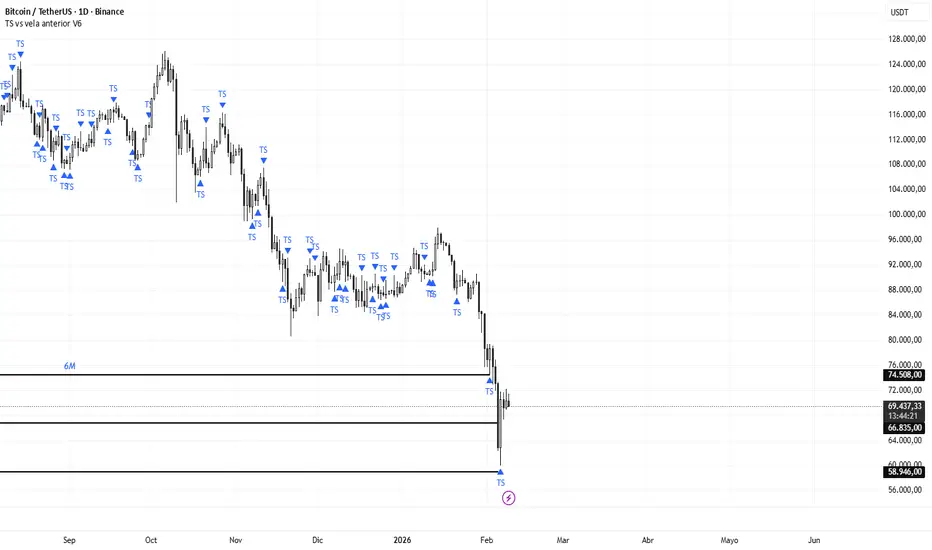
This indicator highlights **Turtle Soup (TS)** setups by comparing **the current candle to the previous one**—and it only triggers **once the candle is fully closed**, so it doesn’t “paint and disappear” while the bar is still forming.
**What it detects**
* **TS Bear (bearish):**
Price *breaks above the previous candle’s high* (liquidity grab), then closes **bearish**, returning back below that prior high.
→ Concept: “fake breakout up, then reversal.”
* **TS Bull (bullish):**
Price *breaks below the previous candle’s low* (liquidity grab), then closes **bullish**, back above that prior low.
→ Concept: “fake breakdown down, then rebound.”
**Strict vs Flexible mode (the indicator switch)**
* ✅ **Allow close outside the previous range (ON):** more flexible.
The close can finish outside the prior candle’s range. Useful in fast, impulsive moves.
* ❌ **Allow close outside the previous range (OFF):** stricter.
The close must finish **inside** the previous candle’s range (cleaner signals, usually fewer of them).
**The key feature**
* Signals are plotted **only after the candle closes on your current timeframe**.
If you’re on M15, it confirms at the M15 close. If you’re on H1, at the H1 close.
Result: more reliable signals and less “indicator drama.”
**What it’s good for**
* Spotting potential **quick reversals** right after a sweep of highs/lows.
* Identifying areas where price often reacts due to **liquidity runs**.
**Practical note**
This isn’t a magic button—signals work best with context (trend, key levels, range/session timing, market structure). Fine-tune strict vs flexible per asset/timeframe and you’ll go from “random dots” to “useful tells.”
**What it detects**
* **TS Bear (bearish):**
Price *breaks above the previous candle’s high* (liquidity grab), then closes **bearish**, returning back below that prior high.
→ Concept: “fake breakout up, then reversal.”
* **TS Bull (bullish):**
Price *breaks below the previous candle’s low* (liquidity grab), then closes **bullish**, back above that prior low.
→ Concept: “fake breakdown down, then rebound.”
**Strict vs Flexible mode (the indicator switch)**
* ✅ **Allow close outside the previous range (ON):** more flexible.
The close can finish outside the prior candle’s range. Useful in fast, impulsive moves.
* ❌ **Allow close outside the previous range (OFF):** stricter.
The close must finish **inside** the previous candle’s range (cleaner signals, usually fewer of them).
**The key feature**
* Signals are plotted **only after the candle closes on your current timeframe**.
If you’re on M15, it confirms at the M15 close. If you’re on H1, at the H1 close.
Result: more reliable signals and less “indicator drama.”
**What it’s good for**
* Spotting potential **quick reversals** right after a sweep of highs/lows.
* Identifying areas where price often reacts due to **liquidity runs**.
**Practical note**
This isn’t a magic button—signals work best with context (trend, key levels, range/session timing, market structure). Fine-tune strict vs flexible per asset/timeframe and you’ll go from “random dots” to “useful tells.”
Open-source Skript
Ganz im Sinne von TradingView hat dieser Autor sein/ihr Script als Open-Source veröffentlicht. Auf diese Weise können nun auch andere Trader das Script rezensieren und die Funktionalität überprüfen. Vielen Dank an den Autor! Sie können das Script kostenlos verwenden, aber eine Wiederveröffentlichung des Codes unterliegt unseren Hausregeln.

Haftungsausschluss
Die Informationen und Veröffentlichungen sind nicht als Finanz-, Anlage-, Handels- oder andere Arten von Ratschlägen oder Empfehlungen gedacht, die von TradingView bereitgestellt oder gebilligt werden, und stellen diese nicht dar. Lesen Sie mehr in den Nutzungsbedingungen.
Open-source Skript
Ganz im Sinne von TradingView hat dieser Autor sein/ihr Script als Open-Source veröffentlicht. Auf diese Weise können nun auch andere Trader das Script rezensieren und die Funktionalität überprüfen. Vielen Dank an den Autor! Sie können das Script kostenlos verwenden, aber eine Wiederveröffentlichung des Codes unterliegt unseren Hausregeln.
Haftungsausschluss
Die Informationen und Veröffentlichungen sind nicht als Finanz-, Anlage-, Handels- oder andere Arten von Ratschlägen oder Empfehlungen gedacht, die von TradingView bereitgestellt oder gebilligt werden, und stellen diese nicht dar. Lesen Sie mehr in den Nutzungsbedingungen.