OPEN-SOURCE SCRIPT
Aktualisiert Daily Institutional Flow + Gamma Setup Board
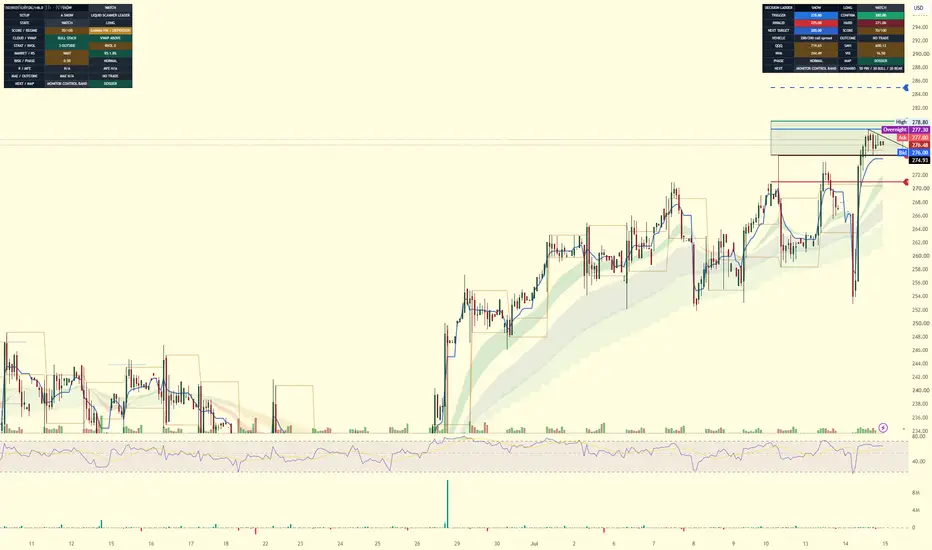
Institutional Flow + Gamma Setup Board
This indicator is a daily institutional setup board designed to convert options flow, gamma exposure levels, technical structure, and market confirmation into a clean execution map for the next trading session.
The script is not a generic buy/sell indicator. It is a structured execution framework built from pre-market or prior-session research. Each mapped ticker contains manually defined institutional levels, including trigger zones, confirmation levels, invalidation levels, hard fails, GEX magnets, GEX air pockets, and target zones.
The indicator uses several live intraday filters to prevent premature entries:
Price vs. VWAP
9 EMA / 21 EMA alignment
Opening range break confirmation
Relative volume filter, optional
Market confirmation from SPY, QQQ, IWM, SMH, and XLE
Regular trading hours logic
Signal cooldown protection
For bullish setups, the indicator looks for price to reclaim the mapped trigger while also holding above VWAP, confirming above the 9 EMA/21 EMA stack, and breaking the opening range if enabled.
For bearish setups, it looks for price to lose the mapped trigger while trading below VWAP, below the EMA stack, and below the opening range if enabled.
Each ticker map includes:
Primary directional bias
Setup grade
Preferred contract or structure
Flow summary
GEX summary
Entry zone
Trigger level
Confirmation level
Invalidation level
Hard invalidation level
Three target zones
Major and minor GEX levels
Manual flow, GEX, technical, and total setup scores
The chart displays mapped levels as labeled horizontal lines. Major levels include triggers, confirmations, invalidations, hard fails, primary targets, flow strikes, and major GEX walls. Minor levels show secondary GEX magnets, nearby gamma pockets, and contextual support/resistance zones. Users can toggle major-only levels, minor labels, all labels, opening range, EMA/VWAP stack, and dashboards.
The main dashboard shows only the active ticker being viewed. It displays the current setup bias, contract reference, trigger, confirmation, invalidation, targets, flow read, GEX read, filter status, opening range status, signal state, and market confirmation.
A separate watchlist dashboard is also included and can be toggled on or off. This acts as the daily mission board, showing the highest-priority setups, triggers, and directional reads for the session.
The indicator supports alerts for:
Long trigger
Long confirmation
Put trigger
Put confirmation
Invalidation
Hard invalidation
Target hits
Mapped level touches
For best use, update the script each trading day with the latest options flow analysis, GEX heatmap levels, technical trigger levels, and ranked watchlist. The structure is designed to be reused daily by updating the ticker maps, index confirmation thresholds, and watchlist dashboard.
This tool is intended for disciplined execution of a pre-built institutional thesis. It is most effective when used after the opening range is set and when VWAP, EMA structure, market confirmation, and price action all align with the mapped levels.
This indicator is a daily institutional setup board designed to convert options flow, gamma exposure levels, technical structure, and market confirmation into a clean execution map for the next trading session.
The script is not a generic buy/sell indicator. It is a structured execution framework built from pre-market or prior-session research. Each mapped ticker contains manually defined institutional levels, including trigger zones, confirmation levels, invalidation levels, hard fails, GEX magnets, GEX air pockets, and target zones.
The indicator uses several live intraday filters to prevent premature entries:
Price vs. VWAP
9 EMA / 21 EMA alignment
Opening range break confirmation
Relative volume filter, optional
Market confirmation from SPY, QQQ, IWM, SMH, and XLE
Regular trading hours logic
Signal cooldown protection
For bullish setups, the indicator looks for price to reclaim the mapped trigger while also holding above VWAP, confirming above the 9 EMA/21 EMA stack, and breaking the opening range if enabled.
For bearish setups, it looks for price to lose the mapped trigger while trading below VWAP, below the EMA stack, and below the opening range if enabled.
Each ticker map includes:
Primary directional bias
Setup grade
Preferred contract or structure
Flow summary
GEX summary
Entry zone
Trigger level
Confirmation level
Invalidation level
Hard invalidation level
Three target zones
Major and minor GEX levels
Manual flow, GEX, technical, and total setup scores
The chart displays mapped levels as labeled horizontal lines. Major levels include triggers, confirmations, invalidations, hard fails, primary targets, flow strikes, and major GEX walls. Minor levels show secondary GEX magnets, nearby gamma pockets, and contextual support/resistance zones. Users can toggle major-only levels, minor labels, all labels, opening range, EMA/VWAP stack, and dashboards.
The main dashboard shows only the active ticker being viewed. It displays the current setup bias, contract reference, trigger, confirmation, invalidation, targets, flow read, GEX read, filter status, opening range status, signal state, and market confirmation.
A separate watchlist dashboard is also included and can be toggled on or off. This acts as the daily mission board, showing the highest-priority setups, triggers, and directional reads for the session.
The indicator supports alerts for:
Long trigger
Long confirmation
Put trigger
Put confirmation
Invalidation
Hard invalidation
Target hits
Mapped level touches
For best use, update the script each trading day with the latest options flow analysis, GEX heatmap levels, technical trigger levels, and ranked watchlist. The structure is designed to be reused daily by updating the ticker maps, index confirmation thresholds, and watchlist dashboard.
This tool is intended for disciplined execution of a pre-built institutional thesis. It is most effective when used after the opening range is set and when VWAP, EMA structure, market confirmation, and price action all align with the mapped levels.
Versionshinweise
Updated for the 5/19 session.Versionshinweise
Updated for 5/20 session.Versionshinweise
update for 5/21 session. Versionshinweise
update for 5/22 sessionVersionshinweise
Updated for 5/26 session.Versionshinweise
updated for 5/27 session.Versionshinweise
Key updates:Added 5/28 index gates: SPX, SPY, QQQ, SMH, IWM, VIX/VXX/UVXY.
Added top 5 execution watches: ASTS, APLD, LUNR, RDW, TTMI.
Added anomaly/failure maps: HCC, PDD, UBER, ARM, LNG, QCOM, PANW.
Added reserve/research maps: AAPL, AXTI, DDOG, VSAT.
Moved dashboard defaults to the left side so right-side level labels are not blocked.
Pushed right-side level labels farther out and aligned them more cleanly.
Reduced board clutter with a compact default board and optional full-board toggle.
Upgraded table aesthetics to a darker institutional theme.
Refined fired labels and dynamic alerts with cleaner message structure, trigger level, close, score, VIX, and filter state.
Kept A+ count at zero pre-open and preserved trigger-only governance.
Versionshinweise
Changes:Replaced separate compact/full board toggles with one clean dropdown: Off / Compact / Full
De-duplicated same-price right-side level labels
Added one-label precedence so Invalid and Hard Fail do not both print on the same candle
Added one-label precedence for targets so a candle that hits T2 or T3 does not also spam T1/T2
Pushed right-side labels slightly farther out again
Kept the v12 institutional layout and 5/28 setup logic intact
Versionshinweise
Updated top board: ASTS, MU, QCOM, SMH, PDDUpdated index gates: SPX, SPY, QQQ, IWM, SMH, VIX
Added reserve/anomaly maps: APLD, CRDO, ACHR, IREN, NBIS, FSLR, CCL, RKLB, ENPH
Added customizable EMA/VWAP line widths
Added improved signal mode: Cross Only / Cross or Retest / Acceptance Bars
Added optional Flow Magnet Zone, a shaded target-area overlay showing where the flow/GEX profile implies price is most likely to gravitate
Preserved compact/full board dropdown and de-duplicated label logic
Kept no A+ pre-open governance
Versionshinweise
Top execution maps: AVGO long, ASTS short, DELL longConditional maps: SNOW, AMD, COHR, MTSI, RKLB, STM, SATS, NTAP, SPCE
Index maps: SPX, SPY, QQQ, IWM, SMH, VIX/VXX/UVXY
Research/rejected maps: MU, QCOM, TSM, GLW, GS, UBER, NVDA, TSLA, ORCL, PLTR, PL, GSAT, IRDM, AVAV, KTOS, LUNR, WMT, DOW, SLS
Preserved v13 features: Flow Magnet Zone, customizable EMA/VWAP widths, compact/full board dropdown, cross/retest/acceptance signal modes, and de-duplicated level labels.
Added 6/1 board rows and updated all dynamic alert labels to SC 6/1.
Versionshinweise
Core updates:Rebuilt the board around the new short-side execution cluster: AMD, SCHW, LRCX, INTC, ASML
Updated index gates: QQQ 741/742 and 737/735, IWM 290/291, SMH 605/600 and 595/590, VIX 16.5/17/17.5/19
Added conditional/radar maps: PLTR, TTWO, RKLB, WOLF, IBM, MRVL, MTZ, DELL, CRWV, LITE, VSAT, ORCL, DOCU, GTLB, TTMI
Defaulted the visual stack to 9/21 EMA + VWAP instead of the full 9/21/50/200 stack
Kept Full Stack as an optional display preset
Added a cleaner 9/21 EMA trend ribbon
Added optional candle-bias coloring based on 9/21/VWAP alignment
Improved signal logic with one trigger per side per session to reduce repeated/retest label spam
Preserved Cross Only / Cross or Retest / Acceptance Bars signal modes
Preserved and updated the Flow Magnet Zone
Updated dashboard and board labels to SC 6/2
Versionshinweise
Runtime corrections made:Added ignore_invalid_symbol = true to all external market proxy request.security() calls, including VXX, which was the most likely cross-user runtime issue.
Added managed fired-label history via maxSignalLabelHistory, so signal/target labels do not accumulate indefinitely on long chart histories.
Preserved the v15 visual framework but updated it to the 6/3 market regime, index levels, ticker maps, and alert labels.
Indicator updates:
Top execution maps: MRVL, PENG, NU, MU, AMD
Conditional maps: HPE, AVGO, COHR, SMTC, INTC, CSCO, OKLO, FSLY
Radar/hedge maps: POET, IBM, PANW, CORZ, MSTR, QCOM, plus dark-horse radar group preservation
Index maps: SPX/SPY, QQQ, SMH, IWM, VIX
Maintained default 9/21 EMA + VWAP stack, trend ribbon, Flow Magnet Zone, dashboard, compact/full board modes, and trigger/retest/acceptance signal modes
Versionshinweise
Logic and usability upgrades:Added default 15-minute 9/21 EMA confirmation, matching the 6/4 analysis process.
Added No-Chase ATR Gate to block late entries too far above or below the trigger.
Added optional Strat directional-break confirmation.
Added dashboard rows for 15m trend, Strat state, and No-Chase status.
Converted target labels into clearer TP1 / TP2 / TP3 labels.
Kept SMH as a semi sequencing tool, not a universal market gate, consistent with the brief.
Removed names are now mapped as watch-only, so they show context but do not fire execution alerts.
Versionshinweise
Added FSLR as the top A short using dynamic inside-low break logic.Added MDB as the top Strat long using dynamic inside-high break logic.
Added fixed-level maps for CNC, FCX, ARRY.
Added conditional maps for NVDA, SATS, MA, WYNN, MSFT, INTC, ORCL, GOOG/GOOGL.
Added hedge/downside maps for META, MU, AMD, GM, SNDK, IWM.
Removed the prior TER/CVS/TMUS/BTDR board from active priority.
Preserved the v17 runtime fix for the array.get() out-of-bounds issue and kept the 15m 9/21 EMA confirmation, No-Chase ATR gate, Strat confirmation option, TP labels, Flow Magnet zone, and compact/full board framework.
Versionshinweise
Key updates:Rebuilt index gates for SPY, QQQ, SMH, IWM, VIX using Monday levels.
Added scenario logic for risk-on reclaim, failed bounce, and sell extension.
Added active maps for PDD, TSM, GOOG/GOOGL, NET, MDB, TWLO.
Added weekly conviction overlay for NVDA, ORCL, MRVL, AXTI, STM.
Added weekly short/risk maps for ASML and CAR.
Kept radar-only treatment for names that need fresh Monday confirmation.
Preserved the prior runtime fix for the array.get() bounds issue.
Preserved 15m 9/21 confirmation, No-Chase ATR Gate, Strat context, Flow Magnet Zone, and TP1 / TP2 / TP3 labels.
The weekly report supports this overlay by showing de-risking in crowded memory/chip pockets, selective accumulation in bottleneck/networking/connectivity and substrate themes, and high-conviction weekly ideas such as NVDA and ORCL, while still emphasizing risk factors like narrow breadth and elevated volatility.
Versionshinweise
Rebuilt the active execution board around NVDA, AMD, TSLA, and TSM.Added SMH 600 as the lead regime switch for semiconductor longs.
Updated index gates for SPX/SPXW, SPY, QQQ, SMH, IWM, and VIX.
Added watch/radar maps for PLTR, CSCO, CAT, MCHP, LRCX, GOOGL/GOOG, INTC, MRVL, MU, AAOI, IHI, AVGO, and MSTR.
Corrected the AMD setup using the brief’s verified close/range logic: AMD is now treated as an inside-close coil, not a failed rejection.
Added structured-flow protections so names like MSTR, MU, CSCO, and stale AVGO flow are not misclassified as directional execution setups.
Preserved the prior runtime-safe array handling, fired-label cleanup, 15m 9/21 confirmation, No-Chase ATR gate, Flow Magnet Zone, TP1/TP2/TP3 labels, compact/full board toggle, and dynamic alerts.
Versionshinweise
Key updates:Added new mapped tickers: HOOD, KO, TLT, DKNG, FUTU, INTC, SMCI, POET.
Added TLT 85.30 bond-tell context as an optional bounce-long confirmation gate.
Rebuilt the compact board around the new final hierarchy.
Preserved MU, TSM, NVDA, AMD as battleground / structural-flow names rather than primary execution leaders.
Tightened the negative-gamma two-step reclaim rule so index, growth, semi, and high-beta longs require reclaim plus retest from above.
Kept WMT, KO, HOOD, and TLT exempt from the broad market gate where appropriate because the analysis treats them as defensive, rotation, or macro-confirmation expressions.
Preserved runtime-safe array handling, Flow Magnet zones, 15m 9/21 EMA confirmation, No-Chase ATR gate, TP labels, fired-label cleanup, and compact/full board modes.
Versionshinweise
Main updates:Rebuilt the primary board around MU, TSLA, INTC, NVDA, AMD, AVGO, HOOD, SATS, TGT, ADBE, SMH, IWM, TLT, QQQ, SPX/SPY, and VIX.
Added new maps for SATS, TGT, and ADBE.
Updated SMH to a true regime leader: 600/605 pullback buy zone, 598 kill level, 620/625 upside targets.
Updated SPX/SPY around 7375/7400/7412.68, with 7375 as the regime line.
Updated QQQ around 710 expiry center, 713 support, 718.37 breakout, 720/725 targets.
Updated MU around the 1000 strike war, with 1020/1040 upside and 935.89 as structural invalidation.
Updated TSLA around the 400 shelf, with 409/415/418.5 upside and 390/384.30 downside.
Added TLT 85.30/85.50 as the bond tell for the equity repair regime.
Added ADBE event-gap protocol after the software gap-down.
Demoted WMT and KO to watch-only because the new analysis says defensive triggers are de-prioritized once SMH is above its flip.
Set TSM, META, COIN, and POET as structural/watch-only where the analysis frames the flow as synthetic, long-term, structured, or not cleanly directional.
Preserved runtime-safe array handling, fired-label cleanup, 15m 9/21 confirmation, No-Chase ATR gate, two-step flip reclaim, Flow Magnet zones, TP1/TP2/TP3 labels, and compact/full board modes.
Versionshinweise
Major changes:Right-side label offset now defaults to 15 bars, with a hard selectable range of 5–20 bars.
Flow Magnet label offset now defaults to 18 bars, also capped at 20.
Added an overnight-gap discipline gate:
Gaps below 1% operate normally.
Gaps of 1% or more require price to return near VWAP before long signals can pass.
Dashboard displays NO CHASE, GAP PULLBACK, or NORMAL GAP.
Added a live 0–100 institutional gate score based on:
SPY regime
QQQ regime
SMH regime
IWM breadth
VIX condition
TLT bond confirmation
The dashboard now classifies the gate as STRONG, LIVE, or WAIT.
The primary execution board is now:
AVGO A+
Dynamic prior-day inside-range trigger
Long above the prior-day high
Short flip below the prior-day low
Dynamic 0.5x, 1.0x, and 1.5x measured-move targets
Requires SMH confirmation
CAT
Trigger: 918.22
Confirmation: 920
Targets: 925 / 935 / 946.83
Invalidation: 900
WMT
Dynamic prior-day inside-high trigger
Targets: 122.50 / 124
Defensive, regime-independent classification
QCOM
Trigger: 215.01
Confirmation: 217.50
Targets: 220 / 225 / 230
Invalidation: 210
Gated behind SMH holding 600
Updated index framework:
SPX: 7456/7430 pullback shelf, 7400 monthly floor, 7475/7500/7525 upside.
SPY: 740 support, 744.42/745 continuation trigger.
QQQ: 718/713 support, 724.01 breakout, 735/740 magnet.
SMH: 605–610 add zone, 620/625 positive-gamma anchors, 598 regime kill.
IWM: 290 support, 295.71 breakout, 297/300 targets.
VIX: below 18 supports dip buying, above 19.85 reduces risk, above 22 cancels the repair.
TLT: 85.30 bond tell, 85.04 invalidation, 87 target.
I also preserved the v25.3 compiler and warning corrections: split setup loaders, precomputed historical functions, safe array access, signal-label history limits, 15-minute persistence, 9/21 EMA confirmation, two-step reclaim logic, and No-Chase ATR filters.
Versionshinweise
Primary mapSMH: A+ pullback long at 643–645, deeper entry at 639, targets 660/670/680, invalid below 635.
TSM: A+ structural pullback at 436–438 or 433.77, breakout above 442.58, targets 448/450.
NVDA: A+ flow-backed long at 208–209 or above 212.71, targets 215/220/225.
AVGO: A long above 396.10; bearish resolution below 388.60.
IWM: breadth confirmation above 296; narrowing warning below 293.
SPX: 7516–7554 trend shelf, 7577.92 confirmation, 7600 magnet.
QQQ: 738–740 pullback zone, 744.75 trigger, 750 magnet.
TLT: 85.30 remains the macro funding line.
VIX: below 16.5 supports the trend; above 18 signals Fed repricing.
Actionability improvements implemented
The indicator no longer reports only generic trigger states. It now classifies the current setup as:
BUY PULLBACK
HALF STARTER OK
BREAKOUT ACTIVE
TRAIL ONLY
TP1 - TRIM
TRIM + TRAIL
EXIT / INVALID
It also calculates and displays:
An effective setup grade capped by the live market-gate score
A suggested position-size multiplier
Estimated R to the first target
Whether leadership is broadening or narrowing
Whether the setup is already too extended from the 21 EMA
Whether the full-day or pre-Fed risk protocol permits a new entry
The flow-quality framework continues to prioritize urgency, ask-side execution, Vol/OI, clustering, and clean directional positioning instead of raw premium alone. GEX remains a mechanical dealer-positioning and acceleration map rather than a standalone bullish or bearish sentiment indicator.
Trend-day exception
The prior overnight-gap restriction was too rigid for Monday’s gap-and-go session. v27 now permits a half-size trend starter when:
The first 30-minute range remains completely above the prior close
The gate score is strong
SMH confirms leadership
The 15-minute 9/21 structure is bullish
Price breaks the 30-minute opening-range high
The balance remains reserved for a pullback.
Visual improvements
Right-side label offset now defaults to 12 bars
Maximum label offset remains 20 bars
Flow-zone labels default to 15 bars
Entry areas are now labeled ACTION ZONE
TP1-to-TP2 is displayed as a separate TARGET BAND
Fired labels provide management instructions such as:
TP1 TRIM / BE
TP2 TRIM / TRAIL
TP3 EXIT / CORE
Versionshinweise
New precision and actionability featuresStaged Federal Reserve protocol
The script now automatically distinguishes four event phases:
PRE-FED LOCK before 2:00 PM
FIRST IMPULSE - WAIT from 2:00–2:05 PM
POST-PRINT PROBE from 2:05–2:35 PM, capped at 0.50x size
POST-PRESSER LIVE after 2:35 PM, permitting the mapped size
The chart background can optionally shade each phase.
Live rotation engine
The indicator now calculates a 0–100 rotation score using:
XLF relative performance
XLI relative performance
AAPL/META/GOOGL quality-basket performance
Semiconductor underperformance
VIX condition
This helps distinguish a genuine financial/quality rotation from a simple broad-market bounce.
Relative-strength gate
Single-stock longs must outperform their appropriate benchmark:
Growth and semiconductor names versus QQQ
Financials and other names versus SPY
Short setups must demonstrate relative weakness. The minimum relative edge is adjustable.
Post-Fed volume validation
Post-announcement entries require elevated relative volume by default. The threshold is adjustable and currently defaults to 1.20 RVOL.
Impulse-close quality
A breakout candle must close in the upper portion of its range for longs or the lower portion for shorts. This filters wick-driven false breaks after the announcement.
Exact-session protection
Signals are locked to the intended June 17 session by default. On a later date, the dashboard displays STALE MAP rather than continuing to fire obsolete levels.
Additional alerts
Added alerts for:
2:05 PM probe window opening
2:35 PM post-press-conference window opening
Rotation gate activation
SMH breaking the 605 trapdoor
QQQ breaking the 727 acceleration level
Secondary maps
The full board also includes:
META, GOOGL/GOOG and JPM as conditional rotation longs
MU, AMD, KLAC and ARM as conditional semiconductor shorts
NVDA as a post-Fed two-way map around 211.49 / 205
TSM as a watch-only Thursday roll decision
CAT and HOOD as runner-management maps
ORCL as a downgraded two-way disagreement setup
LRCX and BE as anomaly/research names rather than directional trades
The right-side label offset remains 12 bars by default and is capped at 20 bars maximum.
Versionshinweise
New Schmidt Capital Golden Trend CloudI built an independent Schmidt Capital Golden Trend Cloud using the concepts that are useful for this system:
Fast/slow exponential trend structure
RSI regime confirmation
Rolling 0.50–0.618 retracement zone
ATR-adjusted cloud width
Bullish and bearish cloud-state transitions
Current-timeframe and 15-minute cloud confirmation
VWAP confluence
Cloud reversal markers and alerts
The cloud is now the default trend overlay and execution filter. The 9/21 EMAs remain available as an optional legacy display and confirmation mode.
Primary execution board
1. SMH — A+ tactical index long
Entry context: hold 630–632
Trigger: 640
Targets: 645 / 650 / 660
Invalidation: 620
Hard regime failure: 603
Defined-risk ETF or call-spread expression
2. AMD — A+ Strat long
Trigger: 532
Targets: 540 / 545 / 558
Invalidation: 512
Hard failure: 507
Classified as a tactical countertrend setup because semiconductor implied volatility remains elevated
3. CRWD — A+ duration short
Dynamic prior-session combo-low trigger
Dynamic measured-move targets
Long flip only above the prior-session combo high
Requires bearish cloud alignment and software-sector weakness
4. HOOD — A+ flow long
Action zone: 99–101
Trigger/hold level: 101
Targets: 106 / 110 / 115
Invalidation: 97
Hard failure: 96
5. SOFI — A small-cap long
Trigger: 18
Targets: 18.50 / 20 / 22
Invalidation: 17
Hard failure: 16.50
Secondary maps include TSM, INTC, SOXL, MU, NVDA, TSLA, MSFT, ORCL, ADBE, IBM, NOW, DDOG, C, JPM, GS, XOM, BA, RIVN, FCEL, NBIS, CRWV and APLD.
OPEX Pin-Gravity Engine
The indicator now identifies the active expiration magnets:
SPY: 745 pin, 740 release line
QQQ: 730 pin, 720 release line
IWM: 290 pin, 288 release line
SPX: 7420 anchor inside the 7400–7450 cage
It measures current price distance from the pin in daily ATR units and displays:
PIN GRAVITY / FADE
OPEX PIN ACTIVE
OPEX EXPIRY WINDOW
NO NEW RISK
Pin-fade sizing is capped at 0.50x, normal OPEX sizing at 0.75x, and new entries are disabled after 3:45 PM ET by default.
Regime and execution upgrades
The live gate now distinguishes:
Tactical semiconductor bounce
Strategic software-duration short
Fintech relative-strength leadership
Financial rate-resilience
Broad OPEX pin stability
VIX stress release
TLT stabilization or continued rate repricing
Semiconductor longs are automatically capped at reduced size and identified as defined-risk spread trades, not ordinary naked-call trend trades. Software shorts receive a higher context score when IGV underperforms, QQQ remains weak, VIX stays elevated, and bonds fail to stabilize.
New alerts
Added alerts for:
Golden Trend Cloud bullish flip
Golden Trend Cloud bearish flip
SPY breaking the 740 release line
QQQ breaking the 720 release line
SMH losing the 620 bounce shelf
OPEX 3:00 PM expiry window
3:45 PM no-new-risk window
Visual and usability changes
Right-side label offset remains 12 bars
Maximum label offset remains 20 bars
Action-zone label offset remains 15 bars, capped at 20
Default chart overlay is now SC Cloud + VWAP
Dashboard shows:
Current cloud state
15-minute cloud state
Cloud RSI
OPEX pin level
Distance from pin in ATR
Duration or semiconductor regime
Suggested size
Expected R
Active action state
Versionshinweise
Key setup maps now include:SMH: 650–655 pullback or break above 664; targets 670/680
BE: above 330 or 310–315 reversal; targets 345/360
INTC: above 135.50 or 130 support; targets 140/145
IWM: above 297; targets 300/304
GEV: above 1118 or 1085–1095 support; targets 1150/1182
CAT: above 995; targets 1015/1040
TLN: above 450 or 425–435 reset; targets 465/480
SPX, SPY, QQQ, DIA and VIX: updated two-sided index maps
VIRT, SNEX, SMR, ACMR and ALAB: scanner/radar maps
HUT, GNRC and FLEX: high-conviction flow maps
SNPS and MSFT: conditional downside-flow maps
MU: earnings-event quarantine
TSM: hedged, defined-risk semiconductor map
I also added institutional futures maps for ES/MES, NQ/MNQ, RTY/M2K, YM/MYM, CL/MCL, natural gas, 10-year Treasury futures, gold and copper.
Major logic upgrades:
Live Breadth Quality Engine: uses RSP, IWM, DIA, XLI, SMH, SPY and QQQ to classify the tape as BROADENING, SELECTIVE, or FAILED.
Post-Impulse Discount: automatically identifies names that moved at least 5% during the prior session and caps sizing until they retest an action zone or prove a persistent breakout.
Post-Holiday Gap Protocol: blocks execution during the opening observation window and limits size after gaps of 0.75% or more.
Decision-Band Escape Rule: index breakouts require two closes outside the mapped gamma/volume band by default.
Cloud Quality Score: grades the Schmidt Capital Golden Trend Cloud from 0–100 using slope, RSI alignment, cloud width and trend direction.
Leadership State: displays whether current leadership is coming from semiconductors, industrials, small caps, or a mixed tape.
Breadth-adjusted sizing: full size is available only during broadening; selective and failed breadth automatically reduce size.
Asset-neutral alerts: labels now use LONG and SHORT rather than only calls and puts, supporting shares, ETFs and futures.
Exact-session lock: the map is locked to June 22 and displays STALE MAP afterward.
Right-side labels remain set to 12 bars by default and cannot exceed 20 bars.
I completed structural checks for delimiter balance, quote integrity, bounded loader sizes, security-call count, and historical-function consistency. TradingView remains the final compiler/runtime validator.
Versionshinweise
Current-Ticker Dashboard DetailMinimal — default
Standard
Full
Minimal mode now shows only eight decision-critical rows:
Action and permitted size
Trigger and confirmation
Invalidation and targets
Filter and event-gate status
Hardware/software regime and breadth state
Oil/inflation context
15-minute cloud direction and cloud quality
Setup rank, expected R and extension status
Standard mode adds entry, tape, market levels, flow split and setup reads. Full mode retains the complete institutional audit context.
Watchlist Board Mode
Off
Focus — default
Full
The Focus board contains only:
SMH
JPM
INTC
CDNS
WMT
IWM breadth gauge
SPX gamma map
PMI and Micron event protocol
This materially reduces chart obstruction without removing information from the underlying model.
Primary execution board
SMH — A+ hardware leadership
Hold zone: 662–664
Primary target: 680
Secondary targets: 685 / 690
Invalidation: 650
Structural failure: 640
JPM — A+ PMI combo
Dynamic prior-day high and low triggers
Long targets: 332.50 / 335
Short targets: 324 / 320
No signal before the PMI reaction settles
INTC — A+ flow momentum
Hold: 138
Trigger: dynamic prior-session high
Targets: 145 / 150 / 155
Invalidation: 133
Hard failure: 130
CDNS — A+ EDA/software short
Dynamic prior-session-low trigger
First target: one daily ATR beneath the breakdown
Structural target: 370
Extended target: 360
Requires weak software/IGV confirmation
WMT — A quality long
Dynamic hammer-high trigger
Targets: 120 / 125 / 130
Invalidation: dynamic hammer low
Hard failure: 115
Updated index maps
SPX: above 7485 targets 7500/7525; below 7450 targets 7420/7400
SPY: above 747 targets 750/752; below 743 targets 740/738
QQQ: above 740 targets 742/745; below 735 opens 730/728
IWM: above 298 targets 300/302; below 295 opens 293/290
DIA: above 517.50 targets 520/525; below 512 opens 510/505
SMH: 662–664 breakout support; 680 primary magnet
VIX: 18 stress trigger, 20 escalation, 21 regime break
New staged PMI protocol
The indicator now automatically blocks or sizes trades according to the 9:45 AM release:
Before 9:45: WAIT PMI
9:45–10:00: FIRST IMPULSE
10:00–10:15: PMI PROBE, capped at 0.50x
After 10:15: PMI LIVE, full mapped size permitted
Both the probe and full-risk activation points have dedicated alerts.
Hardware-versus-software rotation engine
A new live 0–100 Theme Split Score compares:
SMH performance
IGV/software performance
QQQ behavior
Hardware leadership
Breadth confirmation
The dashboard classifies the tape as:
HARDWARE > SOFTWARE
ROTATION MIXED
SOFTWARE RECLAIM
This score directly influences semiconductor-long and software-short context grades.
Crude and inflation-risk gate
The script now monitors WTI through NYMEX:CL1!.
Below 78 supports the disinflation and breadth regime
Above 78 flags renewed inflation/headline risk
An alert fires when crude crosses above the 78 regime threshold
Small-cap and broad-market long permission is reduced when the oil-risk gate activates
Secondary maps
The expanded board also includes:
NVDA hardware continuation
AAPL quality reclaim
TSLA idiosyncratic momentum
C, MS, WFC and FAS financial coils
SNPS, GOOGL, SHOP, PLTR and ADBE downside maps
MU earnings quarantine
AMD extended/reset-only map
BE conditional research map
UAL and DKNG lower-oil consumer setups
The exact-session lock now applies to June 23, 2026, and right-side labels remain 12 bars by default with a 20-bar maximum.
I retained the unconditional setup-loader architecture that removed the prior Pine consistency warnings. Static checks passed for quote integrity, balanced parentheses, brackets and braces, loader call consistency, date-lock accuracy and dashboard-mode references. TradingView remains the final compiler and runtime validator.
Versionshinweise
Primary maps now are:IWM / RTY: A+ relative-strength long above 296; invalid below 294
IBM: A+ value-tech rotation long above its prior range high while holding 252
MSFT: A+ two-way 3-1 combo with a bearish lean; downside objectives 368 and 362
SMH: A+ semiconductor hedge; rejection at 630 or loss of 620 targets 610 and 600
V: A-grade financial-quality combo
INTC: tactical oversold reclaim only after SMH repairs above 630
MU: event-only; no directional alerts or naked-premium treatment
The full mapped universe also includes AVGO, TSM, SHOP, TWLO, ZM, CVS, DIS, UPS, MA, DKS, RDDT, MRNA, BNTX, NVAX, CRSP, COIN, RIVN, CDNS, SNPS, CRWD, WDAY, NVDA, AMD, COHR, HPE, LLY, XBI, AMZN, META, GOOG/GOOGL and BE.
Futures-price correction
You were correct about the futures mapping concern.
I checked the active contracts through the IBKR connector at approximately 11:35 PM ET:
September ES: 7,448.50
September RTY: 2,998.20 snapshot
September YM: 52,076
The script no longer places cash SPX values directly onto an ES chart.
For ES and MES, the indicator now calculates:
Live ES price + (mapped SPX level − current SPX cash value)
That preserves the current futures basis and converts SPX 7400/7350 into proper ES/MES chart levels.
The same framework is used for NQ/MNQ with the current NDX basis. The IBKR NQ expiry lookup was blocked during the connector call, so I did not hardcode an unverified NQ quote. The script instead derives the correct NQ levels dynamically from the live chart price and current NDX value, with a QQQ-ratio fallback if the NDX feed is unavailable.
Additional handling:
RTY/M2K: levels scale from the live futures price versus IWM
YM/MYM: uses actual futures levels, including 51,400 support and 51,000 failure
The current-ticker dashboard displays the live futures basis on ES and NQ charts
Updated futures maps
ES/MES: SPX 7400 repair and 7350 breakdown translated through the live basis
NQ/MNQ: NDX 29,550 repair and 29,000 breakdown translated through the live basis
RTY/M2K: relative-strength long derived from IWM 296/294
YM/MYM: actual 51,400/51,000 futures framework
WTI: failed rallies below 75; 70 is the next downside shelf; bullish exception above 78
Copper: 6.30 reclaim or 6.10 breakdown
Natural gas, Treasury futures, gold, grains and lumber remain mapped
Event and risk improvements
New 10:00 AM data protocol:
WAIT 10AM DATA
FIRST IMPULSE
DATA PROBE
DATA LIVE
Semiconductor entries automatically enter MU EVENT LOCK after 3:30 PM
No new semiconductor signals can fire during that lock
Negative-gamma index breaks require persistence rather than one-bar touches
The dashboard remains focused on indexes and the six highest-confidence opportunities
All secondary setups remain available when their individual charts are opened
Versionshinweise
The primary board is now:SMH: A+ post-PCE long in the locked 640–645 action zone; 650/655/670 targets
MRVL: A+ flow continuation from the locked 278–280 sweep zone; 290/300 targets
AVGO: A+ inside-day recovery break toward 400
IWM / RTY: breadth confirmation above 299; failure below 295
IBM: value-tech continuation
KO: defensive hot-PCE hedge
C / JPM: financial data-break alternatives
MU / QCOM: post-gap structures only; no opening chase
Action-zone correction
The moving action zones had two separate causes:
Futures proxy levels were calculated from the live chart close and live ETF/index value. That caused the vertical zone prices to recalculate continuously.
The zone box began at the current bar_index, so the entire box also slid horizontally as each new bar printed.
v33 corrects both:
Action-zone prices are now captured and locked once per exchange trading day.
The left edge of the zone is fixed to the session anchor bar.
Dynamic futures conversions use the previous completed session’s futures-to-proxy basis or ratio, not live price.
The current dashboard explicitly reports ZONE LOCKED.
The lock can be disabled in settings, but it is enabled by default.
Futures mapping corrections
ES / MES: uses the actual futures decision levels from the report: 7400 bullish / 7375 bearish. SPX cash prices are not plotted on the ES chart.
NQ / MNQ: uses a fixed prior-close QQQ-to-NQ conversion. The converted levels remain constant throughout the session.
RTY / M2K: uses a fixed prior-close IWM-to-RTY ratio.
YM / MYM: uses actual futures levels: 51,600 support / 51,200 failure.
Treasury futures use a fixed prior-close TLT relationship rather than a continuously changing live ratio.
Alpha enhancements
A new Live Alpha Score evaluates each direction from 0–100 using:
Nightly setup score
Live market and thematic regime
Trend-cloud quality
Relative strength versus the correct benchmark
Relative volume
Opening-gap retention
Signals must also meet a configurable confluence threshold. The default requires at least four of six conditions:
VWAP alignment
Current-timeframe cloud alignment
15-minute cloud alignment
Relative strength or weakness
RVOL confirmation
Market/sector confirmation
Additional improvements:
Large-gap longs must retain at least 50% of the opening gap by default.
Pullback entries now require a touch of the locked action zone and a reclaim of its midpoint.
Effective setup grades are capped by the live Alpha Score, so an A+ nightly setup cannot continue displaying as A+ when the intraday tape fails.
Alpha quality now reduces or increases the suggested position-size multiplier.
Dynamic alerts include the Alpha Score and confluence count.
PCE protocol
Before 8:30 AM: WAIT PCE
After the release but before RTH: PREOPEN DIGEST
First 15 RTH minutes: OPENING RANGE
9:45–10:00 AM: PCE PROBE, capped at 0.50x
After 10:00 AM: PCE LIVE
The script retains all equity, index and futures maps while keeping the visible board limited to the highest-confidence setups and major indexes.
Versionshinweise
The analysis establishes a bifurcated regime: AI suppliers, semiconductors, financials, industrials and small-cap breadth are leading, while AI-consuming megacaps and the semiconductor equipment/foundry layer are being used as funding sources.Key changes:
SMH: A+ pullback long
Primary zone: 630–632
Deeper support: 622–625
Reclaim starter: 635
Targets: 647 / 655 / 670
Invalidation: 615
Structural failure: 600
LRCX: A+ relative-value short
Uses the locked prior-session hammer high and low
Short activates on a 15-minute hammer-low failure
ASML and TSM act as equipment/foundry confirmation
Targets are generated from the prior range and daily ATR
MRVL: A+ institutional-flow long
Action zone is locked to the prior-session support shelf
Breakout activation uses the prior-session high
Rich-IV sizing is automatically capped at 0.50x
Targets are ATR-adjusted rather than tied to unstable live prices
QQQ lead-dial engine
QQQ now controls the broader execution hierarchy:
716–718: repair and reconvergence
715: negative-gamma King Node
Below 714: air-pocket regime
Downside path: 710 / 705 / 700
Upside path: 725 / 730 / 735
Broad technology longs are restricted when QQQ is below the repair shelf. SMH, IWM and financials can still operate as relative-strength trades while QQQ is neutral, but their sizing is reduced if the lead dial deteriorates.
Supplier-versus-consumer alpha engine
The script now calculates a live rotation score comparing:
SMH performance
AAPL and MSFT performance
QQQ behavior
Small-cap breadth
Financial and industrial leadership
The dashboard classifies the tape as:
SUPPLIERS > CONSUMERS
SPLIT TAPE
CONSUMER REPAIR
This score directly influences grades, signal permission and position sizing.
Futures corrections
Cash-index prices are not plotted directly onto futures charts.
ES/MES: uses the report’s September ES reference of 7402.50 and applies a fixed +45.01 futures basis to the SPX levels.
NQ/MNQ: uses the September NQ reference of 29,495.50 and a fixed QQQ-to-NQ conversion.
RTY/M2K: uses the September RTY reference of 3,025.30 and a fixed IWM conversion.
YM/MYM: uses the actual futures prior-day range rather than DIA cash prices.
The full futures universe remains included: equity-index futures, crude, natural gas, Treasury futures, gold, copper, dollar, Bitcoin, grains and lumber.
Quarter-end protocol
Friday is the final Friday before the June 30 rebalance. The indicator now:
Reduces new risk after 1:00 PM ET
Caps growth, rich-IV and megacap exposure at 0.50x
Stops new entries after 3:15 PM ET
Suppresses shorts against active rotation winners during the rebalance window
Preserves trailing and target-management alerts for existing positions
A smaller University of Michigan event protocol pauses new entries from 9:55–10:10 AM, permits a half-size probe from 10:10–10:20, and restores mapped risk afterward.
Expanded alpha stack
Signals now require up to eight live confirmations:
VWAP alignment
Current-timeframe cloud alignment
15-minute cloud alignment
Relative strength or weakness
RVOL
Market confirmation
QQQ lead-dial alignment
Supplier-versus-consumer theme alignment
The default threshold is five of eight. Setup grades are capped by the live alpha score, and MRVL/INTC/AMD/MU automatically receive rich-IV sizing discounts.
Versionshinweise
Primary execution boardIWM — A+ breadth long
Locked action zone: 298–300
Breakout: 300–301
Targets: 303 / 305 / 307
Invalidation: 292
Incorporates the approximately $450 million dark-pool shelf and fresh 305–307 call positioning described on pages 7, 13 and 14.
INTC — A+ counter-rotation Strat long
Action zone: 128–130
Trigger: hold above 130
Targets: 133 / 134 / 140
Invalidation: 124
Requires INTC to outperform SMH rather than merely rise with the sector.
AMZN — A+ institutional-flow long
Action zone: 231–232
Confirmation: prior-session high
Targets: 240 / 245 / 250
Invalidation: 228
Built around the clean December 2027 call accumulation identified on pages 10–11.
LRCX / AMAT — armed equipment shorts
Triggered only by an inside-range breakdown
Require SMH below 600
Also require QQQ at or below 705
This prevents premature shorts while the semiconductor cliff is still holding.
Negative-gamma control board
SPX: repair above 7400–7405; downside acceleration below 7360
SPY: repair above 740; failure below 730
QQQ: King Node at 706; repair through 707/711; air pocket below 705
SMH: repair through 615/620; acceleration below 600
IWM: positive wall at 300; first meaningful failure beneath 292
VIX: 20–22 is the amplified stress corridor
Futures correction
The previous static conversions have been replaced with a more accurate, session-locked methodology:
ES/MES: translated from the SPY board using the actual ES-to-SPY ratio captured at the first regular-session bar.
NQ/MNQ: translated from QQQ using the locked NQ-to-QQQ ratio.
RTY/M2K: translated from IWM using the locked RTY-to-IWM ratio.
YM/MYM: continues to use its actual futures range.
These ratios remain fixed after the opening capture. Futures levels therefore appear on the proper futures-price scale and do not drift with either the futures contract or ETF during the session. Sunday-night fallback ratios are based on the analysis references—ES approximately 7,438, NQ approximately 29,586 and RTY approximately 3,037—but are replaced with the synchronized RTH ratios when cash trading opens.
Alpha enhancements
The live scoring engine now evaluates eight confirmations:
VWAP alignment
Current-timeframe cloud
15-minute cloud
Relative strength or weakness
RVOL
Market confirmation
QQQ lead-dial confirmation
Rotation-regime confirmation
The default requirement is five of eight, with a minimum live Alpha Score of 68.
Additional changes include:
Rotation score comparing IWM versus QQQ, equal weight versus cap weight, healthcare, staples, software and semiconductors.
Counter-rotation exception for INTC.
Conditional semiconductor-equipment short arming.
Two-close persistence on negative-gamma index breaks.
Session-locked action zones that cannot move vertically or horizontally with the tape.
Full systematic maps for healthcare, biotechnology, defensive names, rebounding software, semiconductor shorts, capital equipment and AI-hardware shorts.
Full futures and macro maps remain available, while the dashboard displays only the indexes and highest-confidence setups.
Monday risk protocol
Opening range: no entries
Normal Monday starter: maximum 0.75x
Risk reduction begins after 1:00 PM ET
No new positions after 3:15 PM ET
Existing runners continue to receive target and trailing-stop management alerts
Versionshinweise
change to add expanded thesis. Versionshinweise
Primary execution board:SMH — A+ Index, 91
Pullback zone: 620–624
Breakout trigger: 632
Confirmation: 635
Targets: 640 / 650 / 665
Invalidation: 610
Hard failure: 600
TSM — A+ Flow, 90
Action zone: 448–450
Trigger: 452
Targets: 460 / 476 / 490
Invalidation: 442
Requires SMH and QQQ to retain their reclaimed regimes.
SPGI — A+ Strat, 89
Uses the locked prior-session 3-1 combo range.
Trades either resolution, with a bullish bias only while SPX holds 7400 and financials confirm.
Dynamic initial targets plus 456 as the upper structural objective.
Secondary executable maps include:
AMZN: hold 238–240; continuation toward 245/250
TENB: breakout above 33.61 with positive-gamma confirmation
ALGM: breakout above 67.41 with SMH confirmation
Financials: BAC, C, GS, MS, WFC and JPM individual range breaks
CAPR: short below 23.46; invalid above 25.26
EVMN: hard-catalyst short below 14.98
GAP: conditional short below 18.60
OUST and OC: confirmation-only continuation maps
The broader gamma framework is now:
SPX: 7400 flip; 7425 support shelf; 7450/7470/7475 walls
SPY: 735 flip; 745/750 upside
QQQ: 715 flip; 725/726/730 magnets; 705 vacuum
SMH: 620 pivot; 640/650/665 upside; 610/600 trapdoors
IWM: 300 breadth decision; 297 support; 292 failure
VIX: below 20 constructive; 24–28 volatility ceiling
Key logic upgrades:
Added a quarter-end macro protocol that blocks signals through the 9:45–10:00 data cluster:
Opening range
WAIT 10AM DATA
DATA PROBE 0.50X
QUARTER-END LIVE
Reduced new risk beginning at 1:00 PM ET
Stops new entries after 3:15 PM ET
Added strict live A+ classification: the setup must retain an effective score of at least 88 and a market-gate score of at least 70.
Preserved session-locked action zones so levels do not move with the tape.
Improved futures conversion:
ES uses a locked ES–SPX basis
NQ uses a locked NQ/QQQ ratio
RTY uses a locked RTY/IWM ratio
YM uses its actual futures range
Added complete gamma maps for LRCX, AMAT, TSLA, MDB, ISRG and XOM.
Added earnings-price-lag maps for GMED, NYT, DXCM, GRMN and ZWS as swing research rather than intraday signals.
INTC is now management-only because Monday’s call selling contradicts a fresh continuation entry.
QCOM, NVDA and MU remain no-touch or structured-positioning maps.
Versionshinweise
Primary execution boardIWM — A+ Index
Action zone: 299–300
Pullback support: 298
Targets: 303 / 305 / 307
Invalidation: 297
The fresh 307 wall replaces the expired June 30 concentration as the principal forward magnet.
QCOM — A+ Strat + Flow
Inside-range breakout mapped dynamically from the completed session
First objective: 190
Sweep-strike objective: 192.50
Requires post-opening-range acceptance and continuing call-side participation
Cross-confirmed by the reported approximately $2.4 million August 7 $192.50 call activity
ARM — A+ Flow
Primary support: 350
Deeper action zone: 345–350
Reclaim trigger: 356.10
Target: 390
Invalidation: 335
Based on the reported 2,515 July 24 $390 calls, approximately $6 million in premium
Forward gamma framework
SPX: 7450 forward support; 7495 expired-pin edge; 7540–7550 next positive wall
SPY: 745 support; 750 forward magnet
QQQ: constructive 725–735 shelf; breakout permission above 737
IWM: 299–300 support; 307 forward wall
SMH: 640 must hold; 660/665 shelves; 675 trim wall
VIX: two-way instability near 16; material risk gate begins at 22
Additional mapped setups
VRT: clustered accumulation around 328–330 toward the 360 strike
CRWV: two-horizon call activity treated as bullish but possibly calendar-related
NVDA: continuation only while holding above the 200 pivot
MSFT: inside-range confirmation watch
FSLR: inside-close and momentum-confluence watch
TENB: management-only; trail rather than add
CRCL: gated failed-bounce short
AMZN: hold/manage, not add
TSM, AMAT and LRCX: extended leader management
INTC, MU, SNDK and GLW: distribution or trim/no-chase classifications
AMD: jobs-day hedge warning rather than an outright bearish signal
Alpha and execution upgrades
Expiring-column separation: levels from the June 30 quarterly column are excluded from the July 1 forward regime.
Methodology weighting: GEX and cross-confirmed flow receive the highest weight; standalone candlestick patterns are discounted.
Distribution-delay rule: aggressive call selling into a rising stock creates a trim/no-chase condition rather than an immediate short.
Session-locked action zones: vertical prices and horizontal anchors remain fixed and cannot follow the live tape.
Correct futures translation: ES uses a locked ES–SPX basis; NQ and RTY use locked futures-to-ETF ratios. Cash levels are not directly plotted on futures charts.
Pre-jobs protocol: opening observation period, half-size 9:45–10:00 probe, maximum 0.75x after 10:00, risk reduction after 1:30, and no new entries after 3:15.
Focused dashboard: only the major indexes, A+ setups, key secondary flow and distribution warnings are shown.
Versionshinweise
Primary execution boardQQQ — A two-way payroll setup
Bull trigger: 728
Long confirmation: 730
Bull targets: 730 / 733 / 737
Long invalidation: 724.80
Maximum long chase: 730.25
Bear trigger: 723
Bear targets: 720 / 715 / 710
Short invalidation: 726
Longs additionally require:
SMH above 625
IWM above 300.50
VIX below 16.75
No hot-rate reaction from the two-year yield and dollar
Shorts require:
SMH below 617.50
IWM below 297
VIX above 17.50
PG — A defensive coil
Trigger: 147.50
Locked entry: 147.55–148.05
Confirmation: 148.05
Maximum chase: 148.75
Targets: 149 / 152.50 / 155
Invalidation: 146.35
Hard failure: 145.50
Requires XLP strength and SPY above 743.
C — A- financial rotation
Trigger: 141.30
Locked entry: 141.35–141.85
Confirmation: 141.85
Maximum chase: 142.60
Targets: 144.50 / 146 / 149
Invalidation: 139.75
Hard failure: 138.25
Requires XLF above 55, SPY above 743 and a non-recessionary rates response.
Updated market-control framework
SPX: 7480 payroll pivot, 7500 King Node, 7450 gamma cliff
SPY: 748–750 positive shelf, failure below 743
QQQ: 725 balance pivot, 728 bull trigger, 723 bear trigger
SMH: 625 reclaim, 630 confirmation, 617.50 failure
IWM: 300.50 breadth trigger, 297 failure
VIX: 16–18 negative-gamma whip zone; 17.50/18 escalation
Two-year yield and DXY: incorporated directly into the payroll-reaction matrix
New execution and alpha controls
Payroll protocol
8:25–8:35: freeze
8:35–9:30: remap gaps
9:30–9:45: opening-range observation
9:45–10:00: configurable probe-size window
10:00–10:15: factory-orders pause
After 10:15: full mapped execution
After 3:15: reduced risk
After 3:45: no new risk
Failed-bounce state engine: FCEL, QCOM, JKS, TAN, ORCL, WMT and CEG cannot issue short signals merely by falling through a level. Price must first trade into the mapped rebound/supply zone and subsequently fail.
Trigger-accessibility scoring: setups far from their actionable trigger receive lower live Alpha Scores instead of being ranked highly based only on nightly research.
Exact no-chase controls: QQQ, PG and C now use the dossier’s explicit maximum-chase levels in addition to the general ATR extension filter.
Breadth-hedge sizing: the large IWM July 290P hedge reduces permissible size until IWM confirms above 300.50.
VIX-whip sizing: exposure is automatically reduced while VIX remains inside the unstable 16–18 negative-gamma corridor.
Strict grade cap: no setup can display A+ during this session. Effective grades are capped at A and remain dependent on the live market gate, Alpha Score, relative strength, RVOL and sector confirmation.
Full mapped universe retained
The indicator also contains maps for:
CSCO, DASH, NEM and TIGO conditional longs
FCEL, QCOM, JKS, TAN, ORCL, WMT and CEG failed-bounce shorts
CB, LIN, UNH, VLO, PNC and FITB trend-rotation candidates
FDX and JNJ two-way structures
COHR, DDOG, SNDK, TSM, GS, NVO, NKE, META, MA, TENB and VSAT research or management maps
ES/MES, NQ/MNQ, RTY/M2K, YM/MYM and EMD
Crude, natural gas, Treasury futures, gold, copper, Bitcoin, dollar, grains and lumber
The visible board remains limited to the major indexes, QQQ, PG, C, the leading conditional names and the principal protection overlays.
Versionshinweise
Primary board now reflects:SPX / ES — A+ divergence range trade
Buy defended dip: 7445 / 7405
Fade strength: 7520–7550
Upside targets: 7550 / 7566
Downside fade targets: 7445 / 7425 / 7390
Hard invalidation: 7300
TSLA — A+ Strat two-way reversal
Long reclaim: 410
Supply / fade zone: 420
Upside targets: 420 / 432
Fade targets: 390 / 378
Reclaim-thesis invalidation: 385
Fade thesis ends above 432
NVDA — A+ Flow / LEAP-anchored relative outperformer
Dip-buy zone: 190–193
Reclaim trigger: 198
Targets: 205 / 230 / 250
Invalidation: 185
Vehicle bias: LEAP / call spread / shares, not near-term IV chase
SPCX — A-grade event setup
Event entry: 160–165
Targets: 168 / 175 / 185
Hard fail: 148
Classified as event-sized, not a standard swing allocation
Versionshinweise
corrected for too many signals. Versionshinweise
Primary execution boardTSLA — A Strat + Flow
Trigger: 420 hold
Confirmation: 422.50 / 425 acceptance
Entry zone: 420.25–422.50 retest
Targets: 430 / 435 / 450
Invalidation: 415
Hard fail: 410
No opening-gap chase above 425 without a base.
META — A- Flow / Gamma
Trigger: 600 hold
Confirmation: 605 reclaim
Entry zone: 602–605 VWAP hold
Targets: 610 / 620 / 625
Invalidation: 595
AMZN — B+/A- Conditional Flow
Trigger: 245 reclaim
Entry zone: 245.10–246.00
Targets: 250 / 255 / 260
Invalidation: 242.50
Requires QQQ above 725 unless treated as a tactical scalp.
DE — A- Pure Strat 3-1
Trigger: 636–640 acceptance
Targets: 650 / 660 / 670
Invalidation: 628
Options flow is not the lead evidence; the trade is controlled by Strat acceptance and industrial/risk confirmation.
SMH / QQQ / IWM gates
QQQ: long only above 725; failure below 720
SMH: long above 610/615; failed-reclaim short on 610–612 rejection or 604 loss
IWM: breadth confirmation only above 300
Strat emphasis added
The script now gives single-name Strat setups more control over signal permission:
Single-name signals default to requiring a trigger break / Strat break before firing.
A-STRAT methodology now receives the highest methodology weight.
Added a Strat-focused context score.
DE, TSLA, NVDA, SMCI, SOFI, MARA, QCOM, ON, META and AMZN receive specific Strat/flow handling.
DE is now treated as the cleanest institutional-quality 3-1 candidate rather than a generic research name.
Noise reduction and EMA cloud change
The default overlay is now Adaptive Ripster EMA Clouds + VWAP.
The legacy SC/BT cloud is automatically hidden during regular trading hours by default, while the Ripster EMA clouds remain visible. The BT cloud can still be manually re-enabled from inputs, but it no longer clutters the chart after the open.
Signal logic now uses the Adaptive Ripster cloud stack when enabled:
Longs require mapped setup alignment plus Ripster bullish cloud/pullback confirmation.
Shorts require mapped short/rejection setup plus Ripster bearish cloud/rejection confirmation.
HTF Ripster Cloud 2 remains logic-only to preserve TradingView’s plot budget.
Additional updates
SPX/SPY gamma shelf updated around 7535–7540 / 751–752.
QQQ map updated to 720–725 chop, 725 reclaim, 720 failure.
SMH map updated to 604 failure, 610/615 reclaim, 620/625 upside.
Futures maps now use the report’s actual levels:
ES: 7588–7600
NQ/MNQ: 29880–29900
RTY/M2K: 3031–3032
Crude map updated around 68.6–68.9, with 70 as the upside trigger.
Versionshinweise
Key changes:TSLA was downgraded properly
TSLA is no longer treated as a clean A-board continuation long. It is now a tactical bounce / failed-bounce map:
Bounce trigger: 405 / 410
HVL: 415
Call wall / GEX flip: 420
Key support: 400 / 402.50
Lower downside rails: 395 / 390
Institutional visual upgrade
Added a new SC LADDER table on the right side, closer to the screenshot style. It shows:
current symbol
long/short/two-way state
confirm level
trigger level
invalidation / put-side level
tail level
VWAP status
Ripster cloud state
gate status
BT cloud visibility
I left P/C as N/A because Pine does not have real option-chain put/call ladder data unless manually supplied. I did not fabricate that field.
Ripster Clouds retained
Adaptive Ripster clouds remain the primary trend overlay and are still part of the signal logic. The legacy SC/BT cloud still auto-hides during RTH by default to reduce noise.
July 8 setup board rebuilt
The desk board now reflects:
SPY/SPX: 747/748 pivot, SPX 7500
QQQ/NQ: 712/715 repair, 706 failure
SMH: 590/595 repair, 585 failure
IWM/RTY: 298 first repair, 300 breadth gate
LLY/XLV, XLE, META, CRWD/DASH, AMZN/MSFT, NVDA/Semis, TSLA/fades
FOMC protocol added
The script now recognizes:
9:30–9:45: opening range / no automatic entry
1:30–2:15: FOMC risk-reduction window
after 2:15: post-FOMC confirmation only
Futures fixed
ES/NQ/RTY now use the actual prior-session futures range instead of carrying stale fixed levels. QQQ/SPY/IWM remain confirmation gates, not direct futures price substitutes.
Versionshinweise
Key updates:Primary board rebuilt
NVDA — A+ Flow Long
Trigger: 205
Confirm / TP1: 207.50
Targets: 207.50 / 210 / 215
Invalidation: 202.50 / 200
Requires SMH >595 and QQQ repair.
ANET — A Scanner Long
Trigger: 183
Confirm: 184
Targets: 186 / 190 / 195
Invalidation: 179.80 / 178
VLO — A- Energy Continuation
Trigger: 285
Targets: 288 / 292 / 300
Invalidation: 280 / 278
Requires XLE 55.5/56.
AMD — A- Semi Flow Continuation
Trigger: 520
Targets: 525 / 530 / 540
Invalidation: 515 / 512.50
QCOM — A- Semi Continuation
Trigger: 187.50
Confirm: 190
Targets: 197.50 / 200
Invalidation: 185 / 182.50
AAPL — A- Mag 7 RS / Strat Long
Trigger: 315
Targets: 320 / 325
Invalidation: 312.50 / 310
TSLA — A- Failed-Bounce Short
Short trigger: 400 rejection
Confirm: 392.50 loss
Targets: 390 / 385 / 380
Short invalidation: 405 / 410
Long flip only above 410 / 420.
Index / GEX maps updated
SPY: 746.1 / 748 / 750 resistance ladder; below 745 favors chop/fade.
QQQ: 712.5 / 715 master trigger; 710 / 705 / 701 failure path.
SMH: 595 / 600 semi trigger; 590 / 587.5 / 585 failure path.
IWM: 294.2 / 296 weak-breadth repair; 290.7 support.
VIX: 17 risk gate; 18 / 20 / 22 escalation.
Cleaner / less cluttered defaults
Watchlist board now defaults off.
Target / invalidation fired labels default off.
Major levels remain available, but the duplicate discretionary level map was compressed.
Ripster EMA Clouds remain visible and active.
Legacy SC/BT cloud still auto-hides during RTH.
More precise signal logic
Semis now require SMH 595+, not merely 590.
Growth requires QQQ 712.5/715.
Failed-bounce logic was tightened for TSLA, AMZN, CRWD and SHOP.
NVDA now receives the strictest A+ permissioning because the dossier identifies it as the best flow-confirmed long, supported by call premium, call OI expansion and relative strength.
Audit
40 request.security calls retained.
Plot budget remains below the TradingView limit.
Balanced delimiters and quote integrity passed.
Pine/TXT parity confirmed.
TradingView remains the final compiler/runtime validator.
Versionshinweise
Primary July 10 frameworkThe indicator now treats the market as selective risk-on inside hedged positive gamma:
SPX: 7539–7545 pin; expansion above 7555; failure below 7530
QQQ: 722–725 pin; 723 repair; 725 full growth activation; 718.80 failure
SMH: 607.50–610 pivot; 610–615 acceptance; 600 failure
IWM: 295 hold; 300 breadth confirmation
VIX: 17 risk trigger
The primary execution sequence is now enforced:
SPX holds or escapes the 7539–7555 structure.
QQQ holds 723 and clears 725.
SMH holds 607.50/610.
The individual ticker completes its own five-minute acceptance or retest.
Only then can the signal fire.
Updated single-name board
Primary leaders
AVGO: 405 trigger, 410 confirmation, 398 invalidation, 420/425 targets
AAPL: 315 hold, 320 reclaim, 312.50 invalidation, 325/330 targets
META: 640 trigger, 645 acceptance, 635 invalidation, 650/660 targets
ANET: 186 reclaim, 190 acceptance, 183.50 invalidation, 195/200 targets
Pullback-only continuation
AMD: 547–550 hold, 555 confirmation, 540 hard failure
SNDK: 1880 hold, 1900 acceptance, 1850 failure
DDOG: 269–270 hold, 275 acceptance
DELL: 450 hold, 460 acceptance
Reclaim-only
NVDA: no long below 205
AMZN: 247/250 activation with QQQ confirmation
Two-way
TSLA: long above 410; bearish failure below 405/400
Non-repainting five-minute execution engine
The most significant precision upgrade is the new completed five-minute candle state machine.
It uses only the last fully closed five-minute bar, preventing developing-candle repainting. A trigger can activate through either:
A five-minute close through the mapped level with at least the configured RVOL threshold, or
A five-minute acceptance followed by a valid retest within the configured time window
The engine tracks:
5M LONG ARMED
5M SHORT ARMED
5M ACCEPT LONG
5M ACCEPT SHORT
5M RETEST LONG
5M RETEST SHORT
Retest-window expiration
Trigger invalidation before entry
Five-minute VWAP and volume confirmation
Confirmation levels now also require completed five-minute acceptance rather than a simple chart-timeframe crossover.
Gamma-pin suppression
Index breakout alerts are now suppressed while price remains inside the mapped gamma pin:
SPX: 7539–7555
QQQ: 722–725
SPY and other mapped index bands use their corresponding ranges
The dashboard explicitly displays:
PIN / NO BREAKOUT
PIN EDGE / WAIT
ABOVE PIN
BELOW PIN
This prevents the indicator from repeatedly firing inside dealer-controlled compression.
Cleaner institutional interface
The default Institutional Clean preset now shows only:
Ripster execution cloud
Ripster structure cloud
VWAP
major decision levels
action zone
compact current-ticker dashboard
compact execution ladder
Hidden by default:
Micro cloud
higher-timeframe visual cloud
legacy SC/BT cloud during RTH
target bands
minor levels
unnecessary target labels
full watchlist board
The full board remains available through the Execution or Research workflow.
Level deduplication
Overlapping prices are now merged rather than drawn repeatedly.
When several concepts share one price—such as a trigger, dark-pool reference, gamma pivot or support—the indicator retains the highest-priority execution role:
Hard invalidation
Invalidation
Trigger
Confirmation
Major wall
Support
Target
Reference
This eliminates stacked labels and conflicting interpretations.
Correlated risk control
AVGO, AMD, NVDA, ANET, DELL and SNDK are now recognized as a shared semiconductor/AI risk cluster.
The indicator:
Caps each correlated setup at the configured cluster size
Defaults to 0.75× maximum
Displays ONE SEMI RISK UNIT
Prevents several correlated signals from appearing to represent independent diversification
Updated execution board
The optional July 10 board now contains:
SPX/SPY pin structure
QQQ master growth gate
SMH semiconductor gate
IWM breadth gate
AVGO/AAPL
META/ANET
AMD/SNDK
DDOG/DELL
NVDA/AMZN
BAC/MS financial confirmation
TSLA two-way map
Five-minute/Ripster status
Correlation-cluster risk status
Versionshinweise
Primary execution mapsXOM — A+ primary long
Controlled-pullback zone: 139.60–140.25
Trigger: hold/reclaim 140
Invalidation: 138.80
Targets: 142 / 145 / 150
Requires XLE leadership and continued crude strength.
Cannot signal from the initial vertical gap candle.
LRCX — A+ primary short
Required supply test: 338–340
Short activates only after that zone is tested and rejected.
Invalidation: 345
Hard failure: 350
Targets: 330 / 320 / 310
Requires SMH below 600 and SOXX below 570.
SPX / ES — two-way 0DTE framework
Failed 7,550–7,575 reclaim favors puts.
Acceptance below 7,500 permits downside continuation.
Bullish reversal requires:
A flush into 7,500–7,525
Rejection of that area
Subsequent 7,550 reclaim
Downside targets: 7,525 / 7,500 / 7,475
Upside targets: 7,575 / 7,600 / 7,625
ET — primary energy long
Locked zone: 19.90–20.08
Trigger: 20.00
Confirmation: 20.05
Invalidation: 19.60
Targets: 20.50 / 21.00 / 22.00
AVGO — failed-reclaim short
Must test and reject 395–400
Invalidation: 400
Hard failure: 405
Targets: 390 / 385 / 375
Requires QQQ below 720, SMH below 600, and NVDA below 210.
Additional exact maps are included for QQQ, SPY, IWM, SMH, SOXX, WMT, AAPL, CSCO, MRVL, CRWD, TSLA, NVDA, AMD, META, GOOG/GOOGL, EBAY, CB, SBUX, crude futures, ES/MES, NQ/MNQ, and RTY/M2K.
Precision-entry architecture
The signal engine no longer treats a level touch as an entry.
Each potential trade is evaluated through nine visible components:
Dossier research quality
Trigger acceptance
Retest or failed-reclaim quality
Adaptive Ripster alignment
VWAP alignment
Index and sector gate
Relative strength or weakness
Relative volume
Expected-R and no-chase control
Default Institutional mode requires an entry score of at least 82. Optional presets:
Balanced: 72
Institutional: 82
Elite: 90, including HTF cloud and RVOL requirements
Controlled-pullback logic
XOM, ET, and WMT cannot trigger merely because they trade above the mapped level. Price must:
First trade through the trigger
Subsequently pull back into the locked demand zone
Close back above the trigger
Produce a qualifying bullish candle
Retain VWAP, cloud, sector, relative-strength, and expected-R confirmation
Failed-reclaim logic
LRCX and AVGO cannot issue shorts from an opening gap below resistance. Price must first trade into the defined supply zone and reject it within a configurable number of bars.
Hybrid setups such as MRVL, NVDA, QQQ, SMH, and SPX can qualify through either:
A legitimate failed reclaim, or
A confirmed breakdown, acceptance, and retest sequence
Adaptive Ripster upgrade
The script automatically changes EMA-cloud architecture by chart timeframe.
Scalp charts: faster micro and execution clouds
Intraday charts: 5/12, 8/21, and 34/50-style architecture
Swing charts: slower execution and structural clouds
Position charts: 20/21, 34/50, and 50/55-style architecture
The default interface displays:
Execution cloud
Structure cloud
One higher-timeframe guide
Session VWAP
The second higher-timeframe cloud remains logic-only, avoiding visual noise and preserving plot capacity.
The old BT/SC cloud has been removed from this build rather than merely hidden. Ripster is now the sole cloud architecture.
The Strat integration
The script calculates live:
1 inside
2U
2D
3 outside
Prior-day inside status
Prior-day high and low triggers
For dossier-specific setups, Strat direction adds transparent confluence points. It does not override the mapped thesis.
For unmapped tickers, an optional generic engine creates a prior-day range map. By default, generic signals are permitted only when the preceding daily candle was an inside bar, materially reducing low-quality universal breakout signals.
Institutional market-gate matrix
The engine directly evaluates:
SPY
QQQ
IWM
SMH
SOXX
XLE
VIX
WTI crude
SPX cash
Examples:
Energy longs require XLE outperformance and crude confirmation.
Semiconductor shorts require SMH below 600 and SOXX below 570.
High-beta shorts require QQQ below 720 and IWM below 296.
Broad index longs require genuine gap absorption rather than a routine oversold bounce.
AAPL and GOOG longs require QQQ stabilization above 720.
Cleaner institutional interface
The default Institutional Clean preset provides:
Locked horizontal decision levels
Locked demand and supply zones
Adaptive Ripster clouds
VWAP
Opening range
Compact current-ticker command center
Institutional decision ladder
Optional static focus board
Optional target bands and level labels
The command center shows:
Current setup and grade
Live long and short scores
Entry state
Ripster stack
VWAP and RVOL
Strat state
Relative-strength edge
Market regime
Recommended risk unit
Expected R
Risk controls
No entries during the opening-range period.
First 30 minutes capped at 0.50R by default.
Stress risk automatically reduced when VIX exceeds 17.50.
Configurable pause around the 2:00 PM budget release.
No new entries after 3:15 PM ET by default.
Signals automatically disable outside the July 13 map window unless the date lock is manually removed.
ES, NQ, and RTY translations are locked once per session and re-anchor at the cash open; their levels do not drift with the tape.
No indicator can guarantee perfect entries, but this architecture deliberately suppresses anticipation, first-touch signals, stale levels, unconfirmed gap chasing, and structurally poor risk/reward.
Static audit results:
1,070 lines
22 request.security calls
Estimated 25 plot-count components, comfortably below TradingView’s 64 limit
Balanced parentheses, brackets, braces, and strings
No duplicate function definitions
Pine and TXT files are byte-identical
TradingView remains the definitive compiler and runtime validator.
Versionshinweise
July 14 mapped universeMaster index gates
SPX: 7,500–7,530 control pocket
SPY: 751 long / 748 short
QQQ: 716 recovery / 710 failure
SMH: 590 repair / 585 breakdown
IWM: 296 recovery / 292 breakdown
VIX: below 17 absorption / above 18 acceleration
Primary single-name board
NVDA
ANET
META
PLTR
AAPL
NFLX
AVGO
MU
FTNT
DDOG
RBLX
MRVL
ET
Earnings and swing maps
WFC
C
BAC
JPM
GS
V
CVS
CTVA
The mapped triggers and targets directly reflect the dossier’s ranked execution board and its requirement that technology longs be downgraded while SMH remains below 585–590.
Generic Strat support
Any unmapped liquid single ticker can receive a conditional prior-day Strat map. By default, generic signals require a prior inside day, preventing the indicator from manufacturing setups on every ticker.
Technical audit
Pine Script v6
1,167 lines
27 request.security calls
Approximately 28 plot-count consumers
Well below TradingView’s 40-request and 64-plot ceilings
Balanced delimiters and quotes
No duplicate function definitions
Pine and TXT copies are identical
Session levels use actual futures price scales rather than plotting cash-index levels directly
Versionshinweise
update to dashboard positioningVersionshinweise
Core July 15 regimeThe indicator begins neutral and routes trades from five control bands:
SPX: 7,535–7,550
QQQ: 716–722
SMH: 600–602.50
IWM: 293–295
VIX: 16.50–17.00
Bull expansion requires broad acceptance above the upper gates. Bear expansion requires SPX below 7,525, QQQ below 716, SMH below 600, IWM below 293 and VIX above 17. Otherwise, the dashboard identifies the regime as Gamma Pin + Dispersion.
Major performance-driven improvements
1. Full trade-lifecycle engine
The broad and ambiguous LONG ARMED / SHORT ARMED state has been replaced with:
Watch
Trigger hit — confirmation pending
Confirmation hit — wait for retest
Setup forming
Long or short fired
Trade live
T1 hit — stop to breakeven
T2 hit — trail runner
T3 hit — no chase
Breakeven exit
Invalidated
Map broken — remap
Event gap — wait for opening range
Map complete
The dashboard now shows the actual lifecycle state rather than leaving a mature trade labeled as merely armed.
2. Persistent outcome audit
The indicator now tracks:
Entry side
Entry price
Current R
Maximum favorable excursion
Maximum adverse excursion
T1, T2 and T3 status
Invalidation
Breakeven exit
Final outcome state
This directly addresses the need to separate a good setup map from a properly managed executed trade.
3. Event-gap protection and automatic remapping
For ASML, MS, BLK, JNJ, C and other mapped event names:
A material gap can invalidate the static map.
Opening beyond the hard-failure level disables the original map.
A gap consuming too much of the expected move disables chasing.
The system waits for the opening range.
It rebuilds the map using:
Opening-range high
Opening-range low
VWAP
Opening-range expansion targets
The dashboard explicitly displays:
MAP BROKEN — WAIT OR
EVENT OR MAP
REMAP REQUIRED
This corrects the WFC/C/CTVA issue identified in the prior-session audit.
4. Stronger acceptance logic
A single marginal trigger print is no longer sufficient.
A setup now requires either:
The configured number of consecutive closes beyond the trigger, or
A close beyond the confirmation level with:
Required RVOL
Required impulse-bar close location
The remaining requirements still include:
Retest or high-RVOL expansion
Ripster cloud alignment
VWAP alignment
Market/sector gate
Relative strength or weakness
Expected R
Chase-distance control
STRAT direction
This specifically reduces ANET-style premature entries.
5. Institutional level pruning
New customization options include:
Adaptive visibility
1.5 ATR
2.5 ATR
5% of price
All levels
The script can now:
Show only the next unreached target
Hide completed targets
Hide a broken map
Hide the inactive side of a two-way setup
Keep both sides visible on index and volatility maps
Preserve all full-map values in the decision ladder
This should materially reduce chart compression and excessive blank space.
6. Direction-consistent decision ladder
Two-way setups now show:
Long trigger and short trigger
Long confirmation and short confirmation
Long T1 and short T1
Long invalidation and short invalidation
Once one direction activates, the ladder automatically converts to that side and shows:
Trigger
Confirmation
Invalidation
Hard failure
Next target
Current outcome
Vehicle
Market gates
The ladder can no longer display a long map while the dashboard says SHORT ARMED.
7. Specialized VIX interface
VIX now uses volatility-regime language:
Vol suppressed — risk supportive
Vol warning
Risk rising
Vol expansion confirmed
It no longer presents generic short-VIX language that could confuse retail users.
8. Split-Screen Compact workspace
A new preset was added:
Split-Screen Compact
It automatically:
Hides the focus board
Reduces dashboard rows
Hides structure and HTF clouds
Retains execution cloud, VWAP, state and next action
Relies on next-target-only level display
This is designed for the dual-chart layouts shown in the audit screenshots.
July 15 mapped execution universe
Primary board
LOW
SOFI
TSLA
SMCI
BA
PYPL
MRNA
QCOM
AVGO
CRWD
HOOD
Added-play board
SNOW
S
C
NET
BIIB
GEHC
DELL
VIRT
ET
Event read-through maps
ASML
Morgan Stanley
BlackRock
Johnson & Johnson
Index and sector maps
SPX
SPY
QQQ
SMH
IWM/RUT
VIX
ES/MES
NQ/MNQ
RTY/M2K
Other supported futures through actual prior-session levels
PPI protocol
PPI freeze begins at 8:25 ET
Mandatory-refresh state displays through 9:15 ET
Extended-session signals cannot begin before 9:15 ET
Opening-range block remains active after 9:30
First 30 minutes remain capped at 0.5R
VIX above 17 reduces risk
No new entries after 3:15 ET
Minimum expected reward to TP1 is now 1.25R
Versionshinweise
Primary UI rebuildThe default workspace is now Retail Guided, while retaining institutional logic.
Guided Action Console
The main dashboard now answers the execution questions directly:
DO NOW — wait, prepare, enter, manage, exit or remap
ENTRY PLAN — trigger followed by required confirmation
RISK / TARGET — stop, hard failure and next objective
QUALITY / SIZE — setup grade, score, expected R and permitted risk
WHY WAIT — the specific failed condition
MARKET STACK — QQQ, SMH, IWM and VIX status
TREND — Ripster and VWAP alignment
TAPE — STRAT state, RVOL and relative strength
OUTCOME — current R, MFE, MAE and trade result
VEHICLE — preferred execution structure
The indicator no longer forces the user to infer why a setup is inactive. Examples include:
WAIT: INDEX / SECTOR GATE
RIPSTER TREND NOT ALIGNED
PRICE BELOW VWAP
RVOL BELOW 1.10
WAIT FOR FAILED RECLAIM
ALL REQUIRED GATES READY
Institutional Execution Card
The former decision ladder is now a clearer execution card containing:
Entry
Confirmation
Stop
Map failure
T1, T2 and T3
Expected R
QQQ/SMH/IWM/VIX gate stack
Preferred vehicle
Explicit no-trade reason
Current 45/30/25 scenario framework
Two-way setups retain separate long and short entries, confirmations, stops and first targets.
Visual changes
Default level visibility reduced to 1.5 ATR
Only the next unreached target is shown by default
Completed targets remain hidden unless enabled
Action-zone opacity increased for a cleaner institutional appearance
Default table size increased from Tiny to Small
Higher-timeframe cloud disabled by default to reduce visual layering
Ripster execution and structure clouds remain visible
Level badges changed to:
ENTRY
GO
STOP
FAIL
T1/T2/T3
Guided action-zone text now states:
BUY ZONE — WAIT FOR ACCEPTANCE / RETEST
SHORT ZONE — FAILED RECLAIM / BREAKDOWN ONLY
The split-screen, minimal, research and institutional-clean presets remain available.
July 16 regime engine
The script now uses the updated hierarchy:
SPX: 7,565 flip, 7,575 permission, 7,600 ceiling
SPY: 755 pivot, 760 wall, 750 failure shelf
QQQ: 720 repair, 725 full confirmation, 715 failure
SMH: 600 repair, 605 full confirmation, 585 breakdown
IWM: 296 repair, 300 breadth confirmation, 293 failure
VIX: 16 warning, 16.50 regime flip, 17–18 expansion
The regime states are now:
Broad risk-on confirmed
OPEX pin / two-way rotation
Tech repair — not full breadth
Negative-gamma risk-off
Selective — wait for acceptance
Risk is automatically reduced inside the OPEX pin regime, when QQQ is below 720, when SMH is below 600 or when VIX exceeds 16.50.
Updated execution universe
Primary long board
COIN
MSFT
JPM
ADBE
BABA
RIVN
XOM
Primary short board
WMT
SHOP
SNOW
WDAY
ASML
Swing and special situations
ET
MS
TGT
META
NVDA
WFC
ORCL
TSM
PYPL event-risk watch
AAPL, GOOGL, AMZN, GS, BLK and USO are explicitly classified as pullback only, with automatic entry signals disabled.
Catalyst controls
Retail-sales/claims freeze: 8:25–8:45 ET
Mandatory refresh state: 8:20–9:15 ET
TSM and ASML retain event-gap protection
Material gaps trigger opening-range/VWAP remapping
First 30 minutes remain capped at 0.5R
No new entries after 3:15 ET
Versionshinweise
July 20 regime mapThe engine now begins with:
45% negative-gamma chop
35% risk-off unwind
20% repair
Primary market gates:
SPX: failure below 7,515; repair above 7,525, then 7,550/7,565
SPY: 750–752 repair shelf; downside ladder at 740/736/735
QQQ: 708–710 repair; 691/690 failure
SMH: 585 repair; 567.50/562.50/550 downside
IWM: 297 repair; 292 downside acceleration
VIX: 19 warning; 20 repricing confirmation; below 18.50 relief
The script blocks new entries around the 10:00 AM ET LEI release by default.
Primary mapped board
Highest-priority setups
IWM short: below 291.64, confirmed below 290.68
PLTR short: below 129.05, confirmed below 128.68
UNH long: above 437.47
RIVN long: above 18.79, confirmed above 19
CRWV long: above 74.50
IREN short: below 32.22 or after a failed rebound
Additional mapped groups
NVDA, AAPL, TSLA, META, MSFT, GOOGL, GOOG, CSCO and MRVL
NOW, SHOP, IBM, MU and PYPL
SNDK, AVGO, INTC, NFLX, XOM and other flow-confirmation names
NBIS, BE, MSTR, WDC, GPRE, BJRI, FSLY, XMTR and TRVI
Actual-price futures maps for ES, NQ, RTY and crude
SCX-derived institutional enhancements
Source MI versus Effective MI
The dashboard now separates:
Source MI: whether required information is present
Effective MI: source quality after staleness, session and map-freshness penalties
UVOL, DVOL, TICK, VIX1D and VIX9D now request both their values and source timestamps. Repeated stale values are no longer automatically treated as fresh data.
Fail-closed execution integrity
When operational integrity falls below the selected threshold:
Entries are blocked
The native surface becomes non-actionable
The dashboard states INTEGRITY BLOCK
Dedicated blocked and recovered alerts fire
This can be disabled in settings, but the institutional default is fail closed.
Users without the necessary TradingView market-internals entitlements may need to change the symbol mappings or disable the integrity gate.
Native dual-surface lens
Two separate synthetic surfaces were added:
Structural Surface
VWAP acceptance
Adaptive execution EMA structure
Broader Ripster trend
Relative performance
Hedge-Pressure Surface
UVOL/DVOL
TICK
VIX1D/VIX9D
VIX
Index and sector gates
They combine into clear states:
Acceleration up
Acceleration down
Stabilization up
Stabilization down
Equilibrium
Conflict
Blocked
These are TradingView-native proxies, not actual dealer gamma or live options positioning. The dossier’s mapped GEX levels remain the primary institutional levels.
Frozen-context qualification
Outside regular hours, the surface is explicitly marked FROZEN rather than presenting stale overnight calculations as live intraday confirmation.
Level-interaction engine
Every mapped trigger now receives an interaction state:
Approaching
Testing
Accepted
Rejected
Flipped
Dormant
Blocked
The active interaction state appears directly beside the entry plan.
UI improvements
The default remains Institutional Clean:
One high-contrast command dashboard
Decision ladder and focus board off by default
Only the nearest unreached target shown
Completed levels hidden
Locked action zones
Signal-ready and fired-bar highlighting
Clear long and short arrows
Direct DO NOW, entry, stop, target and blocker instructions
Compact surface and data-integrity readout
Automatic dashboard collision prevention
The dashboard now shows instructions such as:
LONG NOW — USE MAPPED STOP
SHORT NOW — USE MAPPED STOP
WAIT FOR FAILED RECLAIM
NO TRADE — DATA QUALITY
T1 HIT — MOVE STOP TO BREAKEVEN
T3 HIT — NO CHASE
MAP BROKEN — REMAP
Versionshinweise
July 20 regime mapThe engine now begins with:
45% negative-gamma chop
35% risk-off unwind
20% repair
Primary market gates:
SPX: failure below 7,515; repair above 7,525, then 7,550/7,565
SPY: 750–752 repair shelf; downside ladder at 740/736/735
QQQ: 708–710 repair; 691/690 failure
SMH: 585 repair; 567.50/562.50/550 downside
IWM: 297 repair; 292 downside acceleration
VIX: 19 warning; 20 repricing confirmation; below 18.50 relief
The script blocks new entries around the 10:00 AM ET LEI release by default.
Primary mapped board
Highest-priority setups
IWM short: below 291.64, confirmed below 290.68
PLTR short: below 129.05, confirmed below 128.68
UNH long: above 437.47
RIVN long: above 18.79, confirmed above 19
CRWV long: above 74.50
IREN short: below 32.22 or after a failed rebound
Additional mapped groups
NVDA, AAPL, TSLA, META, MSFT, GOOGL, GOOG, CSCO and MRVL
NOW, SHOP, IBM, MU and PYPL
SNDK, AVGO, INTC, NFLX, XOM and other flow-confirmation names
NBIS, BE, MSTR, WDC, GPRE, BJRI, FSLY, XMTR and TRVI
Actual-price futures maps for ES, NQ, RTY and crude
SCX-derived institutional enhancements
Source MI versus Effective MI
The dashboard now separates:
Source MI: whether required information is present
Effective MI: source quality after staleness, session and map-freshness penalties
UVOL, DVOL, TICK, VIX1D and VIX9D now request both their values and source timestamps. Repeated stale values are no longer automatically treated as fresh data.
Fail-closed execution integrity
When operational integrity falls below the selected threshold:
Entries are blocked
The native surface becomes non-actionable
The dashboard states INTEGRITY BLOCK
Dedicated blocked and recovered alerts fire
This can be disabled in settings, but the institutional default is fail closed.
Users without the necessary TradingView market-internals entitlements may need to change the symbol mappings or disable the integrity gate.
Native dual-surface lens
Two separate synthetic surfaces were added:
Structural Surface
VWAP acceptance
Adaptive execution EMA structure
Broader Ripster trend
Relative performance
Hedge-Pressure Surface
UVOL/DVOL
TICK
VIX1D/VIX9D
VIX
Index and sector gates
They combine into clear states:
Acceleration up
Acceleration down
Stabilization up
Stabilization down
Equilibrium
Conflict
Blocked
These are TradingView-native proxies, not actual dealer gamma or live options positioning. The dossier’s mapped GEX levels remain the primary institutional levels.
Frozen-context qualification
Outside regular hours, the surface is explicitly marked FROZEN rather than presenting stale overnight calculations as live intraday confirmation.
Level-interaction engine
Every mapped trigger now receives an interaction state:
Approaching
Testing
Accepted
Rejected
Flipped
Dormant
Blocked
The active interaction state appears directly beside the entry plan.
UI improvements
The default remains Institutional Clean:
One high-contrast command dashboard
Decision ladder and focus board off by default
Only the nearest unreached target shown
Completed levels hidden
Locked action zones
Signal-ready and fired-bar highlighting
Clear long and short arrows
Direct DO NOW, entry, stop, target and blocker instructions
Compact surface and data-integrity readout
Automatic dashboard collision prevention
The dashboard now shows instructions such as:
LONG NOW — USE MAPPED STOP
SHORT NOW — USE MAPPED STOP
WAIT FOR FAILED RECLAIM
NO TRADE — DATA QUALITY
T1 HIT — MOVE STOP TO BREAKEVEN
T3 HIT — NO CHASE
MAP BROKEN — REMAP
Open-source Skript
Ganz im Sinne von TradingView hat dieser Autor sein/ihr Script als Open-Source veröffentlicht. Auf diese Weise können nun auch andere Trader das Script rezensieren und die Funktionalität überprüfen. Vielen Dank an den Autor! Sie können das Script kostenlos verwenden, aber eine Wiederveröffentlichung des Codes unterliegt unseren Hausregeln.

Haftungsausschluss
Die Informationen und Veröffentlichungen sind nicht als Finanz-, Anlage-, Handels- oder andere Arten von Ratschlägen oder Empfehlungen gedacht, die von TradingView bereitgestellt oder gebilligt werden, und stellen diese nicht dar. Lesen Sie mehr in den Nutzungsbedingungen.
Open-source Skript
Ganz im Sinne von TradingView hat dieser Autor sein/ihr Script als Open-Source veröffentlicht. Auf diese Weise können nun auch andere Trader das Script rezensieren und die Funktionalität überprüfen. Vielen Dank an den Autor! Sie können das Script kostenlos verwenden, aber eine Wiederveröffentlichung des Codes unterliegt unseren Hausregeln.
Haftungsausschluss
Die Informationen und Veröffentlichungen sind nicht als Finanz-, Anlage-, Handels- oder andere Arten von Ratschlägen oder Empfehlungen gedacht, die von TradingView bereitgestellt oder gebilligt werden, und stellen diese nicht dar. Lesen Sie mehr in den Nutzungsbedingungen.