ATK/DEF The Spirit by Wood Life External Swing
ATK/DEF The Spirit by Wood Life External Swing
Overview
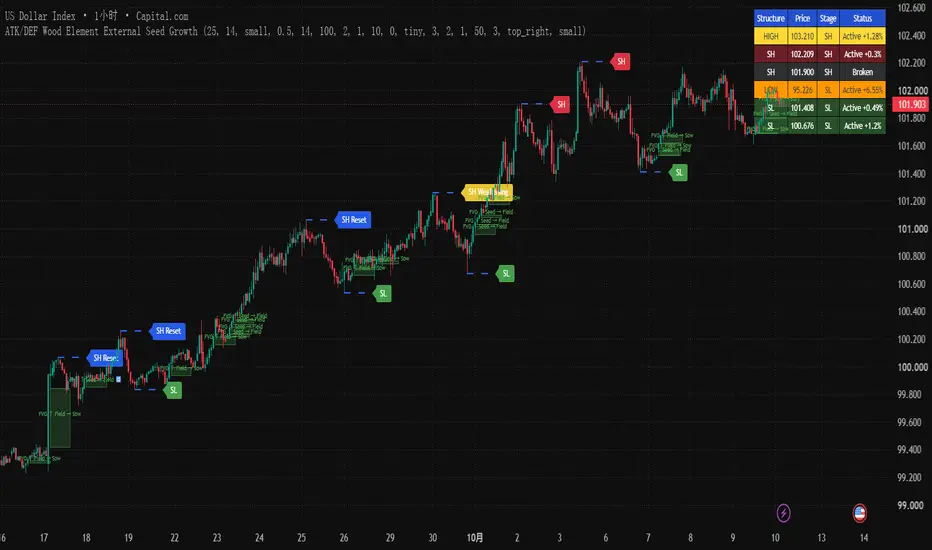
ATK/DEF The Spirit by Wood Life External Swing is a market structure observation framework that combines External Swing tracking, SH/SL lifecycle progression, structural HIGH/LOW identification, and Fair Value Gap (FVG) Seed Growth.
The framework represents external market structure through a lifecycle-based model, connecting swing formation, repeated interaction, structural weakening, transition, and renewal with a seed-growth process applied to bullish and bearish FVG zones.
Wood Life defines the underlying concept: structures are observed as evolving processes rather than isolated price levels.
Defining Conditions
External Swing
Identifies confirmed external swing highs and lows through configurable pivot lengths. Dashed reference lines and SH/SL labels represent the detected structural points. ATR-based deduplication filters nearby swing points according to the selected threshold.

SH/SL Lifecycle
Tracks the evolving conditions of each recorded swing point.
SH: SH → Exhaustion → Weakening → Degradation → Departure → Reset.
SL: SL → Growth → Boost → Evolution → Return → Reset.
State transitions are determined by price interaction, closing-price relationships, touch counts, and ATR-based reset distance.
HIGH / LOW Tracking
Identifies the highest unbroken SH and lowest unbroken SL among the retained structural points. The structure table displays reference prices, lifecycle stages, and current broken or active status.

FVG Seed Growth
Detects bullish and bearish Fair Value Gaps and associates each zone with a lifecycle sequence:
Seed → Field → Sow → Bury → Sprout → Root → Break Soil → Grow → Branch → Bloom → Fruit → Fall.
Additional states represent Wither and Rot, while qualifying conditions can return the displayed lifecycle to its initial stage.

Structure Management
Configurable settings control swing sensitivity, reference-line length, deduplication, lifecycle thresholds, FVG dimensions, confirmation counts, retained points, and table presentation.
Output Results
External SH/SL reference lines and lifecycle labels.
Dynamic HIGH/LOW identification among unbroken recorded swing points.
A structural table containing prices, lifecycle stages, and status.
Bullish and bearish FVG zones with Seed Growth stage labels.
Configurable visual distinctions for structural states and FVG regions.
Next Task / Action Framework
WATCH — Observe the formation of external swing points and new FVG zones.
WAIT — Track developing structural conditions before a lifecycle transition is registered.
TRACK — Monitor SH/SL interactions, repeated touches, lifecycle progression, and FVG development.
CONFIRM — Observe when the model's defined price and threshold conditions establish a new state.
RECHECK — Reassess active structural references, lifecycle status, and FVG zone persistence as market conditions change.
Scope
Designed for market observation and structural analysis through external swing relationships, lifecycle classification, and FVG development.
Overview
ATK/DEF The Spirit by Wood Life External Swing is a market structure observation framework that combines External Swing tracking, SH/SL lifecycle progression, structural HIGH/LOW identification, and Fair Value Gap (FVG) Seed Growth.
The framework represents external market structure through a lifecycle-based model, connecting swing formation, repeated interaction, structural weakening, transition, and renewal with a seed-growth process applied to bullish and bearish FVG zones.
Wood Life defines the underlying concept: structures are observed as evolving processes rather than isolated price levels.
Defining Conditions
External Swing
Identifies confirmed external swing highs and lows through configurable pivot lengths. Dashed reference lines and SH/SL labels represent the detected structural points. ATR-based deduplication filters nearby swing points according to the selected threshold.
SH/SL Lifecycle
Tracks the evolving conditions of each recorded swing point.
SH: SH → Exhaustion → Weakening → Degradation → Departure → Reset.
SL: SL → Growth → Boost → Evolution → Return → Reset.
State transitions are determined by price interaction, closing-price relationships, touch counts, and ATR-based reset distance.
HIGH / LOW Tracking
Identifies the highest unbroken SH and lowest unbroken SL among the retained structural points. The structure table displays reference prices, lifecycle stages, and current broken or active status.
FVG Seed Growth
Detects bullish and bearish Fair Value Gaps and associates each zone with a lifecycle sequence:
Seed → Field → Sow → Bury → Sprout → Root → Break Soil → Grow → Branch → Bloom → Fruit → Fall.
Additional states represent Wither and Rot, while qualifying conditions can return the displayed lifecycle to its initial stage.
Structure Management
Configurable settings control swing sensitivity, reference-line length, deduplication, lifecycle thresholds, FVG dimensions, confirmation counts, retained points, and table presentation.
Output Results
External SH/SL reference lines and lifecycle labels.
Dynamic HIGH/LOW identification among unbroken recorded swing points.
A structural table containing prices, lifecycle stages, and status.
Bullish and bearish FVG zones with Seed Growth stage labels.
Configurable visual distinctions for structural states and FVG regions.
Next Task / Action Framework
WATCH — Observe the formation of external swing points and new FVG zones.
WAIT — Track developing structural conditions before a lifecycle transition is registered.
TRACK — Monitor SH/SL interactions, repeated touches, lifecycle progression, and FVG development.
CONFIRM — Observe when the model's defined price and threshold conditions establish a new state.
RECHECK — Reassess active structural references, lifecycle status, and FVG zone persistence as market conditions change.
Scope
Designed for market observation and structural analysis through external swing relationships, lifecycle classification, and FVG development.

Haftungsausschluss
Die Informationen und Veröffentlichungen sind nicht als Finanz-, Anlage-, Handels- oder andere Arten von Ratschlägen oder Empfehlungen gedacht, die von TradingView bereitgestellt oder gebilligt werden, und stellen diese nicht dar. Lesen Sie mehr in den Nutzungsbedingungen.
Haftungsausschluss
Die Informationen und Veröffentlichungen sind nicht als Finanz-, Anlage-, Handels- oder andere Arten von Ratschlägen oder Empfehlungen gedacht, die von TradingView bereitgestellt oder gebilligt werden, und stellen diese nicht dar. Lesen Sie mehr in den Nutzungsbedingungen.