Aktualisiert
Omega Bias Forecaster
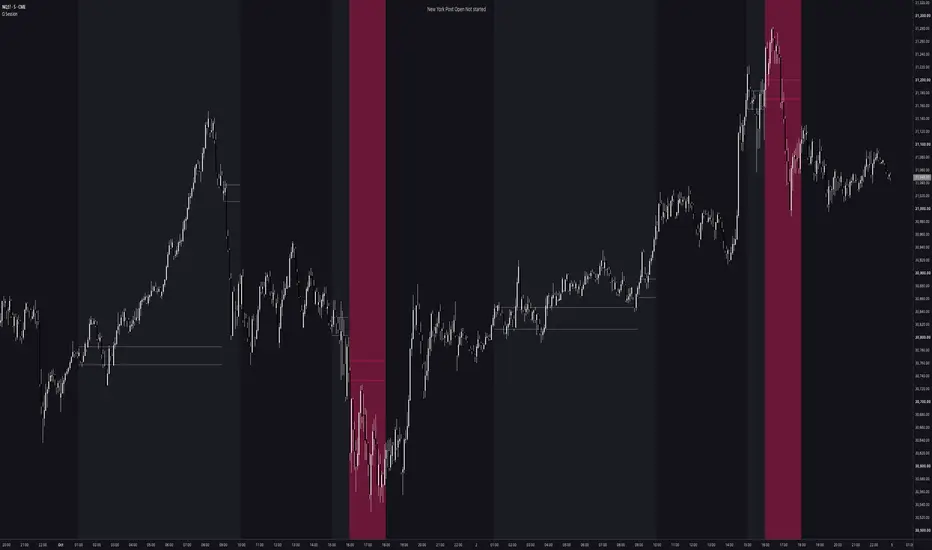
OVERVIEW
The Omega Bias Forecaster is a session-level directional prediction engine that applies a Markov-inspired state transition framework to intraday session analysis. It observes the directional outcome of up to three user-defined input sessions, encodes each into a ternary state (bullish, neutral, bearish), and queries a continuously updated frequency matrix to forecast the most probable directional outcome of a target output session — before that session begins.
The core premise is grounded in a well-documented market microstructure observation: the behavior of early sessions often conditions the behavior of later ones. Ω Session quantifies this relationship systematically, replacing discretionary session-bias reads with a data-driven probabilistic model that learns directly from the instrument's own history.
CONCEPTS
Session-Level Markov Architecture
The indicator discretizes each trading day into distinct session windows. For each input session, the system determines whether that session closed bullish (above the session open range), bearish (below it), or neutral (within it). These ternary classifications are combined into a composite state index that addresses a row in an internal frequency matrix.
The frequency matrix stores, for every observed combination of input session outcomes, how many times each directional outcome occurred in the target output session. When a new trading day begins and the input sessions complete, the system reads the row corresponding to today's observed state and retrieves the historically dominant outcome — producing a forecast for the output session that is grounded entirely in accumulated statistical evidence.
The matrix updates continuously: each time the output session completes, the observed result is recorded at the state address defined by that day's input session outcomes. Over hundreds of trading days, this builds a detailed probabilistic map of how session sequences tend to resolve.
Session Classification & Range Sensitivity
Each session's directional outcome is not a simple open-vs-close comparison. The system constructs a dynamic range envelope around the session's opening bar, calibrated by a fraction of the 200-period ATR. A session is classified as bullish only if it closes above the upper boundary of this envelope, and bearish only if it closes below the lower boundary. Outcomes that fall within the envelope are classified as neutral.
The Range Sensitivity parameter controls the width of this neutral zone. At higher values, only decisive session moves qualify as directional — producing fewer but higher-conviction state transitions. At zero, the neutral category is eliminated entirely and the system operates as a pure binary classifier (long or short), increasing signal frequency at the cost of granularity.
Single Candle Mode
Each input session can optionally operate in Single Candle mode, where instead of evaluating the full session's close relative to its open range, the system classifies only the first candle of that session. This captures the initial order flow impulse — the direction of the opening bar — which in many instruments carries predictive information about how the session will develop, particularly during high-liquidity opens.
Cross-Session State Encoding
The model supports up to three independent input sessions plus an optional daily context layer, producing a state space of up to 3⁴ = 81 unique configurations. Each configuration maps to its own row in the frequency matrix, meaning the system learns the conditional probability of the output session's direction given the specific combination of input session outcomes observed that day.
For example, the model can learn that when the Asian session was bearish, the London session was bullish, and the pre-NY session was neutral, the New York session historically closed bullish 68% of the time — and produce that forecast automatically.
FEATURES
Configurable Session Windows
All session times are fully user-defined, with timezone support spanning UTC-10 to UTC+10 plus automatic detection. This makes the indicator applicable to any global instrument — forex, futures, crypto, equities — regardless of the user's local timezone or the exchange's native hours.
Past Day Context
An optional fourth input channel incorporates the previous day's directional classification into the state vector, extending the model's memory beyond the current day's sessions. This captures overnight bias and multi-day momentum as additional conditioning information.
Dynamic Target Levels
When a directional forecast is active, the indicator computes and plots a projected target level based on the historical distribution of moves in the forecasted direction. The target is derived from a blend of the average move and a user-configurable percentile of historical moves, providing a statistically grounded profit objective rather than an arbitrary fixed distance.
Win Rate Filter
The confidence threshold filters out low-conviction forecasts. Only state configurations whose dominant outcome exceeds the specified percentage are displayed as active predictions, suppressing noise from states with ambiguous or evenly distributed historical outcomes.
Revert Mode
A single toggle inverts the forecast direction, allowing traders to test the contrarian hypothesis — whether fading the statistically dominant session outcome produces a better edge for their specific instrument.
Integrated Backtester
The indicator tracks two performance metrics in real time:
• Win Rate — the percentage of filtered forecasts where the predicted direction matched the actual output session outcome, computed from the user-defined backtest start date
• No Loss Rate — a more permissive metric that counts any outcome other than a loss in the predicted direction as a win, capturing scenarios where the forecast was neutral rather than wrong
Visual Session Mapping
Each input and output session is rendered on the chart with background highlighting and range threshold lines, providing immediate visual context for how the system is reading the current day's session structure.
HOW TO USE
Setup
1 — Define your input sessions to match the market phases you believe carry predictive power for your instrument. The defaults (17:00–01:00 and 01:00–09:00 UTC+2) correspond to the Asian and London sessions for European-timezone traders
2 — Set the output session to the trading window you want to forecast — typically the session where you plan to execute trades
3 — Adjust Range Sensitivity based on your instrument's behavior: higher values for volatile instruments where only decisive moves are meaningful, lower values for quieter markets where smaller directional edges matter
4 — Set the Win Rate Filter to at least 55% initially, then calibrate based on the number of data points available
Reading the Output
• When the output session begins, the table displays the forecasted direction along with its historical probability
• The second and third rows show the probability of the alternative outcomes, giving a complete distributional view
• Bar coloring during the output session reflects the predicted direction and its confidence
• When Target is enabled, a projected level line appears in the forecasted direction, representing the statistically expected move magnitude
Recommended Workflow
• Monitor the input sessions as they complete — the table updates in real time to show the state of each input ("was Long", "was Short", "was Neutral")
• Once all input sessions have completed and the output session begins, the forecast activates
• Use the Full InfoTable toggle to access detailed statistics including total data points, similarity count, individual session states, and backtest metrics
• Compare the forecast's win rate against its theoretical expectation to assess whether the model has captured a genuine edge on the current instrument and timeframe
LIMITATIONS
• The indicator is designed exclusively for intraday timeframes (60 minutes or lower). Applying it to daily or higher timeframes will produce an error
• The quality of the forecast depends directly on the amount of historical data available. Instruments with limited intraday history will have sparse frequency matrices and less reliable predictions
• Session definitions that overlap or leave gaps between input and output windows may produce inconsistent classifications. Ensure your session times form a coherent daily sequence
• The model assumes that inter-session conditional relationships are stationary over the learning period. Structural changes in trading hours, liquidity regimes, or market microstructure may reduce forecast accuracy until the matrix adapts
ORIGINALITY & WHY THIS IS CLOSED-SOURCE
The Omega Bias Forecaster is not a session highlighter or a static bias table. Its core innovation is the application of a Markov-inspired frequency matrix architecture to session-level directional forecasting: the methodology by which intraday session outcomes are discretized through ATR-adaptive range envelopes, combined into a multi-session composite state index, and used to address a continuously updated probabilistic transition table that outputs directional forecasts with confidence metrics and dynamic target projections. The dual-mode session classification (full session vs. single candle), the integrated no-loss backtester, and the percentile-based target computation framework are all proprietary implementations developed exclusively within OmegaTools. The source code is protected to preserve the integrity of the methodology and the commercial value of the tool for licensed users.
IMPORTANT DISCLOSURES
The statistical metrics displayed within the indicator (win rate, no loss rate, confidence percentages) are derived from historical data. Past performance is not indicative of future results. All trading involves risk. Ω Session is a decision-support tool and does not constitute financial advice. It is designed to supplement — not replace — a complete trading methodology that includes risk management, position sizing, and trade management rules.
ABOUT OMEGATOOLS
OmegaTools is a professional suite of proprietary TradingView indicators built for quantitative traders, systematic traders, and technically advanced discretionary traders. All tools are developed with rigorous statistical methodology and tested across multiple instruments and timeframes before release.
© OmegaTools. All rights reserved. Unauthorized redistribution or resale of access is strictly prohibited.
The Omega Bias Forecaster is a session-level directional prediction engine that applies a Markov-inspired state transition framework to intraday session analysis. It observes the directional outcome of up to three user-defined input sessions, encodes each into a ternary state (bullish, neutral, bearish), and queries a continuously updated frequency matrix to forecast the most probable directional outcome of a target output session — before that session begins.
The core premise is grounded in a well-documented market microstructure observation: the behavior of early sessions often conditions the behavior of later ones. Ω Session quantifies this relationship systematically, replacing discretionary session-bias reads with a data-driven probabilistic model that learns directly from the instrument's own history.
CONCEPTS
Session-Level Markov Architecture
The indicator discretizes each trading day into distinct session windows. For each input session, the system determines whether that session closed bullish (above the session open range), bearish (below it), or neutral (within it). These ternary classifications are combined into a composite state index that addresses a row in an internal frequency matrix.
The frequency matrix stores, for every observed combination of input session outcomes, how many times each directional outcome occurred in the target output session. When a new trading day begins and the input sessions complete, the system reads the row corresponding to today's observed state and retrieves the historically dominant outcome — producing a forecast for the output session that is grounded entirely in accumulated statistical evidence.
The matrix updates continuously: each time the output session completes, the observed result is recorded at the state address defined by that day's input session outcomes. Over hundreds of trading days, this builds a detailed probabilistic map of how session sequences tend to resolve.
Session Classification & Range Sensitivity
Each session's directional outcome is not a simple open-vs-close comparison. The system constructs a dynamic range envelope around the session's opening bar, calibrated by a fraction of the 200-period ATR. A session is classified as bullish only if it closes above the upper boundary of this envelope, and bearish only if it closes below the lower boundary. Outcomes that fall within the envelope are classified as neutral.
The Range Sensitivity parameter controls the width of this neutral zone. At higher values, only decisive session moves qualify as directional — producing fewer but higher-conviction state transitions. At zero, the neutral category is eliminated entirely and the system operates as a pure binary classifier (long or short), increasing signal frequency at the cost of granularity.
Single Candle Mode
Each input session can optionally operate in Single Candle mode, where instead of evaluating the full session's close relative to its open range, the system classifies only the first candle of that session. This captures the initial order flow impulse — the direction of the opening bar — which in many instruments carries predictive information about how the session will develop, particularly during high-liquidity opens.
Cross-Session State Encoding
The model supports up to three independent input sessions plus an optional daily context layer, producing a state space of up to 3⁴ = 81 unique configurations. Each configuration maps to its own row in the frequency matrix, meaning the system learns the conditional probability of the output session's direction given the specific combination of input session outcomes observed that day.
For example, the model can learn that when the Asian session was bearish, the London session was bullish, and the pre-NY session was neutral, the New York session historically closed bullish 68% of the time — and produce that forecast automatically.
FEATURES
Configurable Session Windows
All session times are fully user-defined, with timezone support spanning UTC-10 to UTC+10 plus automatic detection. This makes the indicator applicable to any global instrument — forex, futures, crypto, equities — regardless of the user's local timezone or the exchange's native hours.
Past Day Context
An optional fourth input channel incorporates the previous day's directional classification into the state vector, extending the model's memory beyond the current day's sessions. This captures overnight bias and multi-day momentum as additional conditioning information.
Dynamic Target Levels
When a directional forecast is active, the indicator computes and plots a projected target level based on the historical distribution of moves in the forecasted direction. The target is derived from a blend of the average move and a user-configurable percentile of historical moves, providing a statistically grounded profit objective rather than an arbitrary fixed distance.
Win Rate Filter
The confidence threshold filters out low-conviction forecasts. Only state configurations whose dominant outcome exceeds the specified percentage are displayed as active predictions, suppressing noise from states with ambiguous or evenly distributed historical outcomes.
Revert Mode
A single toggle inverts the forecast direction, allowing traders to test the contrarian hypothesis — whether fading the statistically dominant session outcome produces a better edge for their specific instrument.
Integrated Backtester
The indicator tracks two performance metrics in real time:
• Win Rate — the percentage of filtered forecasts where the predicted direction matched the actual output session outcome, computed from the user-defined backtest start date
• No Loss Rate — a more permissive metric that counts any outcome other than a loss in the predicted direction as a win, capturing scenarios where the forecast was neutral rather than wrong
Visual Session Mapping
Each input and output session is rendered on the chart with background highlighting and range threshold lines, providing immediate visual context for how the system is reading the current day's session structure.
HOW TO USE
Setup
1 — Define your input sessions to match the market phases you believe carry predictive power for your instrument. The defaults (17:00–01:00 and 01:00–09:00 UTC+2) correspond to the Asian and London sessions for European-timezone traders
2 — Set the output session to the trading window you want to forecast — typically the session where you plan to execute trades
3 — Adjust Range Sensitivity based on your instrument's behavior: higher values for volatile instruments where only decisive moves are meaningful, lower values for quieter markets where smaller directional edges matter
4 — Set the Win Rate Filter to at least 55% initially, then calibrate based on the number of data points available
Reading the Output
• When the output session begins, the table displays the forecasted direction along with its historical probability
• The second and third rows show the probability of the alternative outcomes, giving a complete distributional view
• Bar coloring during the output session reflects the predicted direction and its confidence
• When Target is enabled, a projected level line appears in the forecasted direction, representing the statistically expected move magnitude
Recommended Workflow
• Monitor the input sessions as they complete — the table updates in real time to show the state of each input ("was Long", "was Short", "was Neutral")
• Once all input sessions have completed and the output session begins, the forecast activates
• Use the Full InfoTable toggle to access detailed statistics including total data points, similarity count, individual session states, and backtest metrics
• Compare the forecast's win rate against its theoretical expectation to assess whether the model has captured a genuine edge on the current instrument and timeframe
LIMITATIONS
• The indicator is designed exclusively for intraday timeframes (60 minutes or lower). Applying it to daily or higher timeframes will produce an error
• The quality of the forecast depends directly on the amount of historical data available. Instruments with limited intraday history will have sparse frequency matrices and less reliable predictions
• Session definitions that overlap or leave gaps between input and output windows may produce inconsistent classifications. Ensure your session times form a coherent daily sequence
• The model assumes that inter-session conditional relationships are stationary over the learning period. Structural changes in trading hours, liquidity regimes, or market microstructure may reduce forecast accuracy until the matrix adapts
ORIGINALITY & WHY THIS IS CLOSED-SOURCE
The Omega Bias Forecaster is not a session highlighter or a static bias table. Its core innovation is the application of a Markov-inspired frequency matrix architecture to session-level directional forecasting: the methodology by which intraday session outcomes are discretized through ATR-adaptive range envelopes, combined into a multi-session composite state index, and used to address a continuously updated probabilistic transition table that outputs directional forecasts with confidence metrics and dynamic target projections. The dual-mode session classification (full session vs. single candle), the integrated no-loss backtester, and the percentile-based target computation framework are all proprietary implementations developed exclusively within OmegaTools. The source code is protected to preserve the integrity of the methodology and the commercial value of the tool for licensed users.
IMPORTANT DISCLOSURES
The statistical metrics displayed within the indicator (win rate, no loss rate, confidence percentages) are derived from historical data. Past performance is not indicative of future results. All trading involves risk. Ω Session is a decision-support tool and does not constitute financial advice. It is designed to supplement — not replace — a complete trading methodology that includes risk management, position sizing, and trade management rules.
ABOUT OMEGATOOLS
OmegaTools is a professional suite of proprietary TradingView indicators built for quantitative traders, systematic traders, and technically advanced discretionary traders. All tools are developed with rigorous statistical methodology and tested across multiple instruments and timeframes before release.
© OmegaTools. All rights reserved. Unauthorized redistribution or resale of access is strictly prohibited.
Versionshinweise
V2: now new inputs are supportedVerfügbar im Paid Space
Dieser Indikator ist nur für Quant Suite-Abonnenten verfügbar. Jetzt beitreten und Zugang zu diesem und weiteren Scripts von OmegaTools erhalten.

Haftungsausschluss
Die Informationen und Veröffentlichungen sind nicht als Finanz-, Anlage-, Handels- oder andere Arten von Ratschlägen oder Empfehlungen gedacht, die von TradingView bereitgestellt oder gebilligt werden, und stellen diese nicht dar. Lesen Sie mehr in den Nutzungsbedingungen.
Verfügbar im Paid Space
Dieser Indikator ist nur für Quant Suite-Abonnenten verfügbar. Jetzt beitreten und Zugang zu diesem und weiteren Scripts von OmegaTools erhalten.
Haftungsausschluss
Die Informationen und Veröffentlichungen sind nicht als Finanz-, Anlage-, Handels- oder andere Arten von Ratschlägen oder Empfehlungen gedacht, die von TradingView bereitgestellt oder gebilligt werden, und stellen diese nicht dar. Lesen Sie mehr in den Nutzungsbedingungen.