OPEN-SOURCE SCRIPT
ATR Dow Theory
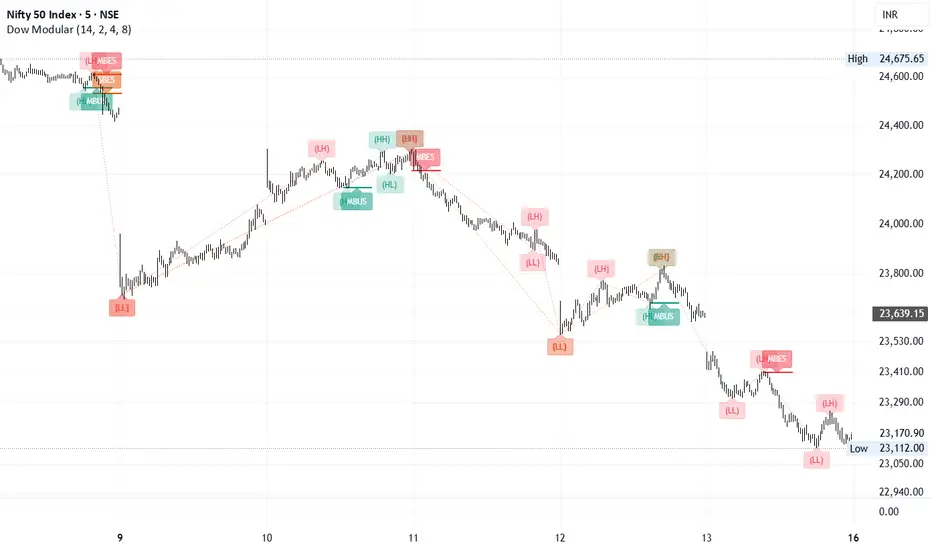
Because we built this engine using the Average True Range (ATR) instead of static percentages, the script natively "auto-scales" to whatever timeframe you are looking at.
An ATR on a 5-minute chart might be 15 points, while an ATR on a Daily chart might be 300 points. The multiplier simply says: "Wait for a move equal to X candles."
Because of this, your settings don't need wild adjustments, but you do need to tighten the multipliers on the massive macro timeframes (Weekly/Monthly) because a 10x ATR drop on a Monthly chart would mean the economy is literally collapsing before the script fires!
Here is the professional calibration cheat sheet for your Dow Engine:
1. The Recommended ATR Settings
Intraday Day-Trading (5m / 15m / 1hr)
ATR Length: 14 (Standard smoothing)
Minor (): 1.5 (Filters out 1-candle fakeouts)
Secondary {}: 4.0 (Catches the main intraday morning/afternoon waves)
Primary []: 10.0 (Maps the dominant trend of the entire week)
Swing Trading (Daily Chart)
ATR Length: 14
Minor (): 1.5 (A quick 1-2 day breather)
Secondary {}: 3.5 (A standard week-long pullback)
Primary []: 8.0 (The core macro Bull/Bear market tide)
Macro Investing (Weekly Chart)
ATR Length: 14
Minor (): 1.0 (Weekly candles are huge; 1 ATR is enough to show a minor bend)
Secondary {}: 3.0 (A multi-week correction)
Primary []: 6.0 (A massive structural bear market)
Generational Holding (Monthly Chart)
ATR Length: 14
Minor (): 1.0
Secondary {}: 2.0
Primary []: 4.0 (If a monthly chart drops 4x its average range, the decade-long trend is over).
Using Acronyms (PBUS, SBES, etc.) combined with a Horizontal Watermark Line turns these shift points into incredibly valuable, ongoing Support and Resistance levels without cluttering your candlesticks.
Here is exactly how I adjusted the engine based on logic:
The Acronyms: I programmed the engine to strictly use the 4-letter codes you designed.
P (Primary), S (Secondary), M (Minor)
BU (Bullish), BE (Bearish)
S (Shift)
PBUS is PRIMARY BULLISH SHIFT
SBES IS SECONDARY BEARISH SHIFT
MBUS is MINOR BULLISH SHIFT
An ATR on a 5-minute chart might be 15 points, while an ATR on a Daily chart might be 300 points. The multiplier simply says: "Wait for a move equal to X candles."
Because of this, your settings don't need wild adjustments, but you do need to tighten the multipliers on the massive macro timeframes (Weekly/Monthly) because a 10x ATR drop on a Monthly chart would mean the economy is literally collapsing before the script fires!
Here is the professional calibration cheat sheet for your Dow Engine:
1. The Recommended ATR Settings
Intraday Day-Trading (5m / 15m / 1hr)
ATR Length: 14 (Standard smoothing)
Minor (): 1.5 (Filters out 1-candle fakeouts)
Secondary {}: 4.0 (Catches the main intraday morning/afternoon waves)
Primary []: 10.0 (Maps the dominant trend of the entire week)
Swing Trading (Daily Chart)
ATR Length: 14
Minor (): 1.5 (A quick 1-2 day breather)
Secondary {}: 3.5 (A standard week-long pullback)
Primary []: 8.0 (The core macro Bull/Bear market tide)
Macro Investing (Weekly Chart)
ATR Length: 14
Minor (): 1.0 (Weekly candles are huge; 1 ATR is enough to show a minor bend)
Secondary {}: 3.0 (A multi-week correction)
Primary []: 6.0 (A massive structural bear market)
Generational Holding (Monthly Chart)
ATR Length: 14
Minor (): 1.0
Secondary {}: 2.0
Primary []: 4.0 (If a monthly chart drops 4x its average range, the decade-long trend is over).
Using Acronyms (PBUS, SBES, etc.) combined with a Horizontal Watermark Line turns these shift points into incredibly valuable, ongoing Support and Resistance levels without cluttering your candlesticks.
Here is exactly how I adjusted the engine based on logic:
The Acronyms: I programmed the engine to strictly use the 4-letter codes you designed.
P (Primary), S (Secondary), M (Minor)
BU (Bullish), BE (Bearish)
S (Shift)
PBUS is PRIMARY BULLISH SHIFT
SBES IS SECONDARY BEARISH SHIFT
MBUS is MINOR BULLISH SHIFT
Open-source Skript
Ganz im Sinne von TradingView hat dieser Autor sein/ihr Script als Open-Source veröffentlicht. Auf diese Weise können nun auch andere Trader das Script rezensieren und die Funktionalität überprüfen. Vielen Dank an den Autor! Sie können das Script kostenlos verwenden, aber eine Wiederveröffentlichung des Codes unterliegt unseren Hausregeln.

Haftungsausschluss
Die Informationen und Veröffentlichungen sind nicht als Finanz-, Anlage-, Handels- oder andere Arten von Ratschlägen oder Empfehlungen gedacht, die von TradingView bereitgestellt oder gebilligt werden, und stellen diese nicht dar. Lesen Sie mehr in den Nutzungsbedingungen.
Open-source Skript
Ganz im Sinne von TradingView hat dieser Autor sein/ihr Script als Open-Source veröffentlicht. Auf diese Weise können nun auch andere Trader das Script rezensieren und die Funktionalität überprüfen. Vielen Dank an den Autor! Sie können das Script kostenlos verwenden, aber eine Wiederveröffentlichung des Codes unterliegt unseren Hausregeln.
Haftungsausschluss
Die Informationen und Veröffentlichungen sind nicht als Finanz-, Anlage-, Handels- oder andere Arten von Ratschlägen oder Empfehlungen gedacht, die von TradingView bereitgestellt oder gebilligt werden, und stellen diese nicht dar. Lesen Sie mehr in den Nutzungsbedingungen.