Ehlers Decycler (DECYCLER)
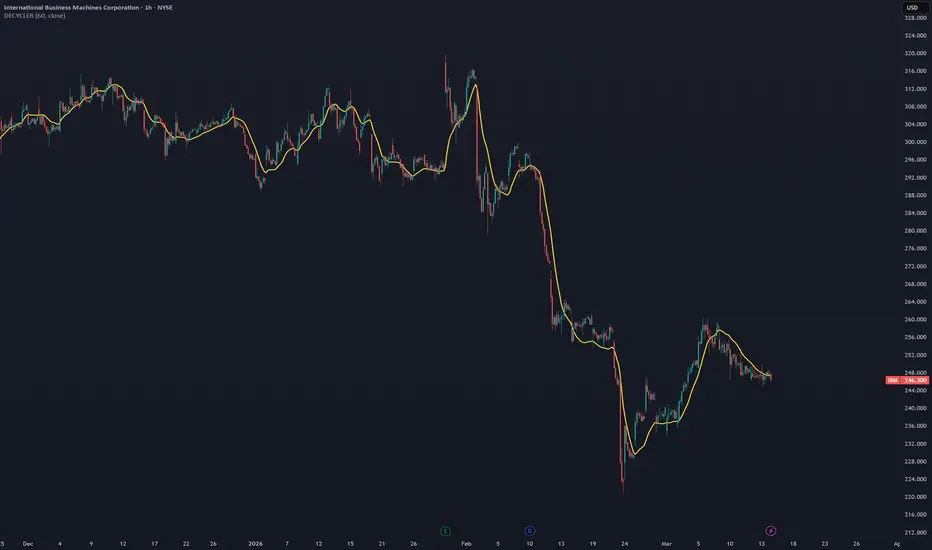
The Ehlers Decycler extracts the trend component from a price series by subtracting a 2-pole Butterworth high-pass filter from the source. Cycles shorter than the cutoff period are removed; everything longer passes through with near-zero phase lag. The result is a trend overlay that tracks price more closely than a comparable EMA during trends, with no smoothing window, no lag-versus-smoothness tradeoff, and exactly one parameter.
HISTORICAL CONTEXT
John Ehlers introduced the Decycler in "Decyclers" (Technical Analysis of Stocks & Commodities, September 2015), alongside its oscillator companion DECO. The underlying 2-pole Butterworth high-pass filter had appeared in Ehlers' earlier work (Cybernetic Analysis for Stocks and Futures, 2004), primarily for cycle measurement. The Decycler simply inverts the question: instead of isolating cycles, subtract them. What remains is trend.
The approach sidesteps the fundamental tension in trend-following design. Moving averages introduce lag proportional to their smoothing window. Adaptive averages reduce lag but add parameters and complexity. The Decycler reframes the problem as a frequency-domain operation: define a cutoff period, remove everything above it, keep everything below. The phase response of the complementary filter preserves the phase of passed frequencies — trend components below the cutoff experience near-zero lag by construction, not by approximation.
HOW IT WORKS
Stage 1 — 2-pole Butterworth high-pass filter
A single coefficient α is derived from the cutoff period P using the Butterworth −3 dB design point (the 0.707 = 1/√2 factor places the half-power point at exactly period P):
ω = 0.707 × 2π / P
α = (cos(ω) + sin(ω) − 1) / cos(ω)
Three recurrence coefficients are computed once at construction from α:
a₁ = (1 − α/2)² ← input gain
b₁ = 2(1 − α) ← first feedback
c₁ = −(1 − α)² ← second feedback
The HP recurrence runs each bar:
HP[t] = a₁ × (x[t] − 2x[t−1] + x[t−2]) + b₁ × HP[t−1] + c₁ × HP[t−2]
The second-difference term (x[t] − 2x[t−1] + x[t−2]) is a discrete second derivative — it rejects DC and linear trends while passing oscillatory content, which the HP feedback then sharpens into a proper bandpass edge.
Stage 2 — Complementary subtraction
The Decycler is one line:
Decycler[t] = x[t] − HP[t]
This guarantees that Decycler + HP = price at every bar. No signal energy is created or destroyed. The trend and cycle components sum exactly to the original series.
Frequency response
- Periods longer than the cutoff: unity gain, near-zero phase shift.
- Periods shorter than the cutoff: attenuated at −12 dB/octave (2-pole rolloff).
- At exactly period P: −3 dB (≈29% amplitude reduction).
INPUTS & PARAMETERS
- Source — Input series. Default: close.
- Period — Cutoff period in bars. Cycles shorter than this are removed. Default: 60.
Period selection
- 20–30: Responsive trend line, tracks swings. Short-term trading on daily bars.
- 40–80: Balanced separation. Default of 60 works well for daily timeframes.
- 100–200: Heavy smoothing, reveals major trend direction only. Position trading and regime detection.
Ensure the dataset has at least 2 × period bars for meaningful trend extraction. On a 100-bar chart, a period of 200 removes almost nothing — the cutoff falls below the Nyquist limit of the data.
HOW TO USE
Trend direction
- Price above Decycler → bullish. Price below → bearish.
- Slope of Decycler indicates trend momentum. Flattening slope → potential exhaustion or transition.
Trend vs. cycle regime
- Decycler hugging price closely → trending: the dominant cycle is shorter than the cutoff and is being removed, leaving clean trend.
- Decycler oscillating with small amplitude → ranging: price is spending time in both directions relative to the trend line.
Multi-period overlay
- Two Decycler instances at different periods (e.g., 30 and 120) reveal short-term and long-term trend simultaneously. Their relationship is interpretable in frequency terms — the gap between them is a specific cycle band.
Cycle complement
- The HP component (price − Decycler) isolates the cycle content. Plot it separately as a zero-mean oscillator to see what the Decycler is removing. If the cycle is large relative to trend, reduce position size.
This is not a moving average
- The Decycler does not compute a weighted sum of past prices. During strong trends it tracks price more closely than a same-period EMA. During ranging conditions it can exhibit small oscillations that a moving average would suppress. Factor this into signal logic.
LIMITATIONS
- Period too short: A cutoff of 10 on daily bars removes only cycles shorter than 10 days — nearly everything passes through and the Decycler approximates raw price. Meaningful separation requires the cutoff period to exceed the dominant cycle in the data.
- Not DECO: The Decycler is a lowpass trend overlay (price − HP). The Decycler Oscillator (DECO) is HP_long − HP_short — a bandpass oscillator that crosses zero. They share the same filter core but produce fundamentally different outputs. Using one where the other is needed produces incorrect results silently.
- Warmup: The HP recurrence requires two prior source values and two prior HP values. For the first two bars, HP = 0 and Decycler = raw price. IsHot = true after period bars; signals before that point are unreliable.
- IIR drift: Feedback terms accumulate floating-point error over very long series (> 10,000 bars). For typical trading horizons (< 5,000 bars), drift stays below 1e−10 and is inconsequential.
- No external validation baseline: TA-Lib, Skender, Tulip, and OoplesFinance do not implement the Ehlers Decycler. Validation is against the Pine reference implementation and internal streaming/batch/span consistency.
REFERENCES
- Ehlers, J. F. (2015). "Decyclers." Technical Analysis of Stocks & Commodities, September 2015.
HISTORICAL CONTEXT
John Ehlers introduced the Decycler in "Decyclers" (Technical Analysis of Stocks & Commodities, September 2015), alongside its oscillator companion DECO. The underlying 2-pole Butterworth high-pass filter had appeared in Ehlers' earlier work (Cybernetic Analysis for Stocks and Futures, 2004), primarily for cycle measurement. The Decycler simply inverts the question: instead of isolating cycles, subtract them. What remains is trend.
The approach sidesteps the fundamental tension in trend-following design. Moving averages introduce lag proportional to their smoothing window. Adaptive averages reduce lag but add parameters and complexity. The Decycler reframes the problem as a frequency-domain operation: define a cutoff period, remove everything above it, keep everything below. The phase response of the complementary filter preserves the phase of passed frequencies — trend components below the cutoff experience near-zero lag by construction, not by approximation.
HOW IT WORKS
Stage 1 — 2-pole Butterworth high-pass filter
A single coefficient α is derived from the cutoff period P using the Butterworth −3 dB design point (the 0.707 = 1/√2 factor places the half-power point at exactly period P):
ω = 0.707 × 2π / P
α = (cos(ω) + sin(ω) − 1) / cos(ω)
Three recurrence coefficients are computed once at construction from α:
a₁ = (1 − α/2)² ← input gain
b₁ = 2(1 − α) ← first feedback
c₁ = −(1 − α)² ← second feedback
The HP recurrence runs each bar:
HP[t] = a₁ × (x[t] − 2x[t−1] + x[t−2]) + b₁ × HP[t−1] + c₁ × HP[t−2]
The second-difference term (x[t] − 2x[t−1] + x[t−2]) is a discrete second derivative — it rejects DC and linear trends while passing oscillatory content, which the HP feedback then sharpens into a proper bandpass edge.
Stage 2 — Complementary subtraction
The Decycler is one line:
Decycler[t] = x[t] − HP[t]
This guarantees that Decycler + HP = price at every bar. No signal energy is created or destroyed. The trend and cycle components sum exactly to the original series.
Frequency response
- Periods longer than the cutoff: unity gain, near-zero phase shift.
- Periods shorter than the cutoff: attenuated at −12 dB/octave (2-pole rolloff).
- At exactly period P: −3 dB (≈29% amplitude reduction).
INPUTS & PARAMETERS
- Source — Input series. Default: close.
- Period — Cutoff period in bars. Cycles shorter than this are removed. Default: 60.
Period selection
- 20–30: Responsive trend line, tracks swings. Short-term trading on daily bars.
- 40–80: Balanced separation. Default of 60 works well for daily timeframes.
- 100–200: Heavy smoothing, reveals major trend direction only. Position trading and regime detection.
Ensure the dataset has at least 2 × period bars for meaningful trend extraction. On a 100-bar chart, a period of 200 removes almost nothing — the cutoff falls below the Nyquist limit of the data.
HOW TO USE
Trend direction
- Price above Decycler → bullish. Price below → bearish.
- Slope of Decycler indicates trend momentum. Flattening slope → potential exhaustion or transition.
Trend vs. cycle regime
- Decycler hugging price closely → trending: the dominant cycle is shorter than the cutoff and is being removed, leaving clean trend.
- Decycler oscillating with small amplitude → ranging: price is spending time in both directions relative to the trend line.
Multi-period overlay
- Two Decycler instances at different periods (e.g., 30 and 120) reveal short-term and long-term trend simultaneously. Their relationship is interpretable in frequency terms — the gap between them is a specific cycle band.
Cycle complement
- The HP component (price − Decycler) isolates the cycle content. Plot it separately as a zero-mean oscillator to see what the Decycler is removing. If the cycle is large relative to trend, reduce position size.
This is not a moving average
- The Decycler does not compute a weighted sum of past prices. During strong trends it tracks price more closely than a same-period EMA. During ranging conditions it can exhibit small oscillations that a moving average would suppress. Factor this into signal logic.
LIMITATIONS
- Period too short: A cutoff of 10 on daily bars removes only cycles shorter than 10 days — nearly everything passes through and the Decycler approximates raw price. Meaningful separation requires the cutoff period to exceed the dominant cycle in the data.
- Not DECO: The Decycler is a lowpass trend overlay (price − HP). The Decycler Oscillator (DECO) is HP_long − HP_short — a bandpass oscillator that crosses zero. They share the same filter core but produce fundamentally different outputs. Using one where the other is needed produces incorrect results silently.
- Warmup: The HP recurrence requires two prior source values and two prior HP values. For the first two bars, HP = 0 and Decycler = raw price. IsHot = true after period bars; signals before that point are unreliable.
- IIR drift: Feedback terms accumulate floating-point error over very long series (> 10,000 bars). For typical trading horizons (< 5,000 bars), drift stays below 1e−10 and is inconsequential.
- No external validation baseline: TA-Lib, Skender, Tulip, and OoplesFinance do not implement the Ehlers Decycler. Validation is against the Pine reference implementation and internal streaming/batch/span consistency.
REFERENCES
- Ehlers, J. F. (2015). "Decyclers." Technical Analysis of Stocks & Commodities, September 2015.

Rigorous technical indicators for Pine Script 6 with O(1) streaming, defensible math, and proper initialization. Fully documented, implemented in C#, transcribed to Pine Script, and wrapped for Python.
Haftungsausschluss
Die Informationen und Veröffentlichungen sind nicht als Finanz-, Anlage-, Handels- oder andere Arten von Ratschlägen oder Empfehlungen gedacht, die von TradingView bereitgestellt oder gebilligt werden, und stellen diese nicht dar. Lesen Sie mehr in den Nutzungsbedingungen.
Rigorous technical indicators for Pine Script 6 with O(1) streaming, defensible math, and proper initialization. Fully documented, implemented in C#, transcribed to Pine Script, and wrapped for Python.
Haftungsausschluss
Die Informationen und Veröffentlichungen sind nicht als Finanz-, Anlage-, Handels- oder andere Arten von Ratschlägen oder Empfehlungen gedacht, die von TradingView bereitgestellt oder gebilligt werden, und stellen diese nicht dar. Lesen Sie mehr in den Nutzungsbedingungen.