Aktualisiert
UT Bot Pro - Advanced Trailing Stop Framework
Get this and other exclusive indicators in UT Bot Suite
This strategy is part of QuantNomad's Paid Space. Subscribe for $9.99/month to use it on your charts along with the author's other exclusive indicators. You pay right on TradingView and get access straight away.
Explore UT Bot SuiteUT Bot Pro is an advanced version of the original UT Bot, built for traders who want more control over how the underlying trailing-stop methodology behaves.
The original UT Bot is intentionally simple: price is evaluated against an ATR-based trailing stop to identify changes in trend. UT Bot Pro keeps that core philosophy, but expands the framework with alternative volatility models, adaptive stop behavior, configurable entry methods, higher-timeframe confirmation, and multiple exit approaches.
The goal is not to produce more signals or claim better performance. It is to make the UT Bot methodology more configurable and researchable, allowing traders to test how different assumptions affect its behavior across markets and timeframes.
Stop Engine
The trailing stop is the foundation of UT Bot. Instead of limiting the calculation to standard ATR, UT Bot Pro provides several ways to measure volatility:
The selected volatility measure is combined with the Stop Multiplier to determine the trailing-stop distance.
Adaptive Multiplier
The Stop Multiplier can optionally adapt to market conditions using an Efficiency Ratio.
The Efficiency Ratio compares directional price movement with the total movement traveled over the selected period. More directional movement produces a higher efficiency reading, while noisier or more back-and-forth movement produces a lower reading.
When adaptive mode is enabled, UT Bot Pro adjusts the multiplier between configurable minimum and maximum values rather than using one fixed multiplier throughout the entire chart.
This does not attempt to predict future volatility or direction. It simply changes how the trailing stop responds to the observed structure of recent price movement.
Entry Engine
UT Bot Pro separates the underlying UT trend state from the method used to trigger an entry.
These modes are not intended to represent a hierarchy from “worse” to “better.” They represent different trade-offs between responsiveness and confirmation.
Higher-Timeframe Confirmation
An optional HTF filter calculates the UT Bot state independently on a selected higher timeframe.
When enabled, long entries require bullish higher-timeframe confirmation and short entries require bearish higher-timeframe confirmation.
Because the UT calculation is performed directly in the higher-timeframe context, the HTF state uses the same selected stop methodology rather than simply resampling the lower-timeframe signal.
Optional chart background shading makes the current HTF regime visible without adding another indicator pane.
Exit Engine
Entry and exit behavior can be researched independently.
This makes it possible to compare, for example, a classic UT reversal strategy with an approach that exits immediately at the trailing stop or combines the stop with a fixed reward objective.
Strategy & Backtesting
UT Bot Pro includes integrated TradingView strategy functionality so different configurations can be evaluated using historical data.
A configurable backtesting date range allows testing over specific market periods rather than relying only on the entire available chart history.
Backtests should be treated as research tools, not predictions of future performance. Results can vary significantly with symbol, timeframe, market regime, execution assumptions, fees, slippage, and parameter selection.
Display & Dashboard
The visual layer can be customized independently from the strategy logic.
Buy/sell markers, trend-based bar coloring, the trailing-stop line, HTF background, and the status dashboard can each be enabled or disabled.
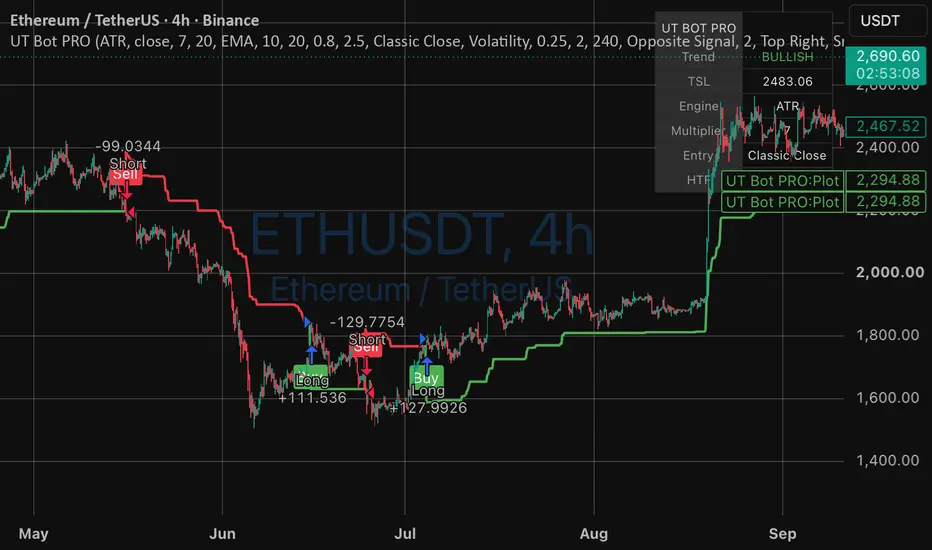
The dashboard provides a compact view of the current UT state and active configuration, including the current trend, trailing-stop value, stop engine, multiplier, entry mode, and higher-timeframe state.
Philosophy
UT Bot Pro is designed around one principle: extend the original UT Bot methodology without turning it into a collection of unrelated indicators.
There are no additional RSI, MACD, or similar confirmation systems hidden behind the signals. The additional controls are centered around the same underlying concepts: volatility, trailing stops, confirmation, timeframe alignment, and trade management.
More parameters do not automatically produce better results. Increasing confirmation can reduce some signals while introducing additional delay. Wider stops can remain in trends longer while increasing risk distance. Faster settings can respond sooner while becoming more sensitive to market noise.
UT Bot Pro is therefore intended primarily as a configurable trend-following and research framework for traders who understand these trade-offs and want greater control over the behavior of the original UT Bot.
Disclaimer: UT Bot Pro does not predict future prices and should not be considered a standalone trading system or guarantee of profitability. Historical performance does not guarantee future results.
The original UT Bot is intentionally simple: price is evaluated against an ATR-based trailing stop to identify changes in trend. UT Bot Pro keeps that core philosophy, but expands the framework with alternative volatility models, adaptive stop behavior, configurable entry methods, higher-timeframe confirmation, and multiple exit approaches.
The goal is not to produce more signals or claim better performance. It is to make the UT Bot methodology more configurable and researchable, allowing traders to test how different assumptions affect its behavior across markets and timeframes.
Stop Engine
The trailing stop is the foundation of UT Bot. Instead of limiting the calculation to standard ATR, UT Bot Pro provides several ways to measure volatility:
- ATR — The classic UT Bot approach using Average True Range.
- Smoothed ATR — Applies additional smoothing to ATR for a less reactive volatility estimate. Smoothing parameters can be adjusted.
- Standard Deviation — Uses the statistical dispersion of price as the volatility measure instead of true range.
- Historical Volatility — Uses the standard deviation of logarithmic returns and converts it into a price-based volatility measure.
The selected volatility measure is combined with the Stop Multiplier to determine the trailing-stop distance.
Adaptive Multiplier
The Stop Multiplier can optionally adapt to market conditions using an Efficiency Ratio.
The Efficiency Ratio compares directional price movement with the total movement traveled over the selected period. More directional movement produces a higher efficiency reading, while noisier or more back-and-forth movement produces a lower reading.
When adaptive mode is enabled, UT Bot Pro adjusts the multiplier between configurable minimum and maximum values rather than using one fixed multiplier throughout the entire chart.
This does not attempt to predict future volatility or direction. It simply changes how the trailing stop responds to the observed structure of recent price movement.
Entry Engine
UT Bot Pro separates the underlying UT trend state from the method used to trigger an entry.
- Classic Close — Preserves the traditional UT Bot approach, confirming the signal when price closes across the trailing-stop threshold.
- Close + Buffer — Requires price to move an additional configurable distance beyond the UT threshold before confirming an entry. This can be used to reduce sensitivity to marginal crosses around the trailing stop.
- X-Bar Confirmation — Requires the new state to remain valid for a specified number of bars before confirming the entry.
- Touch / Stop Order — Uses the trailing-stop level as an order trigger rather than waiting for the standard close confirmation.
These modes are not intended to represent a hierarchy from “worse” to “better.” They represent different trade-offs between responsiveness and confirmation.
Higher-Timeframe Confirmation
An optional HTF filter calculates the UT Bot state independently on a selected higher timeframe.
When enabled, long entries require bullish higher-timeframe confirmation and short entries require bearish higher-timeframe confirmation.
Because the UT calculation is performed directly in the higher-timeframe context, the HTF state uses the same selected stop methodology rather than simply resampling the lower-timeframe signal.
Optional chart background shading makes the current HTF regime visible without adding another indicator pane.
Exit Engine
Entry and exit behavior can be researched independently.
- Opposite Signal — Holds the position until an opposing UT signal occurs.
- TSL Stop — Uses the active UT trailing-stop level as the position stop.
- TSL Stop + R:R Target — Combines the trailing stop with a predefined risk/reward profit target based on the initial trade risk.
This makes it possible to compare, for example, a classic UT reversal strategy with an approach that exits immediately at the trailing stop or combines the stop with a fixed reward objective.
Strategy & Backtesting
UT Bot Pro includes integrated TradingView strategy functionality so different configurations can be evaluated using historical data.
A configurable backtesting date range allows testing over specific market periods rather than relying only on the entire available chart history.
Backtests should be treated as research tools, not predictions of future performance. Results can vary significantly with symbol, timeframe, market regime, execution assumptions, fees, slippage, and parameter selection.
Display & Dashboard
The visual layer can be customized independently from the strategy logic.
Buy/sell markers, trend-based bar coloring, the trailing-stop line, HTF background, and the status dashboard can each be enabled or disabled.
The dashboard provides a compact view of the current UT state and active configuration, including the current trend, trailing-stop value, stop engine, multiplier, entry mode, and higher-timeframe state.
Philosophy
UT Bot Pro is designed around one principle: extend the original UT Bot methodology without turning it into a collection of unrelated indicators.
There are no additional RSI, MACD, or similar confirmation systems hidden behind the signals. The additional controls are centered around the same underlying concepts: volatility, trailing stops, confirmation, timeframe alignment, and trade management.
More parameters do not automatically produce better results. Increasing confirmation can reduce some signals while introducing additional delay. Wider stops can remain in trends longer while increasing risk distance. Faster settings can respond sooner while becoming more sensitive to market noise.
UT Bot Pro is therefore intended primarily as a configurable trend-following and research framework for traders who understand these trade-offs and want greater control over the behavior of the original UT Bot.
Disclaimer: UT Bot Pro does not predict future prices and should not be considered a standalone trading system or guarantee of profitability. Historical performance does not guarantee future results.
Versionshinweise
Updating default commision and quantity size
Quant Developer | Pine Script v6 | Python & R
12+ yrs in systematic trading, derivatives & hedge funds
🚀 Pro Indicators & Tools:
qntly.com/pro
💼 Quant Advisory & Development:
qntly.com/hire
12+ yrs in systematic trading, derivatives & hedge funds
🚀 Pro Indicators & Tools:
qntly.com/pro
💼 Quant Advisory & Development:
qntly.com/hire
Haftungsausschluss
Die Informationen und Veröffentlichungen sind nicht als Finanz-, Anlage-, Handels- oder andere Arten von Ratschlägen oder Empfehlungen gedacht, die von TradingView bereitgestellt oder gebilligt werden, und stellen diese nicht dar. Lesen Sie mehr in den Nutzungsbedingungen.