
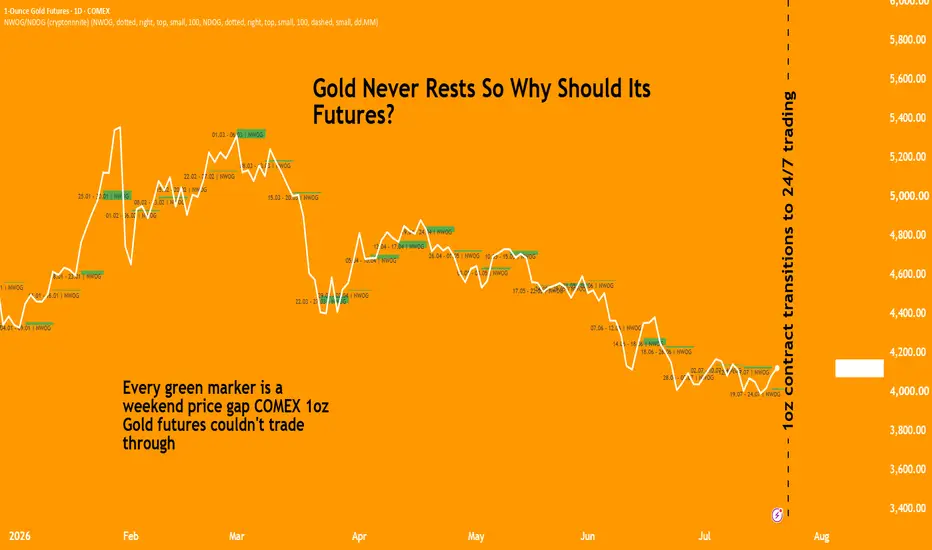
Although COMEX gold futures trade almost continuously during the week, they halt every Friday afternoon and do not reopen until Sunday evening. Yet events that move gold markets can and do occur over the weekend.
While Gold priced through crypto tokenized gold and CFD style products can continue trading during that closure, the most active gold trading venue – CME futures – remains closed.
COMEX has listed gold futures since December 1974, and this weekend break has existed throughout that period. Continuous gold feeds are a much more recent development, creating a structural mismatch between prices that continue to move and regulated derivatives that remain closed.
Any repricing during that window appears as a gap when futures resume trading, leaving no regulated and liquid trading venue between Friday's close and Sunday's reopen.

Against this backdrop, CME is enabling 24/7 trading for its 1oz gold futures, scheduled to launch on 24 July 2026, reducing the roughly two-day blind spot to a brief maintenance window.
What the Data Reveals About Gold Weekend Gaps

To measure the impact of the weekend futures market closure, we analysed 44 weekends between October 2025 and July 2026, comparing the Friday close with the Sunday reopen and tracking whether each gap was filled during the following trading week.
Most gaps were modest, remaining within roughly 0.5% in either direction. The clear outlier was late January 2026, when gold reopened 2.91% lower, the largest gap in the sample. That move followed news of Kevin Warsh's appointment as the next Federal Reserve Chair.
It also shows why weekend price action has become more common. Market-moving policy announcements increasingly land over the weekend. Recent examples span monetary policy, trade measures and geopolitical developments, leaving investors exposed to moves they cannot hedge.
Of the 44 gaps, 42 (95.5%) were filled during the following trading week, leaving only two open.

The 17 April 2026 gap, at 1.03%, has remained open for more than three months, despite closing within 0.02% of filling in late April. The 10 July gap, more recent and larger at 1.08%, has stayed further from filling, closing 0.87% short at its nearest approach.

The Gap Understates Weekend Risk

The Friday-close-to-Sunday-reopen gap captures only two price snapshots and says nothing about gold's path in between.
Comparing it with the full weekend high-low range shows how much risk the headline gap can miss. In late January 2026, the 2.91% gap sat against a 4.84% weekend range. In late February, a 1.96% gap compared with a 4.18% range, more than twice as large.
Across the sample, the weekend range exceeded the two-point gap in 43 of 44 weeks, including ordinary low-volatility periods. The understatement was therefore structural rather than driven by a few large moves. This represents potential market moves that gold traders never had access to before.
Why This Matters
The same pattern exposes the weakness of relying on proxies such as XAUTUSD. Thin, catch-up-prone trading may show where gold has moved, but not at the depth required for genuine price discovery.
CME's 24/7 1oz gold futures replace that blind spot with regulated weekend volume, reducing the roughly two-day closure to a brief maintenance window.
Continuous trading won't make weekend risk disappear, but it does bring that risk into view earlier, when traders can still act on it.
The 17 April gap, still open after more than three months, illustrates the distinction. A move that persists for that long behaves more like a lasting shift in market direction than a temporary blip.
Granular Weekend Hedging using Micro Contracts
The weekend of 30 January 2026 provides a useful example of what continuous access would have meant in practice.

Consider a trader who held a long position in CME 1oz gold futures as of 30/Jan. Under the old framework, the position could not be modified between Friday's COMEX close and the Sunday reopen. The 2.8% decline would therefore have produced a mark-to-market loss of USD 137 before the trader could respond.

The same weekend also shows the upside a short position could have captured, using XAUTUSD as a proxy for how gold would have traded through the closure.
Gold declined steadily into Saturday 31 January, allowing a short to be closed that afternoon at roughly a 2.3% profit. After a brief rebound, prices resumed falling, giving scope to re-enter and close a second short by the Sunday reopen.
Trading both moves would have produced a materially better result than holding a single short across an inactive weekend.

Each CME 1oz Gold futures (1OZ) contract represents 1 troy ounce, one-hundredth of the standard 100-ounce GC contract. This contract requires maintenance margin of ~$200 making them a capital efficient instrument to obtain granular exposure to gold prices.
This content is sponsored.
MARKET DATA
CME Real-time Market Data helps identify trading setups and more effectively express market views. If you have futures in your trading portfolio, you can check out on CME Group data plans available that suit your trading needs at tradingview.com/cme.
DISCLAIMER
This case study is for educational purposes only and does not constitute investment recommendations or advice. Nor are they used to promote any specific products, or services.
Trading or investment ideas cited here are for illustration only, as an integral part of a case study to demonstrate the fundamental concepts in risk management or trading under the market scenarios being discussed.
While Gold priced through crypto tokenized gold and CFD style products can continue trading during that closure, the most active gold trading venue – CME futures – remains closed.
COMEX has listed gold futures since December 1974, and this weekend break has existed throughout that period. Continuous gold feeds are a much more recent development, creating a structural mismatch between prices that continue to move and regulated derivatives that remain closed.
Any repricing during that window appears as a gap when futures resume trading, leaving no regulated and liquid trading venue between Friday's close and Sunday's reopen.
Against this backdrop, CME is enabling 24/7 trading for its 1oz gold futures, scheduled to launch on 24 July 2026, reducing the roughly two-day blind spot to a brief maintenance window.
What the Data Reveals About Gold Weekend Gaps
To measure the impact of the weekend futures market closure, we analysed 44 weekends between October 2025 and July 2026, comparing the Friday close with the Sunday reopen and tracking whether each gap was filled during the following trading week.
Most gaps were modest, remaining within roughly 0.5% in either direction. The clear outlier was late January 2026, when gold reopened 2.91% lower, the largest gap in the sample. That move followed news of Kevin Warsh's appointment as the next Federal Reserve Chair.
It also shows why weekend price action has become more common. Market-moving policy announcements increasingly land over the weekend. Recent examples span monetary policy, trade measures and geopolitical developments, leaving investors exposed to moves they cannot hedge.
Of the 44 gaps, 42 (95.5%) were filled during the following trading week, leaving only two open.
The 17 April 2026 gap, at 1.03%, has remained open for more than three months, despite closing within 0.02% of filling in late April. The 10 July gap, more recent and larger at 1.08%, has stayed further from filling, closing 0.87% short at its nearest approach.
The Gap Understates Weekend Risk
The Friday-close-to-Sunday-reopen gap captures only two price snapshots and says nothing about gold's path in between.
Comparing it with the full weekend high-low range shows how much risk the headline gap can miss. In late January 2026, the 2.91% gap sat against a 4.84% weekend range. In late February, a 1.96% gap compared with a 4.18% range, more than twice as large.
Across the sample, the weekend range exceeded the two-point gap in 43 of 44 weeks, including ordinary low-volatility periods. The understatement was therefore structural rather than driven by a few large moves. This represents potential market moves that gold traders never had access to before.
Why This Matters
The same pattern exposes the weakness of relying on proxies such as XAUTUSD. Thin, catch-up-prone trading may show where gold has moved, but not at the depth required for genuine price discovery.
CME's 24/7 1oz gold futures replace that blind spot with regulated weekend volume, reducing the roughly two-day closure to a brief maintenance window.
Continuous trading won't make weekend risk disappear, but it does bring that risk into view earlier, when traders can still act on it.
The 17 April gap, still open after more than three months, illustrates the distinction. A move that persists for that long behaves more like a lasting shift in market direction than a temporary blip.
Granular Weekend Hedging using Micro Contracts
The weekend of 30 January 2026 provides a useful example of what continuous access would have meant in practice.
Consider a trader who held a long position in CME 1oz gold futures as of 30/Jan. Under the old framework, the position could not be modified between Friday's COMEX close and the Sunday reopen. The 2.8% decline would therefore have produced a mark-to-market loss of USD 137 before the trader could respond.
The same weekend also shows the upside a short position could have captured, using XAUTUSD as a proxy for how gold would have traded through the closure.
Gold declined steadily into Saturday 31 January, allowing a short to be closed that afternoon at roughly a 2.3% profit. After a brief rebound, prices resumed falling, giving scope to re-enter and close a second short by the Sunday reopen.
Trading both moves would have produced a materially better result than holding a single short across an inactive weekend.
Each CME 1oz Gold futures (1OZ) contract represents 1 troy ounce, one-hundredth of the standard 100-ounce GC contract. This contract requires maintenance margin of ~$200 making them a capital efficient instrument to obtain granular exposure to gold prices.
This content is sponsored.
MARKET DATA
CME Real-time Market Data helps identify trading setups and more effectively express market views. If you have futures in your trading portfolio, you can check out on CME Group data plans available that suit your trading needs at tradingview.com/cme.
DISCLAIMER
This case study is for educational purposes only and does not constitute investment recommendations or advice. Nor are they used to promote any specific products, or services.
Trading or investment ideas cited here are for illustration only, as an integral part of a case study to demonstrate the fundamental concepts in risk management or trading under the market scenarios being discussed.

Full Disclaimer - linktr.ee/mintfinance
Exención de responsabilidad
La información y las publicaciones no constituyen, ni deben considerarse como, asesoramiento o recomendaciones financieras, de inversión, de trading u otro tipo, proporcionadas o respaldadas por TradingView. Obtenga más información en Condiciones de uso.
Full Disclaimer - linktr.ee/mintfinance
Exención de responsabilidad
La información y las publicaciones no constituyen, ni deben considerarse como, asesoramiento o recomendaciones financieras, de inversión, de trading u otro tipo, proporcionadas o respaldadas por TradingView. Obtenga más información en Condiciones de uso.