
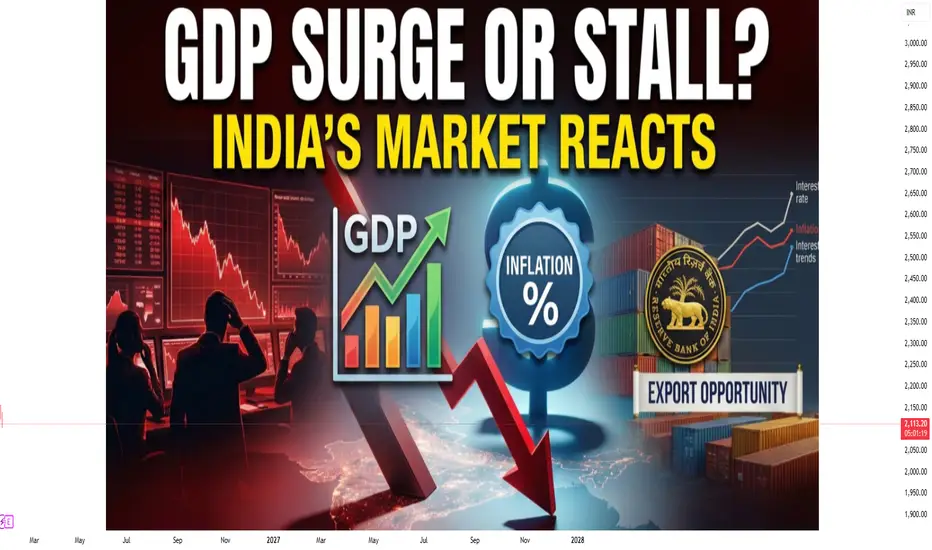
Indian financial markets do not operate in isolation. They are deeply interconnected with global economic conditions and influenced by both international and domestic macroeconomic data. Among the most critical factors shaping market direction are GDP growth, inflation trends, and monetary policy decisions—especially those of the Reserve Bank of India (RBI). Together, these indicators influence investor sentiment, capital flows, corporate earnings, currency movements, and overall market stability. Understanding their impact is essential for investors, traders, policymakers, and businesses.
1. Role of GDP Growth in Indian Markets
a) Domestic GDP Growth
Gross Domestic Product (GDP) is a key measure of economic health. Strong GDP growth in India signals rising consumption, increased industrial production, higher corporate profits, and improved employment levels. Equity markets typically respond positively to higher GDP growth because:
Companies experience revenue and earnings growth
Banks see improved credit demand and lower NPAs
Government tax collections improve, supporting fiscal stability
Sectors such as banking, infrastructure, FMCG, automobiles, and capital goods usually benefit during high-growth phases.
Conversely, slower GDP growth can dampen market sentiment. Weak demand, reduced corporate earnings, and cautious consumer spending may lead to market corrections or prolonged consolidation.
b) Global GDP Growth
Global GDP growth is equally important for India due to its integration with the world economy. Major economies like the US, China, and the EU significantly affect Indian markets:
Strong global growth boosts Indian exports (IT services, pharmaceuticals, engineering goods)
Weak global growth reduces export demand and affects corporate earnings
Global recessions often trigger risk-off sentiment, leading to foreign capital outflows from emerging markets like India
For example, a slowdown in the US or Europe can negatively impact Indian IT stocks, while a slowdown in China may affect metal and commodity-linked companies.
2. Impact of Inflation on Indian Markets
Inflation measures the rise in prices and directly affects purchasing power, interest rates, and profitability. Both domestic inflation and global inflation trends play a vital role.
a) Domestic Inflation (CPI & WPI)
In India, the RBI closely monitors Consumer Price Index (CPI) inflation. High inflation impacts markets in several ways:
Reduces consumer spending power
Increases input costs for companies
Forces RBI to adopt a hawkish stance (rate hikes)
High inflation is generally negative for equity markets, especially for interest-sensitive sectors like banking, real estate, automobiles, and NBFCs. It also affects bond markets, as rising inflation leads to higher yields and falling bond prices.
Moderate and stable inflation, on the other hand, is considered healthy. It indicates steady demand without overheating the economy, supporting long-term market growth.
b) Global Inflation
Global inflation, especially in developed economies, influences Indian markets indirectly:
High global inflation often leads to tighter monetary policies by central banks like the US Federal Reserve
This can strengthen the US dollar and cause capital outflows from emerging markets
Imported inflation rises for India due to higher commodity prices (crude oil, metals, fertilizers)
India is a major importer of crude oil, so global inflation driven by rising energy prices directly impacts India’s trade deficit, fiscal balance, and corporate margins.
3. RBI Monetary Policy and Its Market Impact
The Reserve Bank of India plays a central role in shaping financial market conditions through its monetary policy framework. RBI decisions on interest rates, liquidity, and regulatory measures significantly influence equity, bond, currency, and derivative markets.
a) Interest Rate Policy (Repo Rate)
The repo rate is the primary tool used by the RBI to control inflation and stimulate or cool economic activity.
Rate Cuts:
Reduce borrowing costs
Encourage consumption and investment
Positive for equity markets and rate-sensitive sectors
Rate Hikes:
Increase loan EMIs and borrowing costs
Slow down consumption and capex
Generally negative for equities but supportive for the currency
Banking and financial stocks are particularly sensitive to RBI rate decisions. While moderate rate hikes can improve bank margins, aggressive hikes may reduce credit growth.
b) Liquidity Management
RBI uses tools such as CRR, SLR, open market operations (OMOs), and variable rate repos to manage liquidity.
Excess liquidity supports equity markets and risk assets
Tight liquidity leads to higher interest rates and market volatility
During periods of global uncertainty, RBI liquidity measures often act as a stabilizing force for Indian markets.
c) Policy Communication and Guidance
RBI’s forward guidance influences market expectations. Clear and consistent communication reduces uncertainty and volatility. Sudden changes in stance, however, can cause sharp market reactions.
4. Interaction Between Global Macro Data and RBI Policy
Indian markets often react not just to RBI policy but to how it aligns with global central banks.
If the US Fed tightens aggressively while RBI remains accommodative, capital outflows may increase
If RBI hikes rates ahead of global peers, it can support the rupee but slow domestic growth
Policy divergence affects currency stability, bond yields, and equity valuations
RBI must balance growth, inflation, and financial stability, especially in a globalized environment where shocks transmit quickly.
5. Impact on Key Asset Classes
a) Equity Markets
Positive GDP growth + stable inflation + accommodative RBI policy = bullish equity markets
High inflation + aggressive rate hikes = bearish or volatile markets
Sector rotation is common depending on macro conditions.
b) Bond Markets
Inflation and RBI rate decisions directly affect bond yields
Rising inflation → higher yields → falling bond prices
Stable inflation → attractive long-term bond investments
c) Currency (INR)
Strong GDP growth and stable inflation support the rupee
High inflation, trade deficits, and global risk-off sentiment weaken the rupee
RBI intervention plays a key role in managing excessive volatility
d) Commodity and Derivatives Markets
Global macro data heavily influences commodity prices, which in turn affect Indian commodity-linked stocks and futures markets.
6. Role of Foreign Institutional Investors (FIIs)
Global macro indicators strongly influence FII behavior:
Strong global growth + risk appetite → FII inflows
High global inflation + rising US yields → FII outflows
FII flows significantly impact Indian indices like Nifty 50 and Sensex, often amplifying market trends.
Conclusion
The impact of global macro data—GDP growth, inflation, and RBI policy—on Indian markets is profound and multidimensional. GDP growth drives corporate earnings and long-term market trends, inflation influences purchasing power and interest rates, and RBI policy acts as a stabilizing or tightening force depending on economic conditions. In a globalized world, international macro developments often shape domestic outcomes through trade, capital flows, currency movements, and investor sentiment.
For market participants, understanding these macro linkages is crucial. Long-term investors use macro indicators to identify economic cycles, while traders track data releases for short-term opportunities. Ultimately, sustainable growth in Indian markets depends on a delicate balance between robust GDP expansion, controlled inflation, and prudent, forward-looking monetary policy by the RBI.

Publicaciones relacionadas
Exención de responsabilidad
La información y las publicaciones no constituyen, ni deben considerarse como, asesoramiento o recomendaciones financieras, de inversión, de trading u otro tipo, proporcionadas o respaldadas por TradingView. Obtenga más información en Condiciones de uso.