
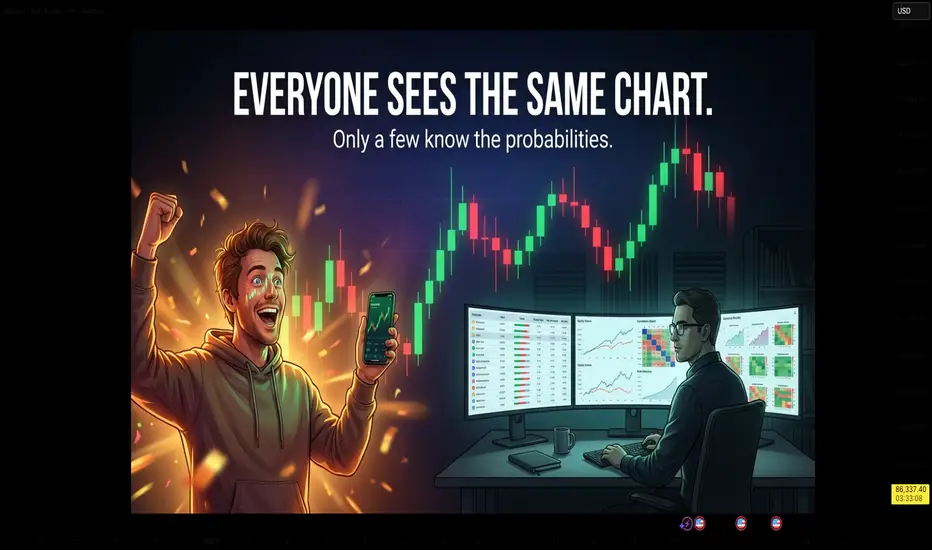
Two traders can trade the exact same strategy and walk away with completely different conclusions. One calls it profitable. The other calls it broken. Most of the time, neither is wrong.
The difference usually isn’t the strategy logic. It’s the testing.
Strategy logic explains why a trade might work. It tells a coherent story about market behavior, momentum, mean reversion, or trend. But logic alone doesn’t tell you how often that behavior holds up, how sensitive it is to small changes, or how it behaves when conditions shift. That’s where many disagreements begin.
Backtesting helps by expanding the sample beyond a single outcome. A strategy that looks reliable on one chart, timeframe, or parameter set may behave very differently when those assumptions are adjusted. Small changes in inputs, market regime, volatility, or timeframe can dramatically alter performance, drawdown, and consistency. Without testing across these variations, it’s easy to mistake coincidence for edge.
This is why strategy debates never really end. Each trader is often judging performance based on a limited slice of data. Within that slice, their conclusion feels justified. One trader may be looking at a period where conditions favored the strategy. Another may be looking at a period where those same rules struggled. Both are drawing conclusions from incomplete information.
Backtesting doesn’t exist to “prove” a strategy works. Its real value is in revealing distribution. It shows how often a strategy succeeds, how often it fails, and how fragile or stable it is when assumptions are changed. Robust strategies tend to exhibit similar behavior across a range of conditions. Fragile strategies depend heavily on specific settings or environments remaining intact.
This is also why optimization alone can be misleading. A strategy that produces exceptional results at a single configuration may collapse when slightly perturbed. Testing across broader parameter ranges helps separate genuine structural behavior from overfitting.
Logic still matters. Backtesting doesn’t replace it. But without testing, logic remains theoretical. With testing, it becomes contextualized. Performance stops being a story and starts becoming measurable.
Most disagreements in trading aren’t really about the market. They’re about how much of the picture has actually been tested.
The difference usually isn’t the strategy logic. It’s the testing.
Strategy logic explains why a trade might work. It tells a coherent story about market behavior, momentum, mean reversion, or trend. But logic alone doesn’t tell you how often that behavior holds up, how sensitive it is to small changes, or how it behaves when conditions shift. That’s where many disagreements begin.
Backtesting helps by expanding the sample beyond a single outcome. A strategy that looks reliable on one chart, timeframe, or parameter set may behave very differently when those assumptions are adjusted. Small changes in inputs, market regime, volatility, or timeframe can dramatically alter performance, drawdown, and consistency. Without testing across these variations, it’s easy to mistake coincidence for edge.
This is why strategy debates never really end. Each trader is often judging performance based on a limited slice of data. Within that slice, their conclusion feels justified. One trader may be looking at a period where conditions favored the strategy. Another may be looking at a period where those same rules struggled. Both are drawing conclusions from incomplete information.
Backtesting doesn’t exist to “prove” a strategy works. Its real value is in revealing distribution. It shows how often a strategy succeeds, how often it fails, and how fragile or stable it is when assumptions are changed. Robust strategies tend to exhibit similar behavior across a range of conditions. Fragile strategies depend heavily on specific settings or environments remaining intact.
This is also why optimization alone can be misleading. A strategy that produces exceptional results at a single configuration may collapse when slightly perturbed. Testing across broader parameter ranges helps separate genuine structural behavior from overfitting.
Logic still matters. Backtesting doesn’t replace it. But without testing, logic remains theoretical. With testing, it becomes contextualized. Performance stops being a story and starts becoming measurable.
Most disagreements in trading aren’t really about the market. They’re about how much of the picture has actually been tested.

Strategy Builder • Explorer • Optimizer
Create strategies, explore thousands of TradingView ideas, & backtest at scale across symbols, timeframes, & parameters.
🌐 quanttradingpro.com
💬 Research & discussion: discord.gg/2systG9frc
Create strategies, explore thousands of TradingView ideas, & backtest at scale across symbols, timeframes, & parameters.
🌐 quanttradingpro.com
💬 Research & discussion: discord.gg/2systG9frc
Exención de responsabilidad
La información y las publicaciones no constituyen, ni deben considerarse como, asesoramiento o recomendaciones financieras, de inversión, de trading u otro tipo, proporcionadas o respaldadas por TradingView. Obtenga más información en Condiciones de uso.
Strategy Builder • Explorer • Optimizer
Create strategies, explore thousands of TradingView ideas, & backtest at scale across symbols, timeframes, & parameters.
🌐 quanttradingpro.com
💬 Research & discussion: discord.gg/2systG9frc
Create strategies, explore thousands of TradingView ideas, & backtest at scale across symbols, timeframes, & parameters.
🌐 quanttradingpro.com
💬 Research & discussion: discord.gg/2systG9frc
Exención de responsabilidad
La información y las publicaciones no constituyen, ni deben considerarse como, asesoramiento o recomendaciones financieras, de inversión, de trading u otro tipo, proporcionadas o respaldadas por TradingView. Obtenga más información en Condiciones de uso.