
Hello Traders
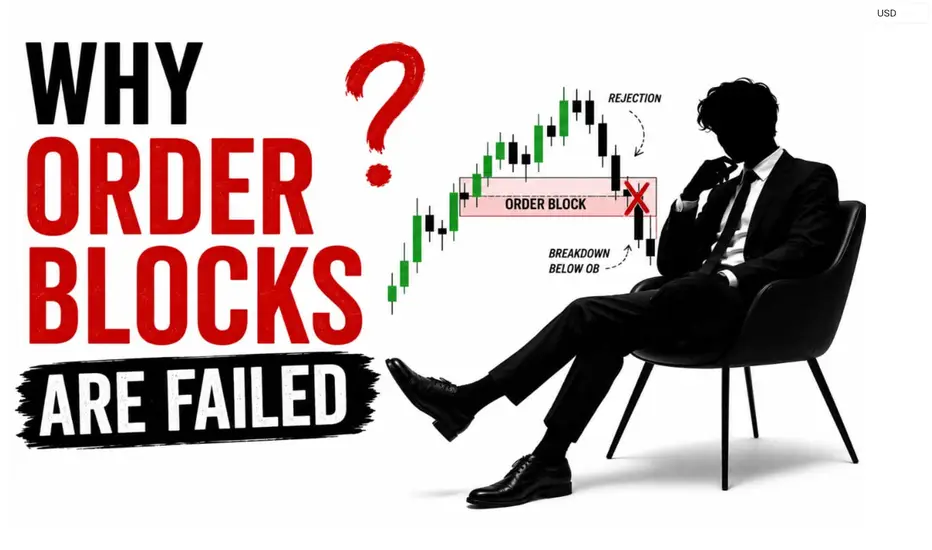
Order Blocks are one of the most widely discussed concepts in Smart Money Concepts (SMC) and price-action trading. Many beginners assume that whenever price reaches an Order Block, the market must immediately reverse. This is one of the most common misconceptions.
An Order Block should not be treated as a guaranteed entry zone. It is better understood as a potential area of institutional interest where price may react if the surrounding market structure and liquidity conditions support the setup.
What Is an Order Block?
In simple terms, an Order Block is generally identified around the last opposing candle or small consolidation area before a strong impulsive move.
A Bullish Order Block may appear before a strong upward displacement, while a Bearish Order Block may appear before a strong downward displacement.
However, the presence of an Order Block alone does not tell us whether price will respect the zone.
Why Do Order Blocks Fail?
1. Lack of Strong Displacement
A high-quality Order Block is usually associated with a meaningful impulsive move. If price leaves the zone without convincing displacement, the Order Block may not have enough significance.
2. Incorrect Market-Structure Context
Market structure should always be considered before relying on an Order Block.
For example, taking a bullish Order Block against a strong bearish higher-timeframe structure can significantly reduce the probability of success.
The Order Block itself is only one part of the analysis; structure provides the broader context.
3. Liquidity Has Not Been Taken
Markets often move toward areas where liquidity is resting, such as previous highs, previous lows, equal highs, or equal lows.
Price may appear to respect an Order Block temporarily, only to sweep nearby liquidity and continue in the opposite direction.
This is why a trader should avoid assuming that the first reaction from an OB automatically confirms a reversal.
4. Multiple Retests of the Same Zone
An Order Block can lose effectiveness after repeated visits.
When price repeatedly trades through the same area, the reaction may become weaker. Therefore, an untouched or relatively fresh zone may be viewed differently from an Order Block that has already been tested several times.
5. Strong Momentum Can Break the OB
An Order Block is not an impenetrable barrier.
If strong momentum enters the market, price can break through the zone and continue toward the next liquidity or structural level.
A clean break and close beyond the relevant invalidation point can indicate that the original Order Block idea is no longer valid.
6. Lower-Timeframe OB vs Higher-Timeframe Structure
One of the biggest mistakes beginners make is focusing on a small timeframe without checking the higher timeframe.
A bullish Order Block on a lower timeframe may look attractive, while the higher timeframe is showing strong bearish pressure.
Professional analysis considers the higher-timeframe narrative first, then uses lower-timeframe price action for confirmation and execution.
How Should Beginners Trade Order Blocks?
Instead of entering immediately when price touches an Order Block, wait for additional evidence.
A more structured approach can be:
Higher-Timeframe Structure → Liquidity → Order Block → Price Reaction → Confirmation → Risk Management
Possible confirmation can include:
- Rejection from the zone
- Strong displacement away from the zone
- Change of market structure
- Break of a relevant swing point
- Clear momentum confirmation
- Alignment with the higher-timeframe direction
The objective is not to predict every reversal. The objective is to wait for evidence that supports the trading idea.
Order Block Invalidation
Every Order Block setup should have a clear invalidation point.
For a bullish setup, a decisive break below the relevant structure/zone may invalidate the bullish thesis.
For a bearish setup, a decisive break above the relevant structure/zone may invalidate the bearish thesis.
The exact invalidation should be determined from the chart structure rather than using an arbitrary number of points.
Risk Management — The Most Important Part
Even a high-quality Order Block can fail.
That is why risk management should come before the entry.
- Define your Stop Loss before entering.
- Risk only a small, predetermined portion of your account on each trade.
- Avoid excessive leverage.
- Do not move your Stop Loss simply because you want the trade to survive.
- Avoid revenge trading after a losing setup.
- Look for a sensible risk-to-reward relationship.
- Accept that losses are part of trading.
A professional trader does not try to make every Order Block work. Instead, they manage the downside when the market proves the idea wrong.
Final Takeaway
Order Blocks are areas of interest—not guaranteed reversal zones.
Their reliability depends on the surrounding market structure, liquidity, displacement, timeframe alignment, price reaction, and risk management.
For beginners, the biggest lesson is simple:
«Do not trade the Order Block alone. Trade the confirmation and manage the risk.»
This content is for educational purposes only and is not financial advice. Always conduct your own analysis and understand the risks before making any trading decision.
Nota
📚 Educational Note — Order BlocksOrder Blocks are potential areas of market interest, not guaranteed reversal zones. A strong Order Block becomes more meaningful when it aligns with market structure, liquidity, displacement, and confirmation.
An Order Block can fail when:
❌ There is no strong displacement from the zone.
❌ The market structure does not support the setup.
❌ Price has already tested the zone multiple times.
❌ Liquidity conditions change or the zone gets invalidated.
Key Lesson: Never enter a trade simply because price reaches an Order Block. Wait for confirmation and clear price action before making a trading decision.
⚠️ Risk Management: Always define invalidation/stop-loss beforehand and manage position size according to your risk tolerance. No setup is guaranteed.
Nota
Order Blocks are one of the most widely discussed concepts in Smart Money Concepts (SMC) and price-action trading. Many beginners assume that whenever price reaches an Order Block, the market must immediately reverse. This is one of the most common misconceptions.Nota
📚 Educational Note — Order BlocksOrder Blocks are potential reaction zones, not guaranteed entry points. A valid Order Block becomes more meaningful when it is supported by strong displacement, clear market structure, and relevant liquidity.
Before taking any trade from an Order Block, look for confirmation through price action rather than entering blindly at the zone. An Order Block can fail when displacement is weak, the market structure is against the setup, or the zone has already been heavily mitigated.
Key takeaway:
Don’t trade the Order Block alone—trade the context around it.
Always use proper risk management, defined invalidation, and controlled position sizing. No setup guarantees a successful trade.

📈 CEO GOLD
🔗 t.me/+KEomSNgDnAwwNzFk
Professional market insights & clean trading analysis.
Join us and stay updated. 🔥
t.me/+VDc8cinpPjw5Yjk8
🔗 t.me/+KEomSNgDnAwwNzFk
Professional market insights & clean trading analysis.
Join us and stay updated. 🔥
t.me/+VDc8cinpPjw5Yjk8
Exención de responsabilidad
La información y las publicaciones no constituyen, ni deben considerarse como, asesoramiento o recomendaciones financieras, de inversión, de trading u otro tipo, proporcionadas o respaldadas por TradingView. Obtenga más información en Condiciones de uso.