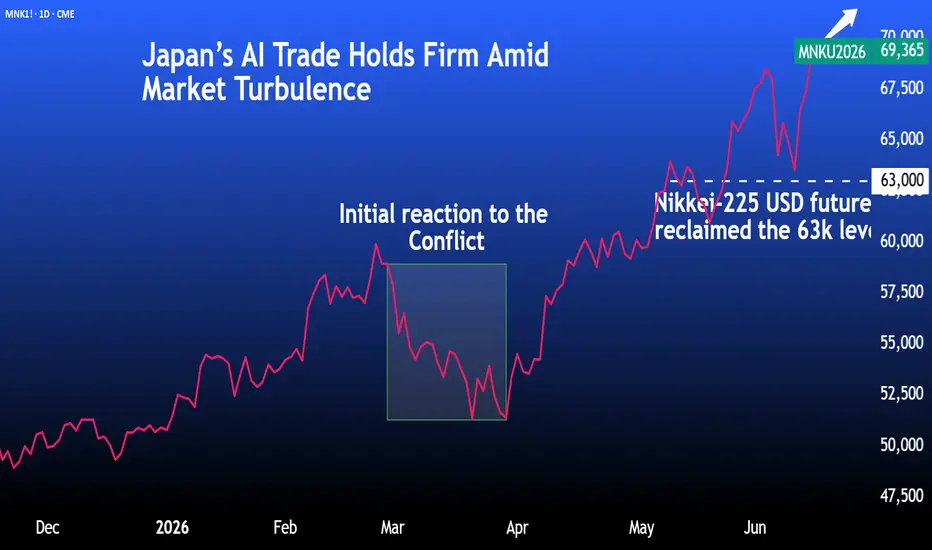
The recent pullback in Japanese equities comes at a pivotal juncture. After climbing to record highs on the back of AI-driven optimism and robust foreign inflows, the Nikkei-225 faced a period of geopolitical uncertainty and growing valuation concerns that prompted a bout of profit-taking. With geopolitical tensions having eased, improving risk appetite could once again support a recovery in Japan’s AI-trade.
How AI Optimism Powered the Nikkei’s Remarkable Rise and Retreat
Japanese equities staged a strong post-Golden Week recovery in early May, buoyed by improving risk appetite and expectations of a potential easing in US-Iran tensions. However, the rally paused briefly in mid-May as rising oil prices and renewed geopolitical uncertainty encouraged profit-taking.

Technology stocks led a 13% surge that lifted the Nikkei-225 above 68,000 to a record high on 3/June, as investors sought exposure to Japan's central role in the AI supply chain.
This rally stumbled a day later when Broadcom's earnings triggered a global selloff in AI-linked stocks. Although demand remained strong, investors were left underwhelmed by the company's outlook, reviving concerns that valuations had become stretched. Combined with uncertainty surrounding the US-Iran ceasefire and rising Treasury yields, the Nikkei fell more than 5% from its early-June peak.
Even so, the broader AI investment theme remains intact. Global demand for AI infrastructure has yet to show meaningful signs of reversal, and Japanese companies remain deeply embedded in that growth story. Near-term volatility, elevated valuations and profit-taking could drive further downside in the weeks ahead. However, if AI spending continues to expand as expected, any correction may ultimately create the foundation for an even stronger rebound in the tech-heavy Nikkei-225.
Not All Boats Rose With the Tide
The Nikkei’s surge to record highs may have looked like a broad-based market rally, but beneath the surface, leadership was surprisingly narrow. A handful of AI-linked stocks and financial names did much of the heavy lifting, masking a far more uneven picture across the wider market.

Source: TradingView
Technology and semiconductor companies dominated performance as investors poured into businesses tied to the global AI buildout. Two major beneficiaries were Kioxia Holdings and Murata Manufacturing.
Kioxia supplies the flash memory and solid-state drives (SSDs) that store and process the vast amounts of data used by AI data centres, while Murata provides the capacitors and power-management components that enable increasingly powerful AI servers. As hyperscalers accelerate spending on AI infrastructure, both companies continue to benefit from rising demand across the supply chain.
Financials were another standout, supported by growing expectations that the Bank of Japan would raise interest rates. For banks, a higher rate environment generally translates into stronger lending margins and improved earnings prospects.

Source: Reuters poll for May and June
Outside these pockets of strength, however, many industrial, consumer and cyclical sectors failed to keep pace, highlighting just how concentrated the Nikkei’s rally had become.
Overseas Buyers Hit the Brakes After an Eight-Week Buying Spree
Every major rally needs buyers, and in Japan's case, foreign investors played that role. As the Nikkei pushed deeper into record territory, overseas funds continued to pour money into the market, contributing ¥1.85 trillion of net inflows during May alone. Their steady demand provided an important tailwind for equities during one of the index's strongest runs of the year.

Source: Japan Exchange Group
But as the market approached new highs, some investors began asking a simple question: how much of the good news was already priced in? In the week ended 29/May, overseas investors sold a net ¥395 billion of Japanese equities, bringing their eight-week buying streak to an end. The cautious tone persisted into early June, with foreign investors recording a further net outflow of roughly ¥81 billion in the first week of the month.
While these outflows were modest relative to the scale of earlier inflows, they pointed to a shift in behaviour. Rather than adding aggressively to positions at record highs, investors appeared increasingly focused on protecting profits as valuations stretched and market expectations became harder to exceed. For a market that had relied heavily on overseas buying, two consecutive weeks of net foreign selling served as an early sign that the rally was entering a more challenging phase.
Historical Trade Setup
The current pullback echoes the market turbulence that followed the onset of the Middle East conflict in late February 2026. In both cases, a strong AI-driven market was interrupted by a geopolitical shock that temporarily shifted investors' attention away from growth opportunities and towards risk management.
History suggests that geopolitical shocks rarely derail a structural bull market on their own. More often, they create periods of consolidation as investors reassess risks and reduce exposure. Following the conflict announcement, Japanese equities initially came under pressure as investors weighed the implications for global growth and trade. Yet as those concerns eased, capital flowed back into AI-linked technology stocks, helping the Nikkei-225 reclaim the 63,000 level.

For instance, a trader who went long on the front-month Micro Nikkei (USD) futures on 31/Mar/2026 and exited on 08/May/2026 would have realised a gross mark-to-market gain of USD 6,335.
Market participants can gain exposure through CME Micro Nikkei (USD) futures, which are one-tenth the size of the standard contract. The smaller contract offers greater flexibility in position sizing and requires less capital, making it easier to participate in moves in the Nikkei while managing risk.
With the BoJ meeting approaching, the USD-denominated futures offer a way to gain exposure to Japanese equities while reducing direct exposure to potential yen volatility and policy-driven currency swings.
Long CME Micro Nikkei (USD) Futures
Entry = USD 51,115
Exit = USD 63,785
PnL: 0.50 x (63,785 - 51,115) = USD 6,335
This content is sponsored.
MARKET DATA
CME Real-time Market Data helps identify trading setups and more effectively express market views. If you have futures in your trading portfolio, you can check out on CME Group data plans available that suit your trading needs at tradingview.com/cme.
DISCLAIMER
This case study is for educational purposes only and does not constitute investment recommendations or advice. Nor are they used to promote any specific products, or services.
Trading or investment ideas cited here are for illustration only, as an integral part of a case study to demonstrate the fundamental concepts in risk management or trading under the market scenarios being discussed.
How AI Optimism Powered the Nikkei’s Remarkable Rise and Retreat
Japanese equities staged a strong post-Golden Week recovery in early May, buoyed by improving risk appetite and expectations of a potential easing in US-Iran tensions. However, the rally paused briefly in mid-May as rising oil prices and renewed geopolitical uncertainty encouraged profit-taking.
Technology stocks led a 13% surge that lifted the Nikkei-225 above 68,000 to a record high on 3/June, as investors sought exposure to Japan's central role in the AI supply chain.
This rally stumbled a day later when Broadcom's earnings triggered a global selloff in AI-linked stocks. Although demand remained strong, investors were left underwhelmed by the company's outlook, reviving concerns that valuations had become stretched. Combined with uncertainty surrounding the US-Iran ceasefire and rising Treasury yields, the Nikkei fell more than 5% from its early-June peak.
Even so, the broader AI investment theme remains intact. Global demand for AI infrastructure has yet to show meaningful signs of reversal, and Japanese companies remain deeply embedded in that growth story. Near-term volatility, elevated valuations and profit-taking could drive further downside in the weeks ahead. However, if AI spending continues to expand as expected, any correction may ultimately create the foundation for an even stronger rebound in the tech-heavy Nikkei-225.
Not All Boats Rose With the Tide
The Nikkei’s surge to record highs may have looked like a broad-based market rally, but beneath the surface, leadership was surprisingly narrow. A handful of AI-linked stocks and financial names did much of the heavy lifting, masking a far more uneven picture across the wider market.
Source: TradingView
Technology and semiconductor companies dominated performance as investors poured into businesses tied to the global AI buildout. Two major beneficiaries were Kioxia Holdings and Murata Manufacturing.
Kioxia supplies the flash memory and solid-state drives (SSDs) that store and process the vast amounts of data used by AI data centres, while Murata provides the capacitors and power-management components that enable increasingly powerful AI servers. As hyperscalers accelerate spending on AI infrastructure, both companies continue to benefit from rising demand across the supply chain.
Financials were another standout, supported by growing expectations that the Bank of Japan would raise interest rates. For banks, a higher rate environment generally translates into stronger lending margins and improved earnings prospects.
Source: Reuters poll for May and June
Outside these pockets of strength, however, many industrial, consumer and cyclical sectors failed to keep pace, highlighting just how concentrated the Nikkei’s rally had become.
Overseas Buyers Hit the Brakes After an Eight-Week Buying Spree
Every major rally needs buyers, and in Japan's case, foreign investors played that role. As the Nikkei pushed deeper into record territory, overseas funds continued to pour money into the market, contributing ¥1.85 trillion of net inflows during May alone. Their steady demand provided an important tailwind for equities during one of the index's strongest runs of the year.
Source: Japan Exchange Group
But as the market approached new highs, some investors began asking a simple question: how much of the good news was already priced in? In the week ended 29/May, overseas investors sold a net ¥395 billion of Japanese equities, bringing their eight-week buying streak to an end. The cautious tone persisted into early June, with foreign investors recording a further net outflow of roughly ¥81 billion in the first week of the month.
While these outflows were modest relative to the scale of earlier inflows, they pointed to a shift in behaviour. Rather than adding aggressively to positions at record highs, investors appeared increasingly focused on protecting profits as valuations stretched and market expectations became harder to exceed. For a market that had relied heavily on overseas buying, two consecutive weeks of net foreign selling served as an early sign that the rally was entering a more challenging phase.
Historical Trade Setup
The current pullback echoes the market turbulence that followed the onset of the Middle East conflict in late February 2026. In both cases, a strong AI-driven market was interrupted by a geopolitical shock that temporarily shifted investors' attention away from growth opportunities and towards risk management.
History suggests that geopolitical shocks rarely derail a structural bull market on their own. More often, they create periods of consolidation as investors reassess risks and reduce exposure. Following the conflict announcement, Japanese equities initially came under pressure as investors weighed the implications for global growth and trade. Yet as those concerns eased, capital flowed back into AI-linked technology stocks, helping the Nikkei-225 reclaim the 63,000 level.
For instance, a trader who went long on the front-month Micro Nikkei (USD) futures on 31/Mar/2026 and exited on 08/May/2026 would have realised a gross mark-to-market gain of USD 6,335.
Market participants can gain exposure through CME Micro Nikkei (USD) futures, which are one-tenth the size of the standard contract. The smaller contract offers greater flexibility in position sizing and requires less capital, making it easier to participate in moves in the Nikkei while managing risk.
With the BoJ meeting approaching, the USD-denominated futures offer a way to gain exposure to Japanese equities while reducing direct exposure to potential yen volatility and policy-driven currency swings.
Long CME Micro Nikkei (USD) Futures
Entry = USD 51,115
Exit = USD 63,785
PnL: 0.50 x (63,785 - 51,115) = USD 6,335
This content is sponsored.
MARKET DATA
CME Real-time Market Data helps identify trading setups and more effectively express market views. If you have futures in your trading portfolio, you can check out on CME Group data plans available that suit your trading needs at tradingview.com/cme.
DISCLAIMER
This case study is for educational purposes only and does not constitute investment recommendations or advice. Nor are they used to promote any specific products, or services.
Trading or investment ideas cited here are for illustration only, as an integral part of a case study to demonstrate the fundamental concepts in risk management or trading under the market scenarios being discussed.

Full Disclaimer - linktr.ee/mintfinance
Exención de responsabilidad
La información y las publicaciones no constituyen, ni deben considerarse como, asesoramiento o recomendaciones financieras, de inversión, de trading u otro tipo, proporcionadas o respaldadas por TradingView. Obtenga más información en Condiciones de uso.
Full Disclaimer - linktr.ee/mintfinance
Exención de responsabilidad
La información y las publicaciones no constituyen, ni deben considerarse como, asesoramiento o recomendaciones financieras, de inversión, de trading u otro tipo, proporcionadas o respaldadas por TradingView. Obtenga más información en Condiciones de uso.