
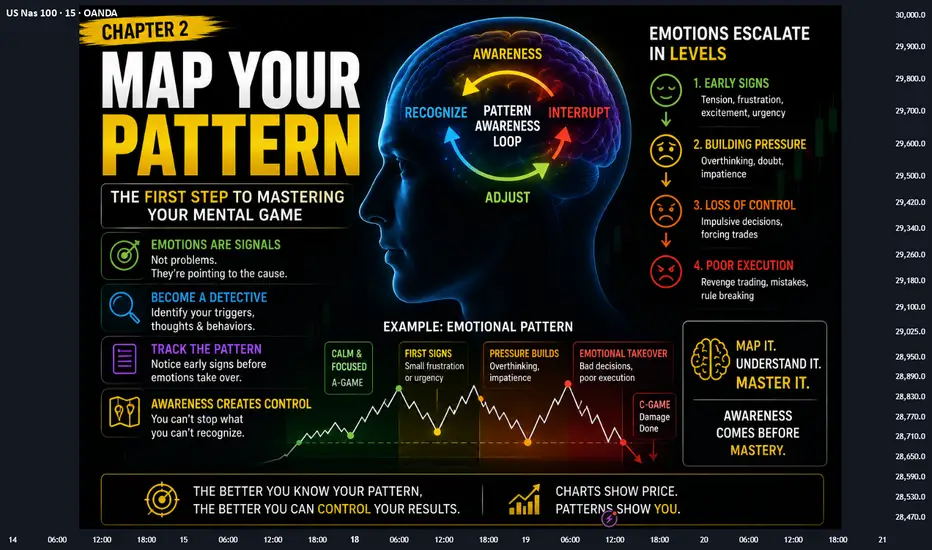
Most traders are trying to fix emotional mistakes too late.
That is one of the biggest lessons from Chapter 2 of The Mental Game of Trading.
By the time most traders realize they are emotional:
the revenge trade is already taken,
the stop loss is already moved,
the overtrade has already happened,
or the hesitation has already cost the opportunity.
Jared Tendler explains something critical:
“You cannot stop what you cannot recognize.”
And that is where the concept of mapping your emotional patterns begins.
What Does “Map Your Pattern” Mean?
The same way traders learn to recognize:
break of structure,
liquidity sweeps,
fair value gaps,
and market cycles…
…we must also learn to recognize emotional patterns.
Because emotions follow patterns too.
Your fear has a pattern.
Your greed has a pattern.
Your tilt has a pattern.
Your hesitation has a pattern.
The problem is:
Most traders only notice emotions AFTER the damage is done.
Professional growth begins when you recognize the signals BEFORE execution breaks down.
Emotions Escalate in Levels
One of the most powerful ideas in this chapter is understanding emotional escalation.
It usually starts small:
slight frustration
tension
urgency
excitement
fear of missing out
Then it builds:
over-analysis
second guessing
impulsive decisions
forcing trades
emotional execution
The dangerous part?
Many traders do not even notice the early stages.
By the time they recognize the emotion, they are already deep inside their C-Game.
The Trigger Is NOT the Real Problem
This chapter explains that:
A loss, stop-out, or missed trade is usually NOT the actual issue.
It is only the trigger.
The real issue is the emotional weakness underneath:
fear of failure
unrealistic expectations
insecurity
need to prove yourself
lack of trust in your edge
The trigger simply exposes what already exists internally.
Your Job Is to Become a Detective
This chapter teaches traders to study themselves like data.
Instead of saying:
“I traded badly today…”
You begin asking:
What triggered me?
What thoughts appeared first?
What changed in my behavior?
When did emotional pressure start increasing?
What physical signs appeared?
Examples:
leaning closer to the screen
increased heart rate
impatience
chart hopping
checking PnL constantly
aggressive clicking
forcing confirmations
These are emotional clues.
And clues create awareness.
Why Mapping Matters
Mapping your emotional pattern creates an “internal GPS.”
It helps you recognize:
when you are emotionally drifting,
when execution quality is dropping,
and when your C-Game is beginning to appear.
This allows you to interrupt the pattern early.
The earlier you recognize emotional escalation, the easier it becomes to regain control.
Key Lesson From Chapter 2
Trading psychology is not random.
Your emotional reactions repeat themselves over and over again.
And once you can identify the pattern clearly enough…
you can begin correcting it.
Awareness comes before mastery.
Final Thought
Most traders spend years studying charts…
…but never study themselves.
Yet your emotions affect:
timing,
execution,
patience,
confidence,
and risk management.
The market is not only testing your strategy.
It is testing your emotional awareness under pressure.
Recognise your challenge in trading psychology?
Fear, hesitation, overtrading, revenge trading, lack of discipline?
You’re not alone.
Leave a comment below sharing the biggest mental challenge affecting your execution right now. I’d love to hear your perspective and possibly cover it in future educational breakdowns.
📈🔥

Publicaciones relacionadas
Exención de responsabilidad
La información y las publicaciones no constituyen, ni deben considerarse como, asesoramiento o recomendaciones financieras, de inversión, de trading u otro tipo, proporcionadas o respaldadas por TradingView. Obtenga más información en Condiciones de uso.
Publicaciones relacionadas
Exención de responsabilidad
La información y las publicaciones no constituyen, ni deben considerarse como, asesoramiento o recomendaciones financieras, de inversión, de trading u otro tipo, proporcionadas o respaldadas por TradingView. Obtenga más información en Condiciones de uso.