
Volatility contraction is a period when candle ranges narrow and successive swings become smaller. It can signal that activity is compressing before a larger move, but it does not reveal which direction that move will take.
On a chart, look for several candles with progressively tighter highs and lows, plus swings that cover less distance. Mark the squeeze boundaries using the highest high and lowest low across that compact range. Treat those as the range edges, not as a prediction.
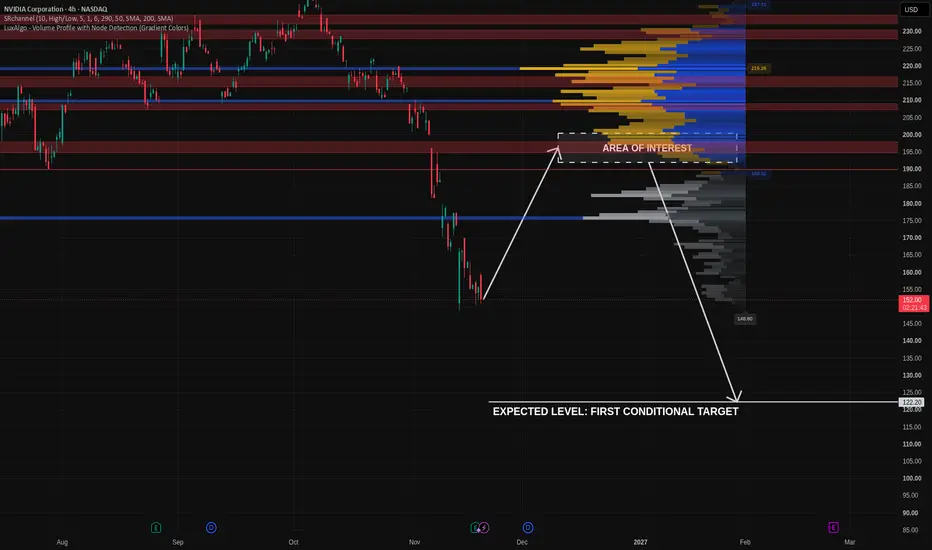
To check the pattern, compare the recent candles and swings with the preceding movement. Then wait for price to leave the marked range and assess whether it holds beyond an edge; a brief move outside that returns into the range is not the same as sustained acceptance. The supplied NVIDIA 4-hour chart shows a sharp decline, not a clearly established tight squeeze at the current price of 152.3, so it does not justify inventing squeeze boundaries. The calculated average 4-hour candle movement is 9.3 by ATR(14), which is context for volatility, not a direction cue.
The chart's 191.8-200.4 zone is a volume-profile interest area, not a verified squeeze range. The accompanying scenario is framed from that zone rather than at the market: its first target is 122.2, based on a 161.8% move projection; its second target is 79.2, based on a 261.8% move projection; and 207.8 is the scenario cancellation level beyond the zone. These levels illustrate a separate conditional framework; they do not establish that a contraction has formed or predict a breakout direction.
A common mistake is guessing bullish or bearish direction while price is still inside the range, then treating any small move as confirmation. Practice by marking only the observed range edges, waiting for a confirmed move beyond one edge, and defining invalidation and acceptable loss before considering any trade. Keep risk limited; a volatility expansion can move sharply in either direction.

SIGNAL INDICATOR
NO REDESIGNING
✅Buy&Sell according to 7 strategies
✅Technical analysis according to 30+ parameters
✅WinRate of signals up to 75%
✅RR 1k3, no deep drawdowns!
Free test drive using my link:
👉midas-club.com/go/tla
NO REDESIGNING
✅Buy&Sell according to 7 strategies
✅Technical analysis according to 30+ parameters
✅WinRate of signals up to 75%
✅RR 1k3, no deep drawdowns!
Free test drive using my link:
👉midas-club.com/go/tla
Exención de responsabilidad
La información y las publicaciones no constituyen, ni deben considerarse como, asesoramiento o recomendaciones financieras, de inversión, de trading u otro tipo, proporcionadas o respaldadas por TradingView. Obtenga más información en Condiciones de uso.