
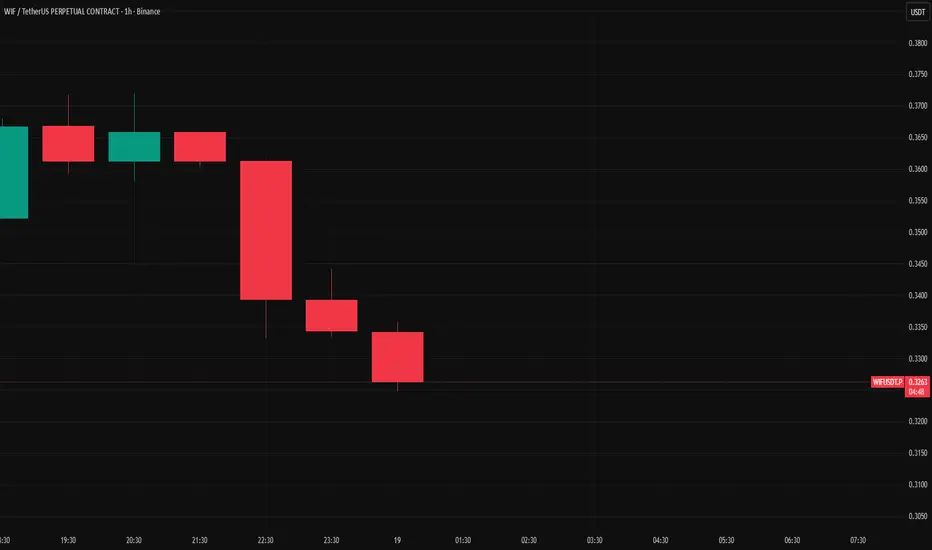
MARAL Execution Example—Discretionary SHORT (Entry 0.01234 → Exit 0.01196) in Binance
This post is not about prediction. It’s about execution quality — how MARAL guides a trader before entry, during the hold phase, and into the exit decision using context + risk controls.
Trade Snapshot
Position: SHORT (manual)
Entry: 0.01234
Exit: 0.01196
Move captured: ~0.00038 (≈ 3.1%)
1) Pre-Entry: Why MARAL allowed the trade
Entry Checklist (Permission Layer)
MARAL’s checklist was green across core pillars:
HTF Alignment: OK
Structure: OK (Bear Structure)
Momentum: OK
Volatility (ATR + ADX): OK
Liquidity Confidence: WARN
Score: 93 / 65 → ENTER SHORT
Important: “Liquidity = WARN” is not a “no-trade.”
It means nearby liquidity pools exist, so the trade may include wick risk / stop-sweep behavior, and execution must be disciplined (no FOMO entries, no oversized risk).
2) Signal vs Framework: What the Master Engine confirmed
MARAL didn’t just show “short.” It confirmed the internal quality of the short context:
Last Signal: SHORT
Direction: Bearish
H1 / H4 / Daily Bias: Bearish alignment
Structure: Bear Structure
Short Score: 93 (A++)
Trend Probability: 93%
Reversal Probability: 7%
This is the key difference:
MARAL doesn’t “tell” you to trade — it grades the environment so your entry is not emotional.
3) Execution Board: What happened AFTER entry (the real value)
Post-entry, the Execution Board shifted into execution guidance:
Execution State (Holding Logic)
Trade Status: VALID
Market Phase: CONTINUATION
TP Probability: HIGH
Obstacle Ahead: NO
Exit Pressure: LOW
Momentum Health: STRONG
Score Trend: Stable / Improving
Active Window: ON
Action: HOLD
Trade Age: FRESH
This is execution intelligence:
VALID + CONTINUATION = trend conditions still supportive
Obstacle Ahead: NO = fewer immediate barriers in path
Exit Pressure: LOW = no urgent reason to panic-exit
Action: HOLD = stay in trade as long as structure remains intact
4) Risk State: Why “OVEREXTENDED” matters even in a VALID trade
MARAL showed:
Risk State: OVEREXTENDED
This does not mean reversal.
It means:
“The move is mature / extended relative to volatility. Continuation can happen, but holding requires risk-managed behavior.”
Execution behavior under OVEREXTENDED:
Don’t add to position (no stacking late)
Protect profits (tighten or trail logically)
Expect wicks/pullbacks even if trend remains bearish
Prefer partials / controlled exits near objectives
5) My exit decision (0.01196): Execution > greed
Even though MARAL was still VALID / HOLD, I chose to exit at 0.01196 to:
Lock a clean capture (~3.1%)
Respect OVEREXTENDED risk
Avoid giving back profit during possible liquidity reaction / mean-reversion
This is exactly what MARAL is designed for:
Stay in when the environment is valid — but exit like a risk manager, not like a gambler.
6) What would invalidate the HOLD (how MARAL helps you stay objective)
For me, a HOLD becomes questionable if MARAL starts flipping these:
Trade Status: VALID → RISKY/WEAK
Exit Pressure: LOW → RISING
Obstacle Ahead: NO → YES
Momentum Health: STRONG → WEAK
Score Trend: IMPROVING → DETERIORATING
Active Window: ON → OFF
That’s the execution framework in action: no emotions, only conditions.
Due to TradingView attachment limitations, the full chart is shared via the link below.
Nota
🔒 ARCHIVED / SUPERSEDED (First Release – Discontinued)This publication reflects an early MARAL release and is kept online only as a historical / educational reference.
The original script/version shown here is no longer available, and MARAL has since been significantly updated (logic, filters, and execution panels). Please treat this Idea as ARCHIVED and not representative of the current build.
✅ Current Version (Invite-Only)
MARAL is now published as a public invite-only script on TradingView. The publication page is visible, but usage requires explicit permission from the author. Access is managed via TradingView invite-only permissions; please request access via private message.
⚠️ EDUCATIONAL DISCLAIMER
This content is for educational and informational purposes only—not financial advice, not a trade recommendation, and no results are guaranteed. Trading involves significant risk; always do your own research and manage risk responsibly.

MARAL Execution Workflow, Long & Short Permission , Dynamic risk mapper & Deep Candle Intelligence
Context → Liquidity Event → Displacement → Structure Shift → POI Confirmation → Risk Clearance (Discretionary | Educational)
Context → Liquidity Event → Displacement → Structure Shift → POI Confirmation → Risk Clearance (Discretionary | Educational)
Exención de responsabilidad
La información y las publicaciones no constituyen, ni deben considerarse como, asesoramiento o recomendaciones financieras, de inversión, de trading u otro tipo, proporcionadas o respaldadas por TradingView. Obtenga más información en Condiciones de uso.