 Oro al contado/Dólar estadounidense
Formación
Anatomy of Smart Money: A Structural Analysis of Volume-Delta
● 📊 Conceptual Origin
- The concept of tracking capital flow through volume and price interaction traces its intellectual roots back to the earliest attempts by technical analysts to look beyond raw price movement and ask a more fundamental question: who is actually transacting behind a given candle, and with what conviction. Long before modern computing made granular order flow analysis possible, analysts such as Joseph Granville and later Marc Chaikin theorized that volume represented the fuel behind price, and that discrepancies between price direction and volume participation often preceded reversals or exhaustion. This lineage of thought treats every printed bar not merely as a static open-high-low-close record, but as a battlefield report, where the size of the volume relative to the resulting price displacement tells a story about which side of the market, buyers or sellers, expended the least effort to achieve the greatest directional result.
- The idea of a Cumulative Delta Flow, at its core, is an evolution of this philosophy into an accumulation framework. Rather than examining a single bar in isolation, the underlying logic sums the net directional volume contribution across a rolling window, producing a longer-term impression of whether capital has been steadily accumulating on the buy side or distributing on the sell side. This is philosophically distinct from simple momentum oscillators, which measure the rate of price change, because a delta flow framework is attempting to measure the rate of capital commitment, treating volume as evidence of intent rather than as a passive byproduct of trading activity.
- An In/Out Ratio interpretation, meanwhile, borrows conceptually from market breadth and advance-decline philosophy, reframing the same underlying inflow and outflow calculations as a bounded percentage rather than an unbounded cumulative sum. This dual-mode thinking reflects a long-standing academic tension in volume analysis literature between absolute measures, which show magnitude but drift over time, and normalized measures, which sacrifice magnitude for comparability across instruments and timeframes.
● 📈 Narrative Technical Analysis
- Structurally, a volume-delta flow framework begins by evaluating the typical price of a given bar, an average of the high, low, and close, multiplied by the transacted volume, in order to approximate the notional capital that changed hands during that period. This notional turnover is then attributed a directional sign based on whether the closing price finished meaningfully higher or lower than the prior close, gated by a threshold that filters out negligible or indecisive price movement from being misclassified as directional conviction.
- A particularly sophisticated layer within this style of architecture is the introduction of an efficiency multiplier, a concept borrowed loosely from the notion of price efficiency found in market microstructure literature. The premise is that not all volume is created equal: a bar that produces a large price displacement on relatively modest volume is, in a structural sense, more efficient and therefore more informative than a bar that produces the same displacement only after absorbing extraordinary volume. By comparing the realized efficiency of the current bar against a recent average efficiency baseline, the framework attempts to weight directional flow by conviction quality rather than by raw size alone, a nuance that separates naive volume-weighted models from more considered structural regression approaches.
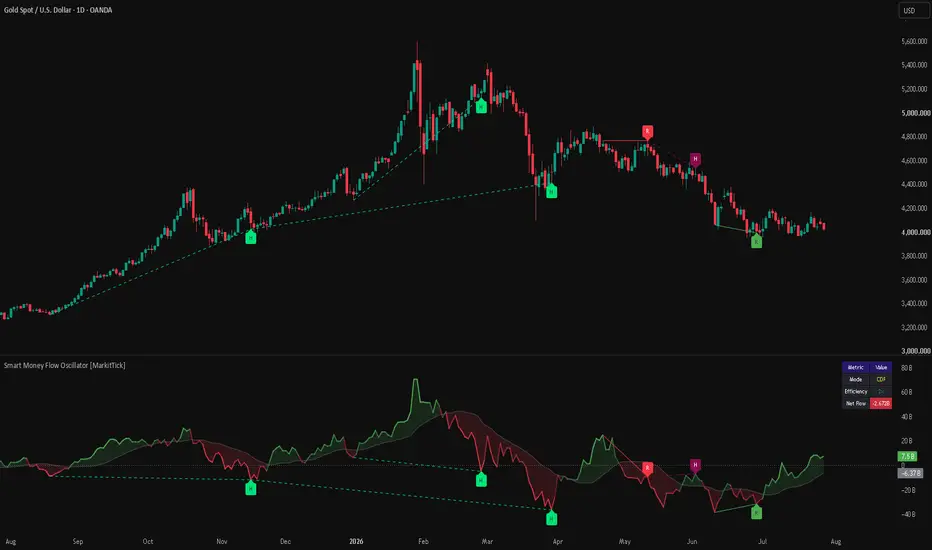
- Once directional, volume-adjusted flow values are established, they are aggregated over a rolling structural window, often adaptively sized depending on whether the instrument is being observed on a weekly, daily, or intraday basis, mirroring the academic understanding that market participation cycles differ meaningfully across timeframes. A smoothed moving average of this cumulative flow then serves as a dynamic equilibrium or signal line, and the spread between the raw flow and its smoothed counterpart becomes a proxy for the acceleration or deceleration of capital commitment, not unlike the relationship between a MACD line and its signal line, but rooted in participation rather than pure price momentum.
- Divergence detection, layered atop this flow calculation, echoes classical technical analysis doctrine: when price achieves a new structural extreme that is not confirmed by a corresponding extreme in the underlying flow measure, this discordance is read as a warning that the price move lacks genuine participation behind it, an idea consistent with decades of oscillator-divergence literature applied here to a participation-based series instead of a pure price-derivative series such as RSI or stochastic momentum.
- Consolidation box mapping and volume profile anomaly recognition become relevant extensions of this narrative when a market enters a range-bound structural phase. During such phases, cumulative flow readings tend to oscillate around a neutral equilibrium, and the academic interest shifts toward identifying subtle asymmetries, moments where flow quietly tilts toward accumulation or distribution well before price breaks out of its consolidation box, a phenomenon that volume profile theorists have long associated with institutional positioning ahead of a directional resolution.
● 🏦 Institutional vs Retail Perspective
- Institutional market participants, by the nature of their size and their obligation to minimize market impact, tend to execute large orders over extended periods, often disguising true directional intent through iceberg orders, algorithmic slicing, and dark pool routing. From this perspective, a cumulative delta flow framework represents an attempt, however imperfect, to reconstruct a shadow of this hidden participation from publicly observable volume and price data. Institutions themselves are less likely to rely on a retail-facing oscillator of this kind for their own execution decisions, since they possess direct access to order book depth, block trade reporting, and proprietary flow data; however, they are acutely aware that retail and less sophisticated market participants often do rely on such tools, and this awareness itself becomes a strategic variable in how liquidity is provided or withdrawn around key levels.
- Retail participants, by contrast, typically lack access to genuine order flow data and therefore treat volume-derived oscillators as one of the few available proxies for institutional footprint. The retail interpretation tends to be more literal: a rising cumulative flow is read directly as evidence that "smart money is buying," without necessarily appreciating the layers of assumption embedded in translating aggregate volume into directional conviction. This creates an interesting asymmetry in market psychology, where the tool is most heavily relied upon by the participants least equipped to contextualize its limitations, while the participants whose behavior the tool is attempting to detect are the least likely to be influenced by its readings.
- The academic implication of this asymmetry is that such oscillators function best not as standalone predictive instruments, but as confirmation layers within a broader analytical framework, since their signals are, by construction, always a step removed from the actual liquidity events they attempt to represent. A rigorous institutional risk desk would treat a cumulative flow reading as one input among many, cross-referenced against order book imbalance, open interest changes, and macro positioning data, whereas an under-resourced retail approach risks treating the oscillator as a self-sufficient signal generator, a methodological shortcut that inflates false-signal exposure.
● ⚙️ Strategic Variance
- In a trending market regime, a volume-delta flow framework tends to perform closest to its conceptual ideal. Sustained directional trends are typically accompanied by persistent, one-sided participation, meaning the cumulative flow measure should track in the same direction as price with relatively few false crossovers of its signal line, and divergence signals that do emerge in this regime carry higher informational value because they represent a genuine departure from an otherwise consistent participation pattern.
- In a ranging or consolidative regime, the framework's behavior becomes considerably more nuanced and, in academic terms, more prone to noise. Because net directional volume oscillates without establishing a persistent bias, the cumulative flow measure tends to whipsaw around its equilibrium line, generating a higher frequency of signal-line crossovers that individually carry less predictive weight. In this regime, the analytical value of the framework shifts away from directional signaling and toward the subtler task of anomaly detection within the consolidation box, watching for the earliest signs of an accumulation or distribution tilt that might precede an eventual range resolution.
- In a high-volatility regime, particularly one driven by macro shocks, earnings events, or liquidity dislocations, the framework faces its most significant conceptual stress test. Volume itself becomes an unreliable signal of conviction during these periods, since panic-driven liquidation and forced deleveraging can produce enormous volume with directional signatures that reflect capitulation rather than considered institutional accumulation. Efficiency-based weighting mechanisms become particularly relevant here, as they are designed, at least in principle, to distinguish between volume that reflects controlled, purposeful participation and volume that reflects disorderly, reactive flow, though no purely quantitative filter can fully separate these two categories with certainty in real time.
● 🧠 Psychological Architecture
- The reliance on flow-based oscillators is itself a psychological artifact of the trader's underlying discomfort with uncertainty. Price alone can feel arbitrary and noisy, and the human mind is drawn toward frameworks that promise to reveal a hidden layer of causality, in this case, the notion that there exists a class of sophisticated, better-informed participants whose behavior can be reverse-engineered from public data. This desire to peer behind the curtain of price action is a deeply rooted cognitive need, related to the broader psychological literature on pattern-seeking behavior and the human aversion to accepting genuine randomness or ambiguity in outcomes that carry financial consequence.
- Confirmation bias represents one of the most persistent hazards in the practical application of such frameworks. A trader who has already formed a directional bias is prone to interpret an ambiguous flow reading as confirmatory evidence, selectively noticing crossovers or divergence signals that align with a pre-existing thesis while discounting contradictory signals as noise. This selective perception undermines the very objectivity that a quantitative flow measure is meant to provide, turning what should be a dispassionate analytical input into a psychological crutch that reinforces existing conviction rather than genuinely testing it.
- Loss aversion further complicates the practical psychology of flow-based analysis, particularly around divergence signals. A trader who identifies a bearish divergence while holding a long position faces an uncomfortable choice between honoring the signal, which may require realizing a loss or forgoing further gains, and rationalizing the signal away in the hope that price will continue in the desired direction. The asymmetric emotional weight of losses relative to equivalent gains, a phenomenon well documented in behavioral finance literature since the foundational work of Kahneman and Tversky, means that traders are systematically prone to under-react to warning signals that threaten an existing position and over-react to warning signals that merely confirm a position they have not yet entered.
- There is also a subtler psychological trap embedded in the very language of "smart money" flow analysis: the implicit framing that there exists an omniscient, always-correct class of institutional participants whose footsteps can be faithfully traced. In reality, institutional participants are themselves fallible, subject to their own risk constraints, mandates, and occasional misjudgments. A trader who anthropomorphizes flow data into an infallible oracle risks substituting one form of overconfidence, blind faith in price action, for another, blind faith in a derived quantitative proxy, without meaningfully improving the underlying quality of decision-making.
● 🎲 Risk and Probability Sagas
- Any serious engagement with a flow-based analytical framework must be grounded in a probabilistic rather than deterministic mindset. No combination of volume, price displacement, and efficiency weighting can produce certainty about future price direction, because markets are reflexive systems in which the very act of participants reacting to a signal alters the conditions that produced it. The academic treatment of such tools therefore properly belongs within a probabilistic edge framework, where the objective is not to be right on every individual signal, but to identify a statistically favorable asymmetry between the frequency and magnitude of successful signals versus unsuccessful ones, sustained over a sufficiently large sample of occurrences.
- The philosophy of risk in this context demands an acceptance that false signals are not a flaw to be eliminated but an inherent, irreducible property of any framework built upon incomplete information. Cumulative flow measures, by construction, are derived from public volume and price data, which represents only a partial reconstruction of the true underlying order flow. Consequently, any probabilistic edge extracted from such a framework must be considered modest and conditional, requiring corroboration from complementary analytical layers such as structural price levels, broader trend context, and independent measures of market breadth, rather than being treated as a sufficient basis for position sizing decisions in isolation.
- Position sizing philosophy, viewed through this probabilistic lens, must account for the fact that divergence and crossover signals generated by flow oscillators tend to cluster in frequency during transitional market phases, precisely the phases in which signal reliability is statistically weakest. A rigorous risk framework therefore does not treat every signal as equally deserving of capital commitment, but instead scales conviction, and by extension position size, according to the surrounding regime context, recognizing that the same nominal signal can carry meaningfully different statistical reliability depending on whether it emerges within a persistent trend or within a directionless, noise-dominated range.
- Ultimately, the deeper academic lesson embedded in any volume-delta or capital-flow framework is that quantitative sophistication does not eliminate uncertainty, it merely reshapes the nature of the bet being made. A trader who internalizes this distinction moves away from seeking false certainty in any single indicator and toward building a broader probabilistic mosaic, in which flow-based analysis contributes one thread of evidence among many, weighted appropriately according to regime, confirmation, and the ever-present acknowledgment that markets remain fundamentally uncertain systems governed by the aggregated, imperfect decisions of countless participants.
Based on the concepts previously discussed, the Smart Money Flow Oscillator indicator was developed to reflect the academic and technical principles outlined in this article.
● ⚠️ Risk Warning
- This article is intended for educational and academic discussion purposes only and does not constitute financial, investment, or trading advice of any kind. Trading and investing in financial markets involves substantial risk of loss and is not suitable for every individual. Past price behavior, historical patterns, and any conceptual framework discussed herein, including volume-based flow analysis, offer no guarantee of future results. Readers should conduct their own independent research and consult with a qualified financial professional before making any trading or investment decisions.
- The concept of tracking capital flow through volume and price interaction traces its intellectual roots back to the earliest attempts by technical analysts to look beyond raw price movement and ask a more fundamental question: who is actually transacting behind a given candle, and with what conviction. Long before modern computing made granular order flow analysis possible, analysts such as Joseph Granville and later Marc Chaikin theorized that volume represented the fuel behind price, and that discrepancies between price direction and volume participation often preceded reversals or exhaustion. This lineage of thought treats every printed bar not merely as a static open-high-low-close record, but as a battlefield report, where the size of the volume relative to the resulting price displacement tells a story about which side of the market, buyers or sellers, expended the least effort to achieve the greatest directional result.
- The idea of a Cumulative Delta Flow, at its core, is an evolution of this philosophy into an accumulation framework. Rather than examining a single bar in isolation, the underlying logic sums the net directional volume contribution across a rolling window, producing a longer-term impression of whether capital has been steadily accumulating on the buy side or distributing on the sell side. This is philosophically distinct from simple momentum oscillators, which measure the rate of price change, because a delta flow framework is attempting to measure the rate of capital commitment, treating volume as evidence of intent rather than as a passive byproduct of trading activity.
- An In/Out Ratio interpretation, meanwhile, borrows conceptually from market breadth and advance-decline philosophy, reframing the same underlying inflow and outflow calculations as a bounded percentage rather than an unbounded cumulative sum. This dual-mode thinking reflects a long-standing academic tension in volume analysis literature between absolute measures, which show magnitude but drift over time, and normalized measures, which sacrifice magnitude for comparability across instruments and timeframes.
● 📈 Narrative Technical Analysis
- Structurally, a volume-delta flow framework begins by evaluating the typical price of a given bar, an average of the high, low, and close, multiplied by the transacted volume, in order to approximate the notional capital that changed hands during that period. This notional turnover is then attributed a directional sign based on whether the closing price finished meaningfully higher or lower than the prior close, gated by a threshold that filters out negligible or indecisive price movement from being misclassified as directional conviction.
- A particularly sophisticated layer within this style of architecture is the introduction of an efficiency multiplier, a concept borrowed loosely from the notion of price efficiency found in market microstructure literature. The premise is that not all volume is created equal: a bar that produces a large price displacement on relatively modest volume is, in a structural sense, more efficient and therefore more informative than a bar that produces the same displacement only after absorbing extraordinary volume. By comparing the realized efficiency of the current bar against a recent average efficiency baseline, the framework attempts to weight directional flow by conviction quality rather than by raw size alone, a nuance that separates naive volume-weighted models from more considered structural regression approaches.
- Once directional, volume-adjusted flow values are established, they are aggregated over a rolling structural window, often adaptively sized depending on whether the instrument is being observed on a weekly, daily, or intraday basis, mirroring the academic understanding that market participation cycles differ meaningfully across timeframes. A smoothed moving average of this cumulative flow then serves as a dynamic equilibrium or signal line, and the spread between the raw flow and its smoothed counterpart becomes a proxy for the acceleration or deceleration of capital commitment, not unlike the relationship between a MACD line and its signal line, but rooted in participation rather than pure price momentum.
- Divergence detection, layered atop this flow calculation, echoes classical technical analysis doctrine: when price achieves a new structural extreme that is not confirmed by a corresponding extreme in the underlying flow measure, this discordance is read as a warning that the price move lacks genuine participation behind it, an idea consistent with decades of oscillator-divergence literature applied here to a participation-based series instead of a pure price-derivative series such as RSI or stochastic momentum.
- Consolidation box mapping and volume profile anomaly recognition become relevant extensions of this narrative when a market enters a range-bound structural phase. During such phases, cumulative flow readings tend to oscillate around a neutral equilibrium, and the academic interest shifts toward identifying subtle asymmetries, moments where flow quietly tilts toward accumulation or distribution well before price breaks out of its consolidation box, a phenomenon that volume profile theorists have long associated with institutional positioning ahead of a directional resolution.
● 🏦 Institutional vs Retail Perspective
- Institutional market participants, by the nature of their size and their obligation to minimize market impact, tend to execute large orders over extended periods, often disguising true directional intent through iceberg orders, algorithmic slicing, and dark pool routing. From this perspective, a cumulative delta flow framework represents an attempt, however imperfect, to reconstruct a shadow of this hidden participation from publicly observable volume and price data. Institutions themselves are less likely to rely on a retail-facing oscillator of this kind for their own execution decisions, since they possess direct access to order book depth, block trade reporting, and proprietary flow data; however, they are acutely aware that retail and less sophisticated market participants often do rely on such tools, and this awareness itself becomes a strategic variable in how liquidity is provided or withdrawn around key levels.
- Retail participants, by contrast, typically lack access to genuine order flow data and therefore treat volume-derived oscillators as one of the few available proxies for institutional footprint. The retail interpretation tends to be more literal: a rising cumulative flow is read directly as evidence that "smart money is buying," without necessarily appreciating the layers of assumption embedded in translating aggregate volume into directional conviction. This creates an interesting asymmetry in market psychology, where the tool is most heavily relied upon by the participants least equipped to contextualize its limitations, while the participants whose behavior the tool is attempting to detect are the least likely to be influenced by its readings.
- The academic implication of this asymmetry is that such oscillators function best not as standalone predictive instruments, but as confirmation layers within a broader analytical framework, since their signals are, by construction, always a step removed from the actual liquidity events they attempt to represent. A rigorous institutional risk desk would treat a cumulative flow reading as one input among many, cross-referenced against order book imbalance, open interest changes, and macro positioning data, whereas an under-resourced retail approach risks treating the oscillator as a self-sufficient signal generator, a methodological shortcut that inflates false-signal exposure.
● ⚙️ Strategic Variance
- In a trending market regime, a volume-delta flow framework tends to perform closest to its conceptual ideal. Sustained directional trends are typically accompanied by persistent, one-sided participation, meaning the cumulative flow measure should track in the same direction as price with relatively few false crossovers of its signal line, and divergence signals that do emerge in this regime carry higher informational value because they represent a genuine departure from an otherwise consistent participation pattern.
- In a ranging or consolidative regime, the framework's behavior becomes considerably more nuanced and, in academic terms, more prone to noise. Because net directional volume oscillates without establishing a persistent bias, the cumulative flow measure tends to whipsaw around its equilibrium line, generating a higher frequency of signal-line crossovers that individually carry less predictive weight. In this regime, the analytical value of the framework shifts away from directional signaling and toward the subtler task of anomaly detection within the consolidation box, watching for the earliest signs of an accumulation or distribution tilt that might precede an eventual range resolution.
- In a high-volatility regime, particularly one driven by macro shocks, earnings events, or liquidity dislocations, the framework faces its most significant conceptual stress test. Volume itself becomes an unreliable signal of conviction during these periods, since panic-driven liquidation and forced deleveraging can produce enormous volume with directional signatures that reflect capitulation rather than considered institutional accumulation. Efficiency-based weighting mechanisms become particularly relevant here, as they are designed, at least in principle, to distinguish between volume that reflects controlled, purposeful participation and volume that reflects disorderly, reactive flow, though no purely quantitative filter can fully separate these two categories with certainty in real time.
● 🧠 Psychological Architecture
- The reliance on flow-based oscillators is itself a psychological artifact of the trader's underlying discomfort with uncertainty. Price alone can feel arbitrary and noisy, and the human mind is drawn toward frameworks that promise to reveal a hidden layer of causality, in this case, the notion that there exists a class of sophisticated, better-informed participants whose behavior can be reverse-engineered from public data. This desire to peer behind the curtain of price action is a deeply rooted cognitive need, related to the broader psychological literature on pattern-seeking behavior and the human aversion to accepting genuine randomness or ambiguity in outcomes that carry financial consequence.
- Confirmation bias represents one of the most persistent hazards in the practical application of such frameworks. A trader who has already formed a directional bias is prone to interpret an ambiguous flow reading as confirmatory evidence, selectively noticing crossovers or divergence signals that align with a pre-existing thesis while discounting contradictory signals as noise. This selective perception undermines the very objectivity that a quantitative flow measure is meant to provide, turning what should be a dispassionate analytical input into a psychological crutch that reinforces existing conviction rather than genuinely testing it.
- Loss aversion further complicates the practical psychology of flow-based analysis, particularly around divergence signals. A trader who identifies a bearish divergence while holding a long position faces an uncomfortable choice between honoring the signal, which may require realizing a loss or forgoing further gains, and rationalizing the signal away in the hope that price will continue in the desired direction. The asymmetric emotional weight of losses relative to equivalent gains, a phenomenon well documented in behavioral finance literature since the foundational work of Kahneman and Tversky, means that traders are systematically prone to under-react to warning signals that threaten an existing position and over-react to warning signals that merely confirm a position they have not yet entered.
- There is also a subtler psychological trap embedded in the very language of "smart money" flow analysis: the implicit framing that there exists an omniscient, always-correct class of institutional participants whose footsteps can be faithfully traced. In reality, institutional participants are themselves fallible, subject to their own risk constraints, mandates, and occasional misjudgments. A trader who anthropomorphizes flow data into an infallible oracle risks substituting one form of overconfidence, blind faith in price action, for another, blind faith in a derived quantitative proxy, without meaningfully improving the underlying quality of decision-making.
● 🎲 Risk and Probability Sagas
- Any serious engagement with a flow-based analytical framework must be grounded in a probabilistic rather than deterministic mindset. No combination of volume, price displacement, and efficiency weighting can produce certainty about future price direction, because markets are reflexive systems in which the very act of participants reacting to a signal alters the conditions that produced it. The academic treatment of such tools therefore properly belongs within a probabilistic edge framework, where the objective is not to be right on every individual signal, but to identify a statistically favorable asymmetry between the frequency and magnitude of successful signals versus unsuccessful ones, sustained over a sufficiently large sample of occurrences.
- The philosophy of risk in this context demands an acceptance that false signals are not a flaw to be eliminated but an inherent, irreducible property of any framework built upon incomplete information. Cumulative flow measures, by construction, are derived from public volume and price data, which represents only a partial reconstruction of the true underlying order flow. Consequently, any probabilistic edge extracted from such a framework must be considered modest and conditional, requiring corroboration from complementary analytical layers such as structural price levels, broader trend context, and independent measures of market breadth, rather than being treated as a sufficient basis for position sizing decisions in isolation.
- Position sizing philosophy, viewed through this probabilistic lens, must account for the fact that divergence and crossover signals generated by flow oscillators tend to cluster in frequency during transitional market phases, precisely the phases in which signal reliability is statistically weakest. A rigorous risk framework therefore does not treat every signal as equally deserving of capital commitment, but instead scales conviction, and by extension position size, according to the surrounding regime context, recognizing that the same nominal signal can carry meaningfully different statistical reliability depending on whether it emerges within a persistent trend or within a directionless, noise-dominated range.
- Ultimately, the deeper academic lesson embedded in any volume-delta or capital-flow framework is that quantitative sophistication does not eliminate uncertainty, it merely reshapes the nature of the bet being made. A trader who internalizes this distinction moves away from seeking false certainty in any single indicator and toward building a broader probabilistic mosaic, in which flow-based analysis contributes one thread of evidence among many, weighted appropriately according to regime, confirmation, and the ever-present acknowledgment that markets remain fundamentally uncertain systems governed by the aggregated, imperfect decisions of countless participants.
Based on the concepts previously discussed, the Smart Money Flow Oscillator indicator was developed to reflect the academic and technical principles outlined in this article.
● ⚠️ Risk Warning
- This article is intended for educational and academic discussion purposes only and does not constitute financial, investment, or trading advice of any kind. Trading and investing in financial markets involves substantial risk of loss and is not suitable for every individual. Past price behavior, historical patterns, and any conceptual framework discussed herein, including volume-based flow analysis, offer no guarantee of future results. Readers should conduct their own independent research and consult with a qualified financial professional before making any trading or investment decisions.

💡 Proprietary indicators. Original research. Built by analysts who trade.
👑 Premium: markittick.com
📢 Free Telegram: t.me/MarkitTick_Updates
👑 Premium: markittick.com
📢 Free Telegram: t.me/MarkitTick_Updates
Exención de responsabilidad
La información y las publicaciones no constituyen, ni deben considerarse como, asesoramiento o recomendaciones financieras, de inversión, de trading u otro tipo, proporcionadas o respaldadas por TradingView. Obtenga más información en Condiciones de uso.
💡 Proprietary indicators. Original research. Built by analysts who trade.
👑 Premium: markittick.com
📢 Free Telegram: t.me/MarkitTick_Updates
👑 Premium: markittick.com
📢 Free Telegram: t.me/MarkitTick_Updates
Exención de responsabilidad
La información y las publicaciones no constituyen, ni deben considerarse como, asesoramiento o recomendaciones financieras, de inversión, de trading u otro tipo, proporcionadas o respaldadas por TradingView. Obtenga más información en Condiciones de uso.