
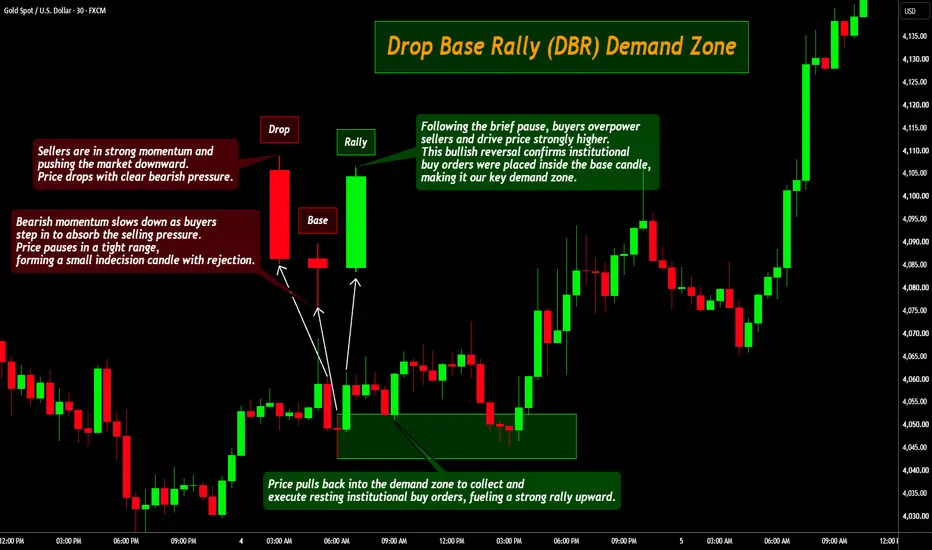
The Drop-Base-Rally (DBR) is one of the strongest bullish reversal patterns in institutional Supply and Demand trading. It forms at the end of a downward move when selling pressure gets absorbed by smart money inside a tight consolidation, followed by an explosive bullish rally—leaving behind a high-probability Demand Zone.
Here is the step-by-step candle-by-candle breakdown of how a DBR Demand Zone forms and how institutional pending orders get executed:
1. The Drop Candle (Bearish Push)
The setup begins with a solid bearish Drop candle. At this stage, bears step in with strong selling pressure and take temporary control of price, driving the market downward with clear conviction.

2. Drop and Base Candle (Selling Absorption & Pause)
Right after the downward push, selling momentum fades as institutional buyers step in to absorb the bearish pressure. The market pauses in hesitation, forming a small-bodied Base candle that signals indecision and smart-money accumulation.

3. Drop-Base-Rally Completion (Bullish Reversal)
Following the brief pause inside the base, buyers step in aggressively and push the market sharply higher with a strong bullish Rally candle. This powerful breakout proves that institutional buy orders were accumulated inside the Base candle, making that base our key Demand Zone.

4. Marking the Demand Zone (Resting Pending Orders)
Because institutional buy orders are too large to get filled all at once during the initial reversal, unfilled institutional pending buy orders remain resting inside this Demand Zone. Instead of chasing the rally, smart traders draw the Demand Zone across the Base candle and wait patiently for price to pull back into the zone.

5. Retest & Pending Order Execution
Later on, price returns to the Demand Zone to collect and execute those resting institutional buy orders. Once triggered, buyers regain full control and launch the market strongly higher—offering a clean, high risk-to-reward buy opportunity.

Key Trading Takeaways:
Here is the step-by-step candle-by-candle breakdown of how a DBR Demand Zone forms and how institutional pending orders get executed:
1. The Drop Candle (Bearish Push)
The setup begins with a solid bearish Drop candle. At this stage, bears step in with strong selling pressure and take temporary control of price, driving the market downward with clear conviction.
2. Drop and Base Candle (Selling Absorption & Pause)
Right after the downward push, selling momentum fades as institutional buyers step in to absorb the bearish pressure. The market pauses in hesitation, forming a small-bodied Base candle that signals indecision and smart-money accumulation.
3. Drop-Base-Rally Completion (Bullish Reversal)
Following the brief pause inside the base, buyers step in aggressively and push the market sharply higher with a strong bullish Rally candle. This powerful breakout proves that institutional buy orders were accumulated inside the Base candle, making that base our key Demand Zone.
4. Marking the Demand Zone (Resting Pending Orders)
Because institutional buy orders are too large to get filled all at once during the initial reversal, unfilled institutional pending buy orders remain resting inside this Demand Zone. Instead of chasing the rally, smart traders draw the Demand Zone across the Base candle and wait patiently for price to pull back into the zone.
5. Retest & Pending Order Execution
Later on, price returns to the Demand Zone to collect and execute those resting institutional buy orders. Once triggered, buyers regain full control and launch the market strongly higher—offering a clean, high risk-to-reward buy opportunity.
Key Trading Takeaways:
- Define the Demand Zone: Mark the high and low of the Base candle where institutional accumulation took place.
- Wait for the Pullback: Never chase the breakout candle; let price retrace into the Demand Zone to trigger resting pending buy orders.
- Trade Fresh Zones Only: The first retest of an untouched DBR Demand Zone offers the highest probability of an explosive bullish bounce.

ForexBee
Publicaciones relacionadas
Exención de responsabilidad
La información y las publicaciones no constituyen, ni deben considerarse como, asesoramiento o recomendaciones financieras, de inversión, de trading u otro tipo, proporcionadas o respaldadas por TradingView. Obtenga más información en Condiciones de uso.