SMC Pro: Strategy & Liquidity
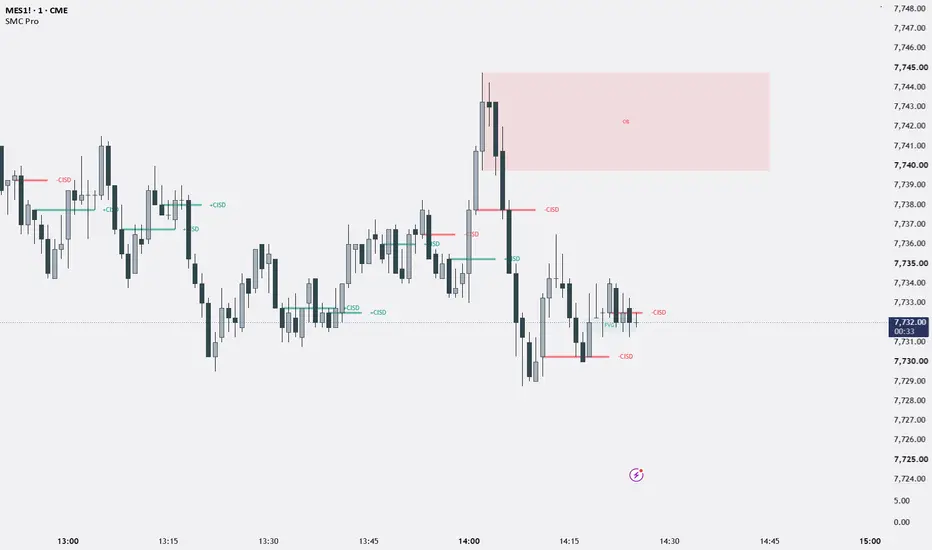
SMC Pro: Strategy & Liquidity
OVERVIEW
SMC Pro: Strategy & Liquidity is a Smart Money Concepts toolkit built around one
idea: a price level only matters once the liquidity resting at it has been taken,
and a liquidity raid only matters once price confirms that delivery has changed
direction afterwards. Instead of plotting every pattern the market prints, the
script sequences six engines so that context, the raid, and the confirmation are
read in order on a single overlay.
The six engines are:
1. Higher timeframe and session reference levels
2. Confirmed liquidity sweeps
3. Fair Value Gaps and Inverse Fair Value Gaps
4. Order Blocks and Breaker Blocks
5. CISD - Change In State Of Delivery, with a dashboard and alerts
6. SMT divergence against a correlated symbol
Every engine evaluates on closed bars. Zones, sweeps, structure breaks and CISD
events are not created or removed based on the movement of the unclosed candle.
WHAT MAKES IT DIFFERENT
The individual concepts here are public knowledge in the Smart Money Concepts
community. What this script contributes is how they are filtered and joined
together:
- Reference levels carry an invalidation state. Once price has CLOSED through a
1H, 4H or session level, that level is permanently disqualified from producing
a sweep for the remainder of its cycle. A level that has already been accepted
by price is no longer liquidity, so it stops being tested as such. Most sweep
tools re-flag the same level repeatedly after it has been broken.
- Only the first sweep per side is drawn per reference cycle. The flags reset
when a new 1H, 4H or session level is confirmed. One raid produces one marker
rather than a cluster of near-duplicates.
- The CISD engine anchors to a swept series, not to a single candle. A candidate
is built from consecutive same-direction candles that swept a confirmed swing,
and the delivery level is taken from the opening price of the FIRST candle in
that series - the price at which the raid began. The confirmed zone then covers
the entire high-to-low range of the series rather than one candle's body.
- Opposing CISD setups cannot both survive. Confirming one direction cancels the
pending setup on the other side, and an optional conflict window removes a
preceding opposite CISD when a new one confirms immediately behind it. The
chart never shows two contradictory claims on the same move.
- FVGs and Order Blocks have a full lifecycle rather than a binary valid/invalid
state: mitigation, inversion or breaker conversion, then a second invalidation
that removes them. An inverted FVG restarts its mitigation clock from the
inversion bar so it can be re-tested in its new role.
HOW EACH ENGINE WORKS
Higher timeframe and session levels
The script requests the high and low of the previous COMPLETED 1H and 4H candle,
and tracks the high and low of each COMPLETED Asian, London and New York session.
Session windows and the session timezone are user-configurable; the timezone
defaults to the exchange timezone so levels stay correct across instruments.
These levels are the pools that the sweep engine tests against.
Liquidity sweeps
A sweep is marked only when a single candle wicks through a reference level and
closes back on its origin side:
Bearish - open below the level, high above it, close back below it
Bullish - open above the level, low below it, close back above it
The invalidation and first-sweep-only filters described above then decide whether
the event is drawn. Confirmed sweeps print a LIQ SWEEP marker at the level.
Fair Value Gaps and Inverse Fair Value Gaps
Three-candle imbalances are detected on confirmed bars: bullish when the current
low is above the high two bars back, bearish when the current high is below the
low two bars back. Trading back into a zone marks it mitigated, and the box stops
extending. A close through the far side inverts the zone: it flips polarity, is
relabelled IFVG, and its mitigation clock restarts from the inversion bar. An
inverted zone that is invalidated a second time is removed.
Order Blocks and Breaker Blocks
Order Blocks are structure-confirmed rather than pattern-guessed. The script
tracks confirmed swing pivots; when price closes through an active swing high,
the most recent down-close candle before that break is stored as a bullish Order
Block, and the mirror applies for bearish. Each swing can be used only once, and
the source candle must sit within a configurable lookback of the break, so a
stale candle cannot be retro-fitted onto a much later structural move. A failed
Order Block can be converted into a Breaker Block: the zone flips polarity, is
relabelled BB, and becomes a retest area in the opposite direction. With breaker
conversion disabled, failed Order Blocks are removed instead.
CISD - Change In State Of Delivery
Building the setup. A bullish candidate begins when a down-close candle sweeps
liquidity below. With the swing sweep filter enabled (default) that means trading
below the most recent CONFIRMED swing low; with it disabled, simply taking the
previous candle's low. Consecutive down-close candles extend the same series, and
the delivery level is anchored to the opening price of the first candle in the
series. Bearish candidates mirror this with up-close candles sweeping a high.
Confirmation. While pending, a dotted line projects forward from the delivery
level. The CISD confirms when a bar CLOSES through that line - above it for
bullish, below it for bearish - within the configured lifetime. If no close
reclaims the level in time the setup expires and its pending line is removed
rather than left on the chart.
On confirmation the script draws the delivery line in the directional colour, a
+CISD or -CISD label, a zone covering the full range of the setup series, and a
coloured halo marking the sequence.
Dashboard. An optional table reports running bullish and bearish CISD counts for
the chart timeframe, current pending state, the most recent event and its bar,
glow status, and how many drawings are retained against the cap. A compact mode
reduces it to counts, last event and sequence status.
SMT divergence
Confirmed pivots on the chart symbol are compared against a correlated symbol.
Bullish SMT is flagged when the chart makes a lower low while the correlated
symbol holds above its prior pivot low; bearish SMT when the chart makes a higher
high while the correlated symbol fails to. An alignment setting caps how far
apart the two pivots may be in bars, so unrelated pivots are never paired.
HOW TO USE IT
The engines are meant to be read in sequence:
1. Where is the liquidity? Read the higher timeframe and session levels.
2. Has it been taken? Wait for a LIQ SWEEP marker, or for a CISD setup series
to sweep a confirmed swing.
3. Has delivery changed? A confirmed +CISD or -CISD after that raid is the
signal that the sweep was a reversal rather than continuation. The CISD zone
marks the range of the candles that did the sweeping.
4. Where would you engage? Use the FVG, IFVG, Order Block and Breaker zones
left behind by the resulting displacement as the retracement areas.
5. Confluence. An SMT divergence aligned with the same raid, or a glow-marked
CISD sequence, adds weight to the read.
Suggested starting values for CISD Lifetime, the number of bars a pending setup
stays valid: 1m 10-20, 5m 12-24, 15m 8-16, 1H 4-8, 4H 3-6, Daily 3-5. Increase it
if setups expire just before they would have confirmed; decrease it if stale
pending lines linger.
Alerts are available for a confirmed bullish CISD, a confirmed bearish CISD,
either direction, and for the bullish and bearish glow sequences.
SETTINGS
HTF & Liquidity - toggles for HTF levels, session levels and sweeps; the three
session windows and their timezone; level projection length; maximum retained
sweep drawings.
FVG - display toggle, forward extension, maximum retained zones.
Order Blocks - display toggle, breaker conversion toggle, source-candle lookback,
forward extension, maximum retained zones.
CISD - display toggle, lifetime, forward extension, swing sweep filter and its
pivot length, conflict window, and full visual control over labels, pending
lines, zones, transparency, line width and style, colours, glow width, colour and
transparency, drawing cap, alert toggles, and dashboard position, text size and
compact mode.
SMT - correlated symbol, display toggle, pivot length, alignment tolerance,
maximum retained drawings.
LIMITATIONS AND DISCLAIMER
Higher timeframe levels are taken from the previous completed candle, so they are
stable on the chart timeframe. Session levels appear only after the session has
closed.
Swing pivots require bars on both sides before they confirm, so the features that
depend on structure - Order Blocks, the CISD swing sweep filter and SMT - confirm
with the natural lag of pivot detection. This is inherent to pivot logic.
SMT requires the correlated symbol to be genuinely correlated and available on
your data subscription. Pairing unrelated instruments produces meaningless
divergences.
Drawing counts are capped by the maximum settings in each group; the oldest
drawings are removed as new ones form. Very low caps on a busy chart will discard
history quickly.
This script is an analysis and visualisation tool. It is not a signal service and
it does not generate orders. It highlights context and confirmation; entry, stop,
target and position sizing decisions remain entirely with the trader. Nothing
here is financial advice, and the historical behaviour of any pattern does not
guarantee future results.

Exención de responsabilidad
La información y las publicaciones no constituyen, ni deben considerarse como, asesoramiento o recomendaciones financieras, de inversión, de trading u otro tipo, proporcionadas o respaldadas por TradingView. Obtenga más información en Condiciones de uso.
Exención de responsabilidad
La información y las publicaciones no constituyen, ni deben considerarse como, asesoramiento o recomendaciones financieras, de inversión, de trading u otro tipo, proporcionadas o respaldadas por TradingView. Obtenga más información en Condiciones de uso.