Actualizado
Time Range ORB Detector [34ematrader]
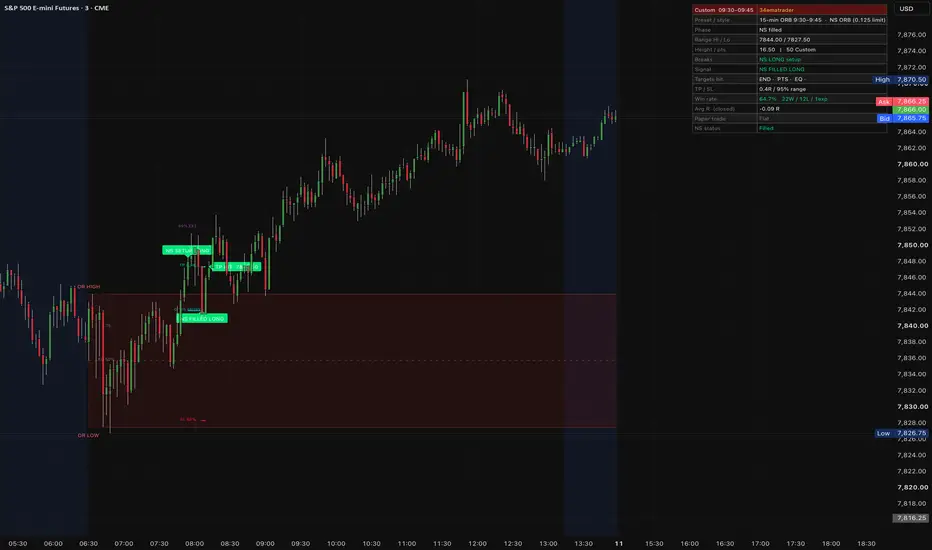
Time Range ORB + Reversal is a session-range toolkit for futures and indices.You choose the market (point defaults for NQ, ES, YM, RTY, metals, oil) and the clock window: NY pre-open hour, 5/15/30-minute opening range, initial balance, London hour, or a custom start/end or start+duration. Timezone is selectable (America/New_York handles DST).
After the window locks, the script detects the first break of the range high or low (wick or close). Trade style is selectable:
1. fade the first break toward the opposite end,
2. trade the breakout,
3. breakout first, then a second signal if the opposite end is taken.
Optional confirmation: sweep only, close back inside, or opposing candle.
Risk is user-defined: take profit in ATR multiples (default 1.0), stop in ATR multiples (default 0.5), or a swing/pivot stop, or the tighter/wider combination. The table shows paper-trade win rate, W/L/expired, and average R for the current settings on loaded history. If TP and SL trade in the same bar, the stop is counted first. This is not the Strategy Tester and not a live brokerage record.
Originality: Source is original Pine v6. It does not reuse another TradingView publication’s code. Building a high/low from a time window is a common method (opening range / session range).
A public process that uses 08:12–09:12 ET is one optional preset only. This script is independent and is not affiliated with, approved by, or a product of any third-party educator or paid community. Use on 1- or 5-minute charts so session boundaries land on bars.
Not financial advice
Notas de prensa
Updated labels for the take profit to be more visible Notas de prensa
Added an additional model. The NS ORB (0.125 limit) is the new trade style added the Time Range ORB Detector indicator. Core idea
After the opening range locks, you do not market-order the break. You wait for a full-body 5-minute candle to close outside the range, then place a limit order at a precise 12.5% pullback level inside the range. The stop and target are fixed as percentages of the range itself. The limit stays live until 14:30 NY even if price has already reached the 50% extension.
What the indicator does when this style is selected
Builds the range normally (default 15-min ORB 9:30–9:45).
On the first qualifying full-body close outside the range it:
Labels the bar “NS SETUP LONG” or “NS SETUP SHORT”
Draws the 0.125 entry line, 95% SL, 0.4R TP, and (optionally) the 50% extension
The entry line stays live. If price later touches it before 14:30, it labels “NS FILLED LONG/SHORT” and starts the paper-trade tracker using those exact levels.
If the limit is never touched by 14:30, it expires.
All of this feeds the existing win-rate / average-R table so you can see how the model is performing on your chart history.
Inputs you can tweak (NS ORB group)
Entry pullback fraction (default 0.125)
SL protect fraction (default 0.95)
TP R multiple (default 0.4)
Full-body requirement (open and close outside, or close only)
Show 50% extension and internal 0.25/0.50/0.75 levels
How to use it
Chart: 5-minute
Style: NS ORB (0.125 limit)
Session preset: 15-min ORB 9:30–9:45
Signal cutoff: already defaults to 14:30
Everything else in the indicator (other styles, TBR windows, ATR/swing risk, table, alerts, historical boxes, etc.) continues to work unchanged. The NS path simply overrides the entry/SL/TP calculation and the signal timing when that style is active.
This is a pure structural, high-win-rate, small-R model that relies on the statistical tendency for a close outside the ORB to reach the 50% extension, while entering on a controlled pullback and risking almost the full range.

Exención de responsabilidad
La información y las publicaciones no constituyen, ni deben considerarse como, asesoramiento o recomendaciones financieras, de inversión, de trading u otro tipo, proporcionadas o respaldadas por TradingView. Obtenga más información en Condiciones de uso.
Exención de responsabilidad
La información y las publicaciones no constituyen, ni deben considerarse como, asesoramiento o recomendaciones financieras, de inversión, de trading u otro tipo, proporcionadas o respaldadas por TradingView. Obtenga más información en Condiciones de uso.