OPEN-SOURCE SCRIPT
MTF Bias Table
Script name
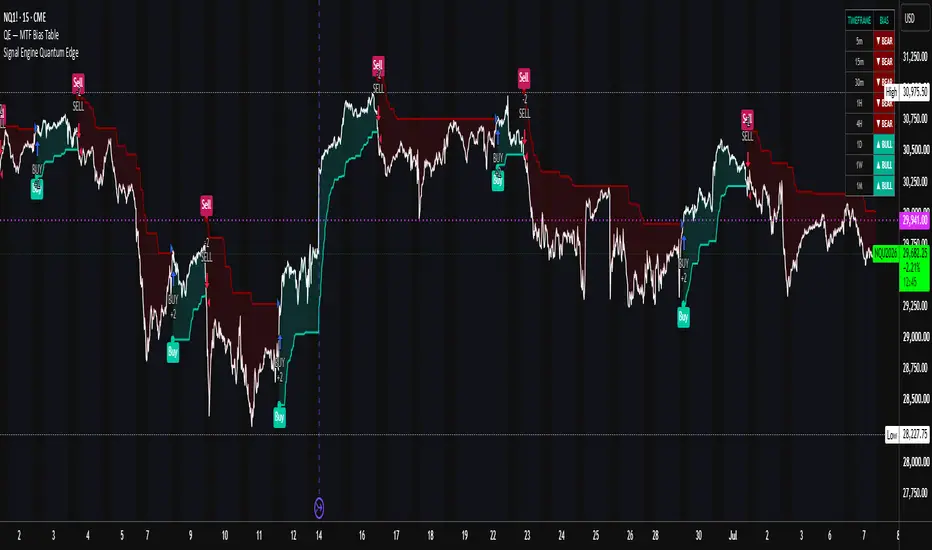
QE — MTF Bias Table
Short description
Multi‑timeframe trend bias dashboard. Compares fast vs. slow MA alignment across 5m through 1M to classify each timeframe as bullish or bearish at a glance.
Description
QE — MTF Bias Table is a non‑repainting, multi‑timeframe trend dashboard built for traders who need higher timeframe context before entering lower timeframe setups. It evaluates fast vs. slow moving average alignment across eight timeframes (5m, 15m, 30m, 1H, 4H, 1D, 1W, 1M) and prints a clean, color‑coded table directly on the chart.
The indicator is intentionally designed to pair with order‑flow, structure, and liquidity tools. It does not predict direction; it answers one question: “Is this timeframe aligned bullish or bearish?”
How it works
Fast MA > Slow MA = Bullish alignment (green “▲ BULL”)
Fast MA < Slow MA = Bearish alignment (red “▼ BEAR”)
All MTF requests use lookahead disabled to prevent repainting. The script reads a fresh close‑based value at each higher timeframe candle, so the bias state is stable and reflects the confirmed bar, not the developing one.
Configurable inputs
Fast MA Length (default 20)
Slow MA Length (default 50)
MA Type (EMA or SMA)
Why use this
Instantly see if your entry timeframe aligns with the daily/weekly bias
Avoid counter‑trend entries when the HTF is stacked against you
Use it as a filter: only trade setups that agree with the higher timeframe bias
Compact table design with minimal chart clutter
Tags
multi-timeframe
trend
bias
dashboard
Usage note
This is a bias filter, not an entry system. Combine it with your own structure, liquidity, and confirmation models for a complete trading plan.
QE — MTF Bias Table
Short description
Multi‑timeframe trend bias dashboard. Compares fast vs. slow MA alignment across 5m through 1M to classify each timeframe as bullish or bearish at a glance.
Description
QE — MTF Bias Table is a non‑repainting, multi‑timeframe trend dashboard built for traders who need higher timeframe context before entering lower timeframe setups. It evaluates fast vs. slow moving average alignment across eight timeframes (5m, 15m, 30m, 1H, 4H, 1D, 1W, 1M) and prints a clean, color‑coded table directly on the chart.
The indicator is intentionally designed to pair with order‑flow, structure, and liquidity tools. It does not predict direction; it answers one question: “Is this timeframe aligned bullish or bearish?”
How it works
Fast MA > Slow MA = Bullish alignment (green “▲ BULL”)
Fast MA < Slow MA = Bearish alignment (red “▼ BEAR”)
All MTF requests use lookahead disabled to prevent repainting. The script reads a fresh close‑based value at each higher timeframe candle, so the bias state is stable and reflects the confirmed bar, not the developing one.
Configurable inputs
Fast MA Length (default 20)
Slow MA Length (default 50)
MA Type (EMA or SMA)
Why use this
Instantly see if your entry timeframe aligns with the daily/weekly bias
Avoid counter‑trend entries when the HTF is stacked against you
Use it as a filter: only trade setups that agree with the higher timeframe bias
Compact table design with minimal chart clutter
Tags
multi-timeframe
trend
bias
dashboard
Usage note
This is a bias filter, not an entry system. Combine it with your own structure, liquidity, and confirmation models for a complete trading plan.
Script de código abierto
Fiel al espíritu de TradingView, el creador de este script lo ha convertido en código abierto, para que los traders puedan revisar y verificar su funcionalidad. ¡Enhorabuena al autor! Aunque puede utilizarlo de forma gratuita, recuerde que cualquier republicación del código está sujeta a nuestras Normas internas.

Any Questions or concerns, contact: Founder@quantumedge.finance
Sincerly, Alexander Morhan
Sincerly, Alexander Morhan
Exención de responsabilidad
La información y las publicaciones no constituyen, ni deben considerarse como, asesoramiento o recomendaciones financieras, de inversión, de trading u otro tipo, proporcionadas o respaldadas por TradingView. Obtenga más información en Condiciones de uso.
Script de código abierto
Fiel al espíritu de TradingView, el creador de este script lo ha convertido en código abierto, para que los traders puedan revisar y verificar su funcionalidad. ¡Enhorabuena al autor! Aunque puede utilizarlo de forma gratuita, recuerde que cualquier republicación del código está sujeta a nuestras Normas internas.
Any Questions or concerns, contact: Founder@quantumedge.finance
Sincerly, Alexander Morhan
Sincerly, Alexander Morhan
Exención de responsabilidad
La información y las publicaciones no constituyen, ni deben considerarse como, asesoramiento o recomendaciones financieras, de inversión, de trading u otro tipo, proporcionadas o respaldadas por TradingView. Obtenga más información en Condiciones de uso.