Actualizado
Sphinx KVP - Key Levels, VIX & Psychology
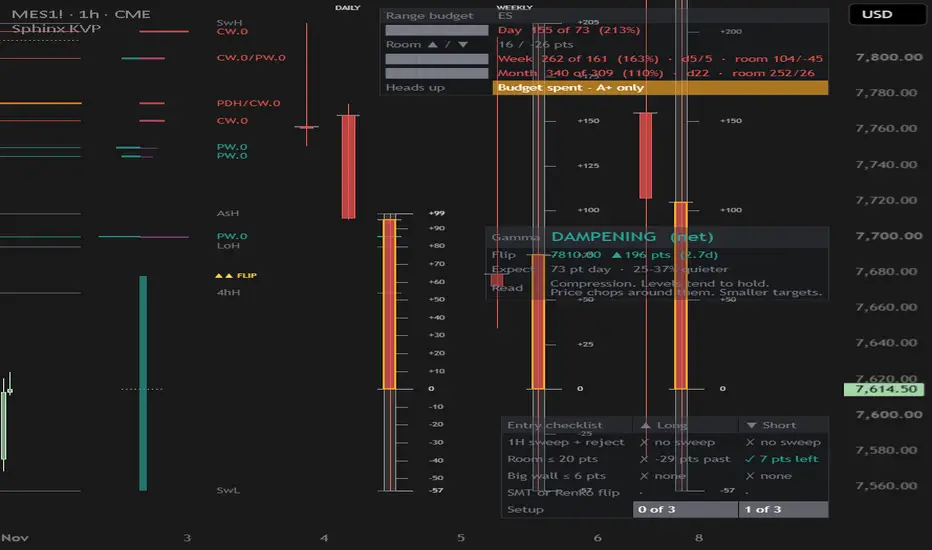
Sphinx KVP is a context and discipline tool for intraday index futures traders. It combines four questions into one chart and panel:
DESCRIPTION
Range budget: how much of today's move is already paid for?
Volatility: how big a day is the options market pricing?
Key levels: where are the levels that matter, and is there untaken liquidity beyond the obvious one?
Psychology: am I in a state to trade, and am I about to enter early?
It does not generate buy or sell signals. Every prompt describes where you stand relative to the context, never where price will go.
━━━━━━━━━━━━━━━━━━━━
RANGE BUDGET
The trading day is anchored at the 18:00 New York open. The budget is the median daily range of the last 20 completed days, held constant through the session. The panel shows range used, points of room left above and below, and whether the day is approaching or past its typical size.
VOLATILITY
The implied daily move is taken from the matching CBOE volatility index, locked at the 18:00 open: VIX for ES, VXN for NQ, RVX for RTY, GVZ for GC.
Term structure (VIX9D vs VIX) and VVIX show whether near-term fear is building.
Self-calibration: the script records every completed day and compares the real range with what the average day and the volatility index predicted.
It reports how far off each forecast has been.
It shows an adjusted implied move, because implied volatility normally prices above what actually happens.
It flags a "bigger" or "quieter" day only when today is unusual relative to recent days.
Until enough days are recorded, it uses fixed thresholds and says so.
KEY LEVELS AND KEY ZONES
Liquidity levels are tracked with a naked / swept / broken state:
previous day high/low
Asia and London session high/low
previous 4H candle high/low
previous week high/low (optional)
A swept level (wicked through, back inside) stays on the chart. A broken level is removed as soon as price trades beyond it.
A key zone is where structure and untaken liquidity sit together:
With gamma data loaded: a gamma wall within the confluence radius of an unbroken liquidity level.
Without it: a range-budget projection stands in for the wall.
The nearest key zone above and below price is drawn and listed in the panel.
DON'T FADE (INDUCEMENT) ZONES
The shaded purple zone marks the space between an obvious level and a naked liquidity level just beyond it, when the remaining budget can reach that liquidity. Entering at the obvious level is the early trade. The zone ends in one of three ways:
Swept and reclaimed (closes back inside within the reclaim window): the event worth waiting for.
Swept without reclaim: the level broke.
Price moves away: nothing to act on.
If the budget cannot reach the liquidity, no zone is drawn: the obvious level may simply be the level.
GAMMA (OPTIONAL)
Paste a gamma string exported from your own options data provider:
SYM.DTE:F{flip}|T{unix time}|N{net,call,put}|CW{strike:exposure:oi,...}|PW{...}
Segments are separated by ; and fields are identified by prefix.
Walls: each wall is drawn with a diverging exposure bar (call exposure right, put exposure left) and an open interest bar beneath.
Market mode: read from net gamma exposure or the flip. The panel flags when those two disagree.
Expiry: a 0DTE board exported before the current 18:00 open is marked expired and removed from all calculations. Expired walls can be shown faded for reference.
No gamma: everything else works without it, and market mode falls back to the volatility read.
PSYCHOLOGY
Pre-session checklist: plan reviewed, mentally prepared, max loss set and accepted, sleep quality. Add up to five of your own rules. It counts only when its date is set to today, so it never carries over. Until it is complete, the status reads NOT CLEARED with the next unchecked item.
Loss log: enter the time of each loss. Losses count per CME trading day. Each one starts a cooldown ("step away, get some air"), and reaching your limit shows STOP. Low sleep lowers the limit by one (optional).
Heads-up prompts: entering a Don't Fade zone early, chasing a new extreme late in the budget, budget spent, negative gamma at a wall.
POWER OF 3 CANDLES
The two previous days and today are drawn to the right of price at true levels, built 18:00 to 18:00, with each candle's open marked. Labels show the range and the distance travelled above and below the open.
━━━━━━━━━━━━━━━━━━━━
SETUP
Add to a time-based intraday chart. A 5-minute chart is a good default: levels are identical across timeframes, and reclaims confirm on 5-minute closes.
Optionally paste your gamma string each session. If you also use a separate gamma-level indicator, turn off "Draw key levels".
Each session, set the checklist date to today and tick your items.
ALERTS
Entered a Don't Fade zone · sweep and reclaim · sweep without reclaim · key zone reached · range budget exhausted.
NOTES AND LIMITATIONS
Not for Renko, range or other non-time charts. Session levels and daily data depend on clock-based bars.
CBOE data is delayed on free plans. The implied budget locks from the prior close, so it is unaffected. Live term-structure and VVIX readings will lag.
Pine Script cannot see your fills. Losses are logged by hand.
Alerts store settings at creation. Cooldown and checklist states are shown on the chart only. Re-create alerts after pasting a new gamma string.
Your data, your assumptions. Gamma levels are only as current as the string you paste. Wall roles rest on the standard dealer-positioning assumption, which is a convention, not observed inventory.
This script is for education and decision support. It is not financial advice and makes no claim about future performance.
Notas de prensa
v1.3.0: Regime and VIX now shape the Don't Fade zonesRegime-aware zones (new default)
Positive gamma, large wall: when the obvious level is a large wall (70%+ of the biggest wall exposure on the board), the zone now reads TWO-WAY in blue, meaning the wall can hold on its own. The liquidity beyond is still shown. The early-entry prompt is replaced with a two-way note.
Negative gamma, or smaller walls: zones behave as before (don't fade, wait for the liquidity).
New setting, "Inducement priority": Regime-aware / Liquidity first (previous behaviour) / Walls first (zones only when no live walls exist).
VIX-scaled box reach
The maximum distance from the obvious level to the liquidity now scales with the calibrated VIX read: ×1.5 on a bigger-than-usual day, ×0.6 on a quieter one.
A new Box reach row in the panel shows the current limit and why.
The default reach is now 0.25 × daily ATR (was 0.50), sized for short-target intraday trading.
Display
Inducement shading is stronger, so it reads on dark themes. The two-way colour is adjustable in Display.
Your published description also has a "DON'T FADE (INDUCEMENT) ZONES" section. Replace it with this so the description matches:
DON'T FADE (INDUCEMENT) ZONES
The shaded zone marks the space between an obvious level and a naked liquidity level just beyond it, when the remaining budget can reach that liquidity.
Purple, "don't fade": entering at the obvious level is the early trade. Wait for the liquidity.
Blue, "two-way": in positive gamma, a large wall can hold on its own. Both the wall and the liquidity beyond are in play.
The zone ends in one of three ways:
Swept and reclaimed (closes back inside within the reclaim window): the event worth waiting for.
Swept without reclaim: the level broke.
Price moves away: nothing to act on.
How far past the obvious level the liquidity may sit (box reach) scales with the volatility read: longer on a bigger-than-usual day, shorter on a quieter one. If the budget cannot reach the liquidity, no zone is drawn.
Notas de prensa
v1.4.1: Swing strength now defaults to 1 (3-candle swing). Swings are removed as soon as price trades through them. Each swing line starts at the candle that made it, with a marker on that candle.Notas de prensa
v1.5.0: Entry checklist, 1H swings and regime-aware zonesEntry checklist: a new table scores long and short setups separately. The default rules are a 1H swing sweep and reject, room left at the sweep extreme (≤ 20 points), a high magnitude wall at the sweep, and a manual lower-timeframe trigger. Every rule is switchable and tunable, with two custom rows. Setups show READY, and are marked blocked while the pre-session status isn't cleared. New alerts: long and short setup ready.
1H swing highs and lows: added as liquidity levels. They're confirmed and non-repainting, removed once price trades through them, and each is drawn from the candle that made it.
Regime-aware zones: in positive gamma, a large wall's zone reads TWO-WAY (blue). Zone reach scales with the VIX read.
Walls: up to 10 per side per board.
Layout: Power of 3 candles now sit after the level labels, clear of the panel.
Notas de prensa
v1.9.0: A point scale on the ghost candle shows the points of room above and below current price (or today's open), for placing stops and targets. Levels within today's reach are marked on the candle. Label colour and size can now be customized.Notas de prensa
Add manual entries for call wall and pull wall. Notas de prensa
v1.11.2: 1H swings now follow market structure. There's one active swing high and low; when one breaks, the opposite swing moves to the protected extreme of the breaking leg. Swing markers sit on the exact candle that set them.Notas de prensa
v1.12.1 — Weekly range budgetAdds a weekly budget in its own panel: how much of a typical week this week has already delivered, the room left either way, and which day of five it is. The denominator is the median weekly range over the last 20 completed weeks, taken with a one-bar offset so the forming week never enters its own benchmark and the figure stays constant through the week. The week is anchored to the Sunday 18:00 NY open and tracked from the clock rather than read off the weekly bar.
A “by day” row breaks the week down Monday to Friday. This is extension contribution, not each day’s own range — only the points by which a day pushed the running week high or low outward — so a day that trades inside the existing week range correctly reads zero, and the five sum to the week’s range exactly.
Note that a weekly range is not five daily ranges. Price mean-reverts inside the week, so on index futures the weekly median typically runs around two to two and a half times the daily. No verdict label is applied to either reading: whether a spent week caps the following sessions or precedes continuation has not been measured, and the panel states the numbers rather than asserting a conclusion.
Notas de prensa
Added weekly range budget ghost candle Notas de prensa
Added monthly budget. Reduce PO3 to PO2 for weekly and daily candles. Notas de prensa
Adjust the padding between PO3 candles. Notas de prensa
v1.16.2 — Room rule fix, range regimeFixes a scoring error in the entry checklist. The Room ≤ 20 pts rule passed on negative readings: −42 is arithmetically at or under 20, so it scored a point. But the two readings mean opposite things — 20 means price is near the edge of the day’s expected range, −42 means price is 42 points past that edge, which argues for continuation rather than exhaustion. The rule was firing hardest on the days it was least reliable. Room must now also be at or above zero, and the cell reads “pts past” instead of “pts left” when it isn’t. A toggle restores the old behaviour.
Adds a range regime row under the budget gauge: a short-window median daily range divided by the long-window one, both from completed days. This is separate from the Market mode row, which describes dealer hedging — this one describes how wide days have been running, and the two can disagree.
Its job is the ambiguity in a reading past 100%. On its own that could mean the day is finished or that the denominator is too low; paired with an elevated ratio it means the second, and the gauge now says EXPANDING rather than leaving it to read as exhaustion. Volatility expands in hours and decays over weeks, so a fixed window reads stale on the first day of a new climate. Note the ratio uses completed daily bars only — it cannot say today is expanding, only that recent days have been.
The point ruler now prints to the right of the current candle, with the daily ghost’s level names moving to the left so the two never collide. Ruler side is an input.
Internally, the last-bar pass is split across two blocks. Pine caps how much can live inside one if block and the single block had grown to carry the whole level pass, three candle columns, three panels and the checklist. The candle columns now build after the panels. No visible change.
Notas de prensa
The gamma sign is corrected. This feed's F field runs inverted to thestandard convention, measured across 192 snapshots over two months and
confirmed on a held-out month.
Price above the flip now reads as
amplifying, not dampening. The mixed-signal warning was firing on the
normal state about 85% of the time; it no longer does. The flip line is
redrawn to match. It takes the regime colour, flags FRAGILE within a
quarter of a day's range, and when the level sits off screen its label
clamps into view with an arrow and the distance. Distance is given in
days of budget as well as points.
Walls carry the regime too: bold in positive gamma, where hedging defends the strike, and thin and faded in negative gamma, where it runs through. DOL levels are unchanged.
The panel now uses one denominator. The gauge used to divide by the average
day while Room and the projections divided by the budget, which differed
whenever the budget came from VIX. Nothing on screen said so. It is also
one table: the weekly and monthly budgets have moved into the
Notas de prensa
Key levels, range budget and dealer positioning in one board.Three panels: a range budget showing how much of a typical day, week
and month has been spent and the room left either way; a gamma panel
reading the dealer regime off a GEX string, with a meter drawn on the
price axis so the flip and current price sit on it at true scale; and
an entry checklist scoring sweep, room and wall proximity.
REQUIRES A GEX STRING for the gamma half. Paste it into the first
field under Gamma. Format is SYM.DTE:F{flip}|N{net},{call},{put}|CW...
|PW..., same as Sphinx DOL+G. Without one the budget panel and levels
still work; the regime, the flip and the spine meter stay dark.
Note the Flip convention input. The default reads price ABOVE the flip
as amplifying, which is inverted from the textbook and is what the
feed this was built against measurably does. If your GEX provider
follows the standard convention, switch it — and verify against your
own data rather than assuming either way.
Notas de prensa
Wall opacity changes based on option level magnitude. 
Hermetic Trader · "What gets measured gets managed."
hermetictrader.com
hermetictrader.com
Exención de responsabilidad
La información y las publicaciones no constituyen, ni deben considerarse como, asesoramiento o recomendaciones financieras, de inversión, de trading u otro tipo, proporcionadas o respaldadas por TradingView. Obtenga más información en Condiciones de uso.