Actualizado
ICT Core: MSS, Liquidity Raids, FPFVG & Gap Quarters
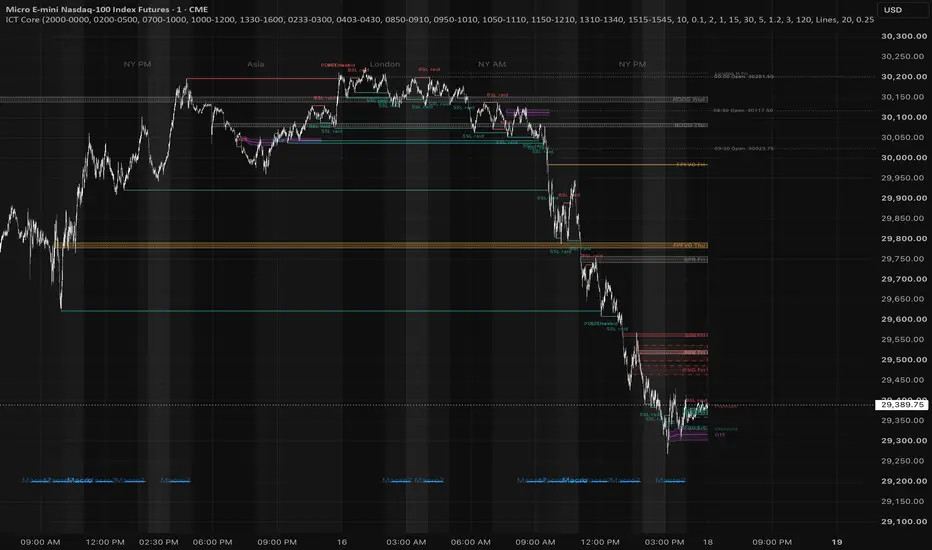
ICT Core is an overlay that organizes the main concepts taught by the Inner Circle Trader into one chart, with strict, non-repainting logic. It is built to help you read context — where liquidity rests, where price is imbalanced, and what time it is — not to generate buy/sell signals.
WHAT IT SHOWS
Market Structure Shift (MSS)
A structure break is labeled MSS only when it happens with displacement: a large-body candle (default: body ≥ 1.2× ATR14) that also leaves a fair value gap, within the last few bars. Breaks without displacement do not flip the structure. An optional "BMS" label marks continuation breaks.
OTE zone
After each MSS, the 62–79% retracement of the displacement leg is drawn, with a 70.5% line. The zone extends with the leg until price first retraces into it, then freezes. It is removed if price closes back through the leg's origin or after a set number of bars.
Liquidity (BSL / SSL)
Buy-side and sell-side liquidity is tracked at prior day high/low, prior week high/low, Asia and London session highs/lows, swing highs/lows, and relative equal highs/lows (REH/REL).
- Raid: price trades through a level and closes back on the original side within a short window (default 2 bars).
- Run: price trades through and holds beyond the window. Runs are not marked as raids.
PD arrays
- FVGs labeled BISI / SIBI, with consequent encroachment (50%) lines.
- Inversion FVGs: a gap that price closes through flips role and is relabeled IFVG.
- First Presented FVG (FPFVG): the first FVG whose first candle opens in the 09:30–10:00 ET window (editable). Kept as a reference for two days.
- NWOG and NDOG with quarter levels (0, 0.25, 0.50, 0.75, 1).
- Balanced price ranges (BPR), volume imbalances (consecutive ones grouped), and optional order blocks with mean threshold.
Dealing range
Premium, discount, and equilibrium of the current swing range.
Time
Killzone shading (Asia, London, NY AM, London Close, NY PM), Silver Bullet windows, and midnight / 08:30 / 09:30 opening prices. Macro windows appear as a line along the bottom of the chart. Each macro window has its own on/off, time, and "Verified" setting, so you can mark only the windows you have confirmed yourself. Verified windows draw solid; unverified ones draw faint with a "Macro?" tag.
SMT divergence
Compares swing highs/lows against a correlated symbol (default ES1!), with an optional second symbol for triad SMT.
Optional
CBDR and Asian range standard-deviation projections.
HOW IT'S BUILT
- All signals use confirmed data and do not repaint. Higher-timeframe and daily/weekly values use closed candles only.
- Anything based on swing pivots confirms N bars after the pivot forms. This lag is inherent and disclosed in the settings.
- A "nearest N" display filter shows only the FVGs closest to price, to reduce clutter. Hidden gaps keep updating in the background.
- All times are locked to New York time regardless of your chart's timezone.
- Alerts: presets for MSS, BSL/SSL raids, OTE entry, and SMT, plus detailed messages via "Any alert() function call".
PARAMETER CHOICES
ICT defines several concepts discretionarily. Where a number was needed, the choice is an input you can change, not an official definition: the displacement threshold, dealing-range pivot length, killzone hours, raid window, and the order block definition (last opposing candle body before the displacement candle).
NOTES
Designed for intraday charts, primarily index futures (NQ/MNQ, ES/MES). On equity charts such as SPY, enable extended hours and consider disabling the Asia/London features.
This script is an independent, original implementation and is not affiliated with, endorsed by, or connected to the Inner Circle Trader (ICT) or Michael J. Huddleston. It is an educational charting tool and does not provide financial advice or trading signals.
Notas de prensa
v1.5: visual cleanupOnly the look changed. MSS, raids, FVGs, OTE and SMT are detected the same way as before, and alerts haven't changed.
- Colors: teal for bullish, red for bearish, grey for reference levels, purple for OTE, amber for the FPFVG.
- Killzones: one light grey shade, with the session name at the top of the chart (you can turn the names off). Silver Bullet windows are a shade darker, and each killzone still has its own color setting.
- Liquidity: key levels like PDH/PDL and the Asia and London highs and lows are thin dotted grey lines labeled with just the name, like "PDH Thu". When one gets raided, the line turns solid red or teal and gets a "raid" tag.
- MSS and SMT: thin lines with small colored text instead of filled labels. SMT now uses the bullish and bearish colors, so it no longer has its own color setting.
- OTE: drawn bar by bar, so you can see where the zone was on each bar, and the active zone has a small "OTE" tag. Past zones now stay on the chart instead of disappearing.
- Dealing range: lines with Premium and Discount labels. Set Style to "Shaded" to get the old look back.
- PD arrays are softer, IFVGs have a dashed border, and opening prices and macros are smaller and lighter.
Already have it on a chart? If it still shows the old colors, open the settings and click Defaults > Reset settings, or remove the indicator and add it back. Resetting wipes any settings you changed, so jot those down first.

Exención de responsabilidad
La información y las publicaciones no constituyen, ni deben considerarse como, asesoramiento o recomendaciones financieras, de inversión, de trading u otro tipo, proporcionadas o respaldadas por TradingView. Obtenga más información en Condiciones de uso.
Exención de responsabilidad
La información y las publicaciones no constituyen, ni deben considerarse como, asesoramiento o recomendaciones financieras, de inversión, de trading u otro tipo, proporcionadas o respaldadas por TradingView. Obtenga más información en Condiciones de uso.