OPEN-SOURCE SCRIPT
Actualizado Arc Engine
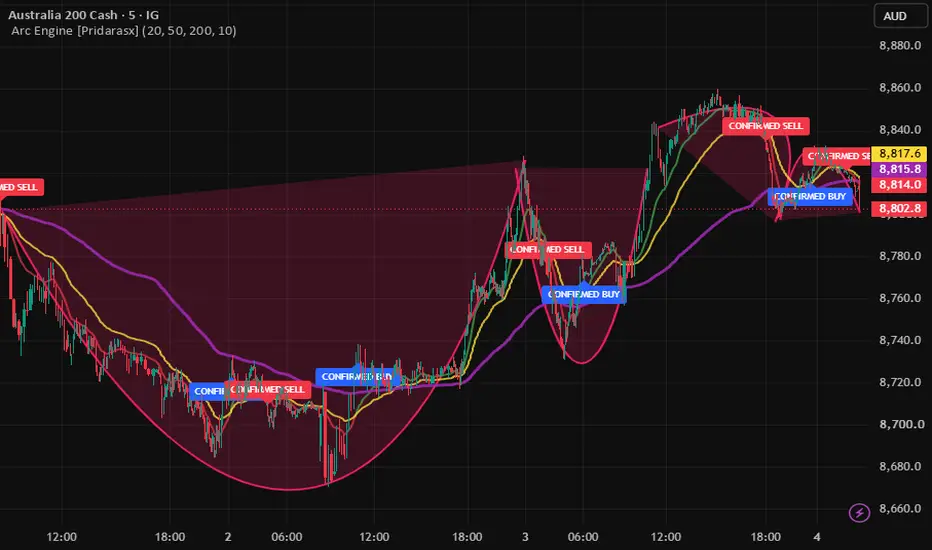
Executive Summary
Arc Engine - is a high-performance, non-repainting quantitative trading script engineered specifically for intraday market structures. The engine is architected to exploit the fractal geometry of financial markets by tracking systematic cycles of expansion and contraction (represented visually as macro structural "arcs").
By mapping the footprints of high-frequency trading (HFT) models and institutional order execution routing, the engine isolates structural exhaustion zones, filters out toxic market noise, and targets explosive breakouts with mechanical precision.
Core System Architecture & Multi-Layer Logic-
The engine structures market data into a clean, hierarchical multi-layered framework designed to eliminate emotional bias and lag:
LAYER 1: THE MACRO BASELINE ANCHOR (200 EMA) |
| Defines the structural environment (Dominant Cycle Slope) |
+------------------------------------------------------------+
│
▼
+------------------------------------------------------------+
| LAYER 2: INSTITUTIONAL RIBBON MATRIX (20 EMA / 50 EMA) |
| Maps short-to-medium term value capture & contraction zones|
+------------------------------------------------------------+
│
▼
+------------------------------------------------------------+
| LAYER 3: CLEAN BREAKOUT FILTER (Execution Trigger) |
| Enforces strict structural clearance rules (No Fake Wicks) |
+------------------------------------------------------------
1. The Macro Baseline Anchor (Layer One)
At the core of the engine sits the 200-period Exponential Moving Average (EMA). Serving as the system's "gravitational center," this line distinguishes between macro expansion and structural mean reversion. In a heavy downward cycle or macro arc formation, this boundary represents the institutional ceiling where short-sellers repeatedly defend liquidity.
2. The Institutional Ribbon Matrix (Layer Two)
The intermediate structural behavior is governed by a smoothed ribbon matrix comprising the 20 EMA (Fast Line) and 50 EMA (Slow Line).
The Squeeze Zone: When these lines compress, flatten, and twist, the engine identifies a low-volatility compression zone (e.g., Wave 2 or Wave B structures).
The Expansion Phase: When the ribbon fans out with a steep slope, it confirms true algorithmic momentum (e.g., Wave 3 or Wave C expansions).
3. The Clean Breakout Filter (Layer Three)
To mitigate the risk of algorithmic "liquidity hunts" (where market makers intentionally trigger retail stops via volatile wicks before reversing price), the engine abandons standard line crossovers.
Execution requires a Clean Candle Breakout:
Long Trigger: The entire body (both the open and the close) of the execution candle must clear completely above the highest boundary of the Ribbon Matrix.
Short Trigger: The entire body of the candle must close completely below the lowest boundary of the Ribbon Matrix.
Algorithmic State Control & Execution Mechanics
Signal Pruning & Noise Reduction
To avoid the mathematical trap of "signal stacking" during high-volatility expansions, the script utilizes a strict persistent state variable architecture (last Signal Direction).
Execution Framework-
The engine is highly optimized for lower timeframes (such as the 1-minute, 2-minute, or 5-minute charts) to capture micro-turns with minimal drawdown.
By implementing the bar state is confirmed runtime condition, the engine evaluates execution rules exclusively at the exact millisecond a bar closes. This mathematically eliminates historical repainting, ensuring back testing performance matches live execution identically.
Notas de prensa
Visual RefreshNotas de prensa
Financial Disclaimer & Terms of Use
This script ("Arc Engine") is a technical analysis tool designed for educational and informational purposes only. It does not constitute financial, investment, legal, or tax advice, nor does it represent a recommendation to buy, sell, or hold any financial instrument.
1. Risk Warning: Trading financial markets involves a high degree of risk. Past performance is not indicative of future results. Highly volatile, small-cap, or low-liquidity assets carry elevated risks of rapid price fluctuations and capital loss.
2. No Guarantees: The author makes no representations or warranties regarding the accuracy, reliability, or completeness of the signals or metrics generated by this tool. Signals are based on historical technical data and are subject to market anomalies and false signals.
3. User Responsibility: You are solely responsible for your own trading decisions and risk management. Always conduct your own thorough research, backtest across multiple market conditions, and consult with a licensed professional before risking capital. The author assumes no liability for any financial loss or damages resulting directly or indirectly from the use of this script.
Script de código abierto
Fiel al espíritu de TradingView, el creador de este script lo ha convertido en código abierto, para que los traders puedan revisar y verificar su funcionalidad. ¡Enhorabuena al autor! Aunque puede utilizarlo de forma gratuita, recuerde que cualquier republicación del código está sujeta a nuestras Normas internas.

Exención de responsabilidad
La información y las publicaciones no constituyen, ni deben considerarse como, asesoramiento o recomendaciones financieras, de inversión, de trading u otro tipo, proporcionadas o respaldadas por TradingView. Obtenga más información en Condiciones de uso.
Script de código abierto
Fiel al espíritu de TradingView, el creador de este script lo ha convertido en código abierto, para que los traders puedan revisar y verificar su funcionalidad. ¡Enhorabuena al autor! Aunque puede utilizarlo de forma gratuita, recuerde que cualquier republicación del código está sujeta a nuestras Normas internas.
Exención de responsabilidad
La información y las publicaciones no constituyen, ni deben considerarse como, asesoramiento o recomendaciones financieras, de inversión, de trading u otro tipo, proporcionadas o respaldadas por TradingView. Obtenga más información en Condiciones de uso.