Directional Path Entropy Spectrum [Pineify]
Overview
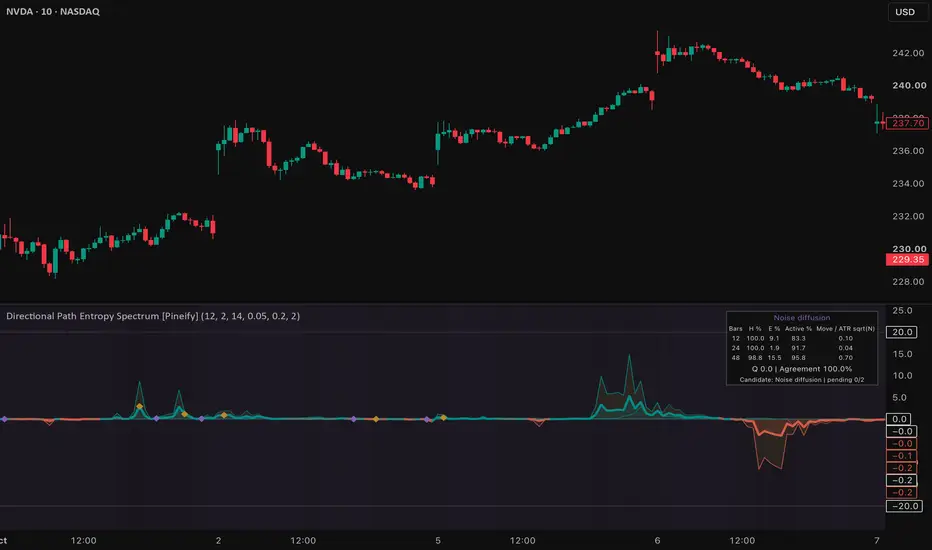
This trend quality indicator separates directional count imbalance from efficient price displacement. Three nested windows form a signed field; an optional fan shows score disagreement.
Problem Definition
An equal net move can result from mostly one-sided closes or large offsetting steps. A slope hides the distance spent getting there. Binary sign entropy alone also fails: a single active step among many inactive bars has zero entropy. Quality requires count imbalance, efficient displacement and activity together. Here, "ordered" describes those measurements, not the temporal order of returns.
Design Rationale
A prior-ATR dead zone excludes tiny direction counts; active share limits sparse samples. Path efficiency penalizes travel that cancels; ATR-scaled displacement suppresses small but perfectly efficient moves. Multiplication lets a weak component constrain quality; addition could mask it. Signed score agreement discounts opposing windows. Nested windows share samples; agreement is not independent evidence. Hysteresis and consecutive closes reduce phase chatter at the cost of delay.
Key Features
How It Works
Defaults use 12, 24 and 48 bars, with a 14-bar ATR. Each valid close step is positive or negative only beyond the larger of 0.05 prior ATR and half a tick; other steps are inactive. In each window, H is binary entropy of positive versus negative active counts, scaled from zero to one. No active signs give H=0 and activity=0. E is absolute net change divided by total absolute steps, including inactive steps. D is absolute net change divided by prior ATR times the square root of window length. Window score = sign(net) * E * (1-H) * active share * D/(1+D). Agreement is absolute sum of scores divided by sum of absolute scores; the spectrum is their mean times agreement. Zero denominators return zero. Quiet takes priority, followed by ordered, noise, signed drift and otherwise transition. Every window needs full valid coverage after ATR warm-up. Invalid OHLC or ATR clears confirmed plots until full coverage returns.
How Multiple Indicators Work Together
Sign counts describe directional balance; path length tests whether magnitudes support that balance. Activity closes the sparse-sample loophole, and normalized displacement separates meaningful travel from tiny drift. Only then does agreement combine windows. Removing any factor changes what can earn a high score; this is a constrained measurement chain rather than a vote among unrelated indicators.
Trading Ideas and Insights
Use ordered phases to inspect progress across horizons alongside chart structure. A widening fan shows disagreement before the phase changes. Noise identifies active, balanced counts with inefficient net travel; it does not identify a tradable range. Entropy release invites reassessment, not a reversal forecast.
Unique Aspects
Unlike slope or entropy alone, activity, cancellation and displacement cap quality before window disagreement is applied. Quiet data is separated from active noise. Ordered admission needs quality at least 0.20, agreement at least 0.80, mean entropy at most 0.45 and activity at least 0.55. Thus low entropy by itself cannot establish an ordered phase.
How to Use
Wait for all three windows to mature on standard OHLC charts. Teal is positive direction, coral negative; the table names the confirmed phase. Fan width is score dispersion, not a confidence interval. Purple background intensity equals confirmed mean entropy times active share. Diamonds mark accepted changes; the optional gold dot is unconfirmed. Alerts should use once per bar close.
Customization
Short window and multiplier keep lengths strictly increasing. Longer windows delay response. Dead zone changes sign counts but does not remove steps from efficiency. Ordered admission is adjustable; retention uses 60% of that score threshold with looser entropy, agreement and activity gates. Default drift admission is 0.07; noise requires all windows to satisfy H>=0.80 and E<=0.22. Two matching closes accept a phase; noise retention relaxes to H>=0.70 and E<=0.30. Fan, background, markers, table and live dot can be switched separately; defaults are starting points, not universal optima.
Assumptions and Limitations
Sign entropy is a count statistic, not transition entropy or proof of randomness. Paths with the same counts, net and total travel can remain indistinguishable. Nested-window dependence, dead-zone choice, ATR lag and confirmation delay affect interpretation; a jump can dominate displacement. Quiet means low activity under these settings. Core plots and diagnostics hold the last close, while table candidate text and an enabled dot may change intrabar. Data-loss reset is immediate at a confirmed close; phase acceptance takes the selected number of closes. Feed revisions and history changes can alter output. No volume, order flow, higher-timeframe requests or execution model is used.
Conclusion
Use confirmed phases as descriptive context. Window diagnostics show which of count imbalance, path efficiency, activity or displacement constrains quality; the score does not forecast the next move.
This trend quality indicator separates directional count imbalance from efficient price displacement. Three nested windows form a signed field; an optional fan shows score disagreement.
Problem Definition
An equal net move can result from mostly one-sided closes or large offsetting steps. A slope hides the distance spent getting there. Binary sign entropy alone also fails: a single active step among many inactive bars has zero entropy. Quality requires count imbalance, efficient displacement and activity together. Here, "ordered" describes those measurements, not the temporal order of returns.
Design Rationale
A prior-ATR dead zone excludes tiny direction counts; active share limits sparse samples. Path efficiency penalizes travel that cancels; ATR-scaled displacement suppresses small but perfectly efficient moves. Multiplication lets a weak component constrain quality; addition could mask it. Signed score agreement discounts opposing windows. Nested windows share samples; agreement is not independent evidence. Hysteresis and consecutive closes reduce phase chatter at the cost of delay.
Key Features
- A signed quality field, with zero separating upward and downward net movement.
- Three optional window lines and a disagreement envelope.
- Confirmed phase diamonds, entropy background and a diagnostics table.
- Separate live candidate display and close-confirmed alerts.
How It Works
Defaults use 12, 24 and 48 bars, with a 14-bar ATR. Each valid close step is positive or negative only beyond the larger of 0.05 prior ATR and half a tick; other steps are inactive. In each window, H is binary entropy of positive versus negative active counts, scaled from zero to one. No active signs give H=0 and activity=0. E is absolute net change divided by total absolute steps, including inactive steps. D is absolute net change divided by prior ATR times the square root of window length. Window score = sign(net) * E * (1-H) * active share * D/(1+D). Agreement is absolute sum of scores divided by sum of absolute scores; the spectrum is their mean times agreement. Zero denominators return zero. Quiet takes priority, followed by ordered, noise, signed drift and otherwise transition. Every window needs full valid coverage after ATR warm-up. Invalid OHLC or ATR clears confirmed plots until full coverage returns.
How Multiple Indicators Work Together
Sign counts describe directional balance; path length tests whether magnitudes support that balance. Activity closes the sparse-sample loophole, and normalized displacement separates meaningful travel from tiny drift. Only then does agreement combine windows. Removing any factor changes what can earn a high score; this is a constrained measurement chain rather than a vote among unrelated indicators.
Trading Ideas and Insights
Use ordered phases to inspect progress across horizons alongside chart structure. A widening fan shows disagreement before the phase changes. Noise identifies active, balanced counts with inefficient net travel; it does not identify a tradable range. Entropy release invites reassessment, not a reversal forecast.
Unique Aspects
Unlike slope or entropy alone, activity, cancellation and displacement cap quality before window disagreement is applied. Quiet data is separated from active noise. Ordered admission needs quality at least 0.20, agreement at least 0.80, mean entropy at most 0.45 and activity at least 0.55. Thus low entropy by itself cannot establish an ordered phase.
How to Use
Wait for all three windows to mature on standard OHLC charts. Teal is positive direction, coral negative; the table names the confirmed phase. Fan width is score dispersion, not a confidence interval. Purple background intensity equals confirmed mean entropy times active share. Diamonds mark accepted changes; the optional gold dot is unconfirmed. Alerts should use once per bar close.
Customization
Short window and multiplier keep lengths strictly increasing. Longer windows delay response. Dead zone changes sign counts but does not remove steps from efficiency. Ordered admission is adjustable; retention uses 60% of that score threshold with looser entropy, agreement and activity gates. Default drift admission is 0.07; noise requires all windows to satisfy H>=0.80 and E<=0.22. Two matching closes accept a phase; noise retention relaxes to H>=0.70 and E<=0.30. Fan, background, markers, table and live dot can be switched separately; defaults are starting points, not universal optima.
Assumptions and Limitations
Sign entropy is a count statistic, not transition entropy or proof of randomness. Paths with the same counts, net and total travel can remain indistinguishable. Nested-window dependence, dead-zone choice, ATR lag and confirmation delay affect interpretation; a jump can dominate displacement. Quiet means low activity under these settings. Core plots and diagnostics hold the last close, while table candidate text and an enabled dot may change intrabar. Data-loss reset is immediate at a confirmed close; phase acceptance takes the selected number of closes. Feed revisions and history changes can alter output. No volume, order flow, higher-timeframe requests or execution model is used.
Conclusion
Use confirmed phases as descriptive context. Window diagnostics show which of count imbalance, path efficiency, activity or displacement constrains quality; the score does not forecast the next move.

🚀🚀🚀 Pineify - pineify.app
Essential Toolkit for Every Trader
- AI Pine Script Generator
- Finance AI Agent
- AI Stock Picker
- Pine Script Visual Editor
- Invited indicators
- Strategy Optimizer
- Trading Journal
- Backtest Report
Essential Toolkit for Every Trader
- AI Pine Script Generator
- Finance AI Agent
- AI Stock Picker
- Pine Script Visual Editor
- Invited indicators
- Strategy Optimizer
- Trading Journal
- Backtest Report
Exención de responsabilidad
La información y las publicaciones no constituyen, ni deben considerarse como, asesoramiento o recomendaciones financieras, de inversión, de trading u otro tipo, proporcionadas o respaldadas por TradingView. Obtenga más información en Condiciones de uso.