
Where Is Oil Heading To ? - /CL Analysis
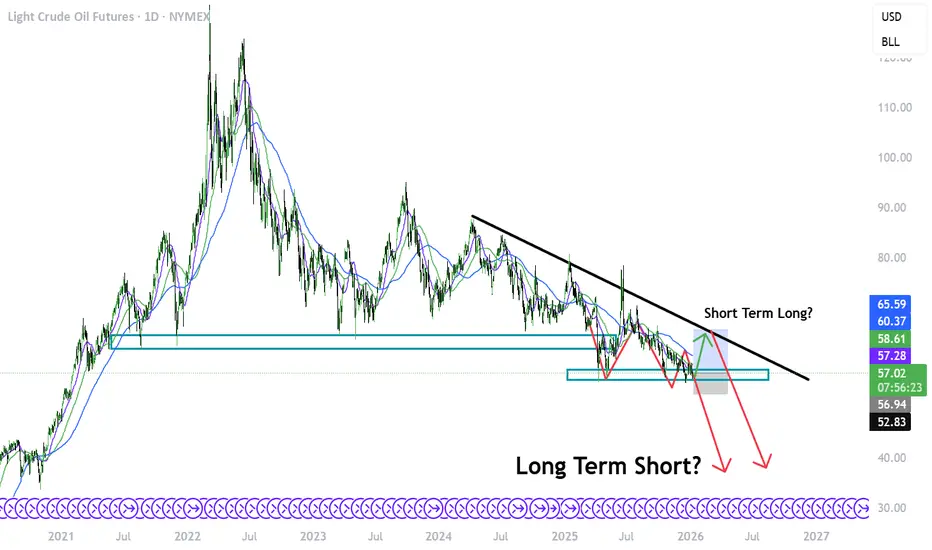
1) Technical Perspective: Support & Resistance
~$65 was a support zone earlier (2021–2024). In 2025–26, that $65 area now often acts as resistance. Prices have come down toward $55
2) Fundamental Drivers Behind the Downtrend
Oil has been in a multi-year decline from the highs seen in 2022 after the Russia–Ukraine war spike. A combination of oversupply and weaker demand has kept price pressure on:
• 2025 saw a large annual price drop due to persistent oversupply and slow demand.
• EIA and IEA reports project global oil supply continuing to exceed demand into 2026.
This structural oversupply (positive global inventories) pushes the short-term bias lower unless demand surprises on the upside.
3) Geopolitical Drivers — Including Venezuela
Recent news confirms that geopolitics remain a key wild card: The U.S. has taken actions around Venezuelan oil assets and plans to export Venezuelan crude, which could add supply and weigh on prices, especially if revitalisation occurs. Oil prices did tick up short-term on inventory draws and Venezuela focus, but long-term gains from Venezuelan production may be limited because infrastructure will take years to rebuild. Geopolitical tensions can spike oil temporarily, but unless supply physically tightens, the structure stays bearish.
4) OPEC / OPEC+ Decisions
OPEC’s recent behaviour has been a big driver:
In 2025, OPEC+ unwound production cuts, which contributed to oversupply and lower prices.
For 2026: The OPEC+ view has shifted toward equilibrium, but global supply growth still challenges prices. If OPEC+ cuts output further or extends cuts, prices could find stronger support around current levels ($55–$65). If OPEC+ maintains or increases production while demand stays soft, that supports a drop toward $45–$50. So OPEC policy is one of the most important catalysts, it fundamentally shifts supply.
5) Demand Risks & Macro Conditions
Global demand remains under pressure: Chinese economic weakness and slower global growth reduce oil demand. And EIA forecasts oversupply growth in 2026.
Lower demand growth + abundant supply = structural downside risk.
6) Link to US Dollar, Inflation & Rates
Higher real rates / stronger USD → oil tends to weaken:
Oil is USD-denominated. A stronger dollar makes oil more expensive for holders of other currencies. Tight monetary policy (higher rates) can slow economic growth and demand for oil.
Lower real rates / weaker USD → oil tends to strengthen: Cheaper USD can support crude prices if demand fundamentals improve.
Right now, with US economic strength and mixed inflation data elsewhere, it’s not certain the Fed will aggressively cut. If inflation re-accelerates and the Fed resists rate cuts or even raises, that could strengthen the USD and pressure oil lower.
However, if the Fed eases later, weaker real rates could help commodities broadly, but oil’s supply/demand story still matters more.
Disclaimer:
This analysis is for informational and educational purposes only and does not constitute financial advice, investment recommendation, or an offer to buy or sell any securities. Asset prices, valuations, and performance metrics are subject to change and may be outdated. Always conduct your own due diligence and consult with a licensed financial advisor before making investment decisions. The information presented may contain inaccuracies and should not be solely relied upon for financial decisions. I am not a licensed financial advisor or professional trader. I am not personally liable for your own losses; this is not financial advice.
~$65 was a support zone earlier (2021–2024). In 2025–26, that $65 area now often acts as resistance. Prices have come down toward $55
2) Fundamental Drivers Behind the Downtrend
Oil has been in a multi-year decline from the highs seen in 2022 after the Russia–Ukraine war spike. A combination of oversupply and weaker demand has kept price pressure on:
• 2025 saw a large annual price drop due to persistent oversupply and slow demand.
• EIA and IEA reports project global oil supply continuing to exceed demand into 2026.
This structural oversupply (positive global inventories) pushes the short-term bias lower unless demand surprises on the upside.
3) Geopolitical Drivers — Including Venezuela
Recent news confirms that geopolitics remain a key wild card: The U.S. has taken actions around Venezuelan oil assets and plans to export Venezuelan crude, which could add supply and weigh on prices, especially if revitalisation occurs. Oil prices did tick up short-term on inventory draws and Venezuela focus, but long-term gains from Venezuelan production may be limited because infrastructure will take years to rebuild. Geopolitical tensions can spike oil temporarily, but unless supply physically tightens, the structure stays bearish.
4) OPEC / OPEC+ Decisions
OPEC’s recent behaviour has been a big driver:
In 2025, OPEC+ unwound production cuts, which contributed to oversupply and lower prices.
For 2026: The OPEC+ view has shifted toward equilibrium, but global supply growth still challenges prices. If OPEC+ cuts output further or extends cuts, prices could find stronger support around current levels ($55–$65). If OPEC+ maintains or increases production while demand stays soft, that supports a drop toward $45–$50. So OPEC policy is one of the most important catalysts, it fundamentally shifts supply.
5) Demand Risks & Macro Conditions
Global demand remains under pressure: Chinese economic weakness and slower global growth reduce oil demand. And EIA forecasts oversupply growth in 2026.
Lower demand growth + abundant supply = structural downside risk.
6) Link to US Dollar, Inflation & Rates
Higher real rates / stronger USD → oil tends to weaken:
Oil is USD-denominated. A stronger dollar makes oil more expensive for holders of other currencies. Tight monetary policy (higher rates) can slow economic growth and demand for oil.
Lower real rates / weaker USD → oil tends to strengthen: Cheaper USD can support crude prices if demand fundamentals improve.
Right now, with US economic strength and mixed inflation data elsewhere, it’s not certain the Fed will aggressively cut. If inflation re-accelerates and the Fed resists rate cuts or even raises, that could strengthen the USD and pressure oil lower.
However, if the Fed eases later, weaker real rates could help commodities broadly, but oil’s supply/demand story still matters more.
Disclaimer:
This analysis is for informational and educational purposes only and does not constitute financial advice, investment recommendation, or an offer to buy or sell any securities. Asset prices, valuations, and performance metrics are subject to change and may be outdated. Always conduct your own due diligence and consult with a licensed financial advisor before making investment decisions. The information presented may contain inaccuracies and should not be solely relied upon for financial decisions. I am not a licensed financial advisor or professional trader. I am not personally liable for your own losses; this is not financial advice.
Transaction en cours
Interesting take: -If the USA helps the Iranian regime fall, then oil prices should spike as Iran produces around 3 mil bpd, compared to Saudi's 9 mil bpd. So, it would seem plausible that oil would go up due to supply disruptions, and as Trump mentioned that he wants to keep oil prices at around 50$ per barrel, we could take a short till 45-50$ which aligns with the analysis made above. Again, Trump's promises must be taken with a grain of salt, and markets move very violently during times of distress, so this idea might not play out, but i think it can (just my personal opinion, not a financial recommendation).

Clause de non-responsabilité
Les informations et publications ne sont pas destinées à être, et ne constituent pas, des conseils ou recommandations financiers, d'investissement, de trading ou autres fournis ou approuvés par TradingView. Pour en savoir plus, consultez les Conditions d'utilisation.
Clause de non-responsabilité
Les informations et publications ne sont pas destinées à être, et ne constituent pas, des conseils ou recommandations financiers, d'investissement, de trading ou autres fournis ou approuvés par TradingView. Pour en savoir plus, consultez les Conditions d'utilisation.