
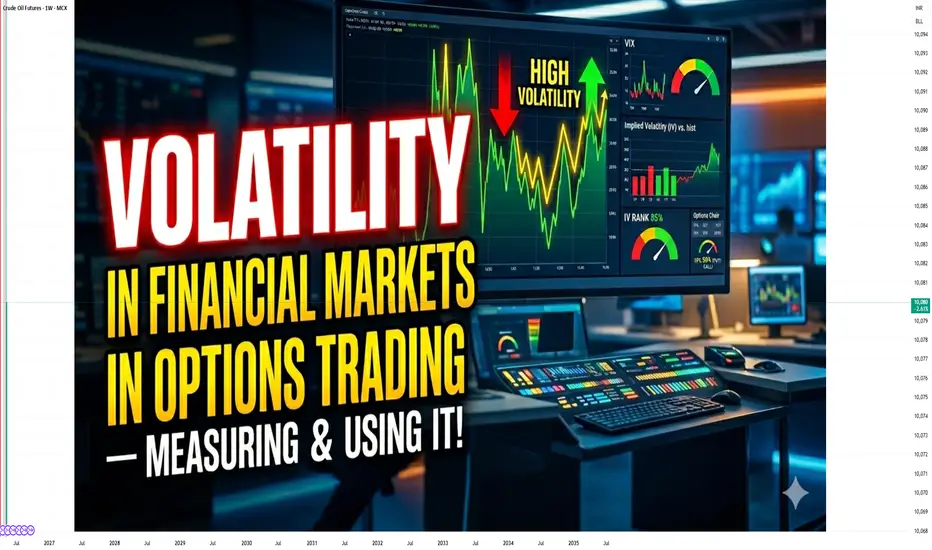
1. What is Volatility?
Volatility measures the degree of variation in the price of an asset.
If prices move rapidly and aggressively, volatility is considered high.
If prices move slowly and remain stable, volatility is considered low.
For example:
A stock moving 10% daily has high volatility.
A stock moving only 1% daily has low volatility.
Volatility does not indicate direction. It only measures movement.
A stock can be highly volatile while moving upward or downward.
2. Importance of Volatility in Options Trading
Volatility is extremely important because option pricing depends heavily on it.
Option premiums are influenced by:
Stock price
Strike price
Time to expiry
Interest rates
Volatility
Among these factors, volatility can create very large changes in option prices.
When volatility increases:
Option premiums rise.
Buyers benefit from premium expansion.
Sellers face higher risk.
When volatility decreases:
Option premiums fall.
Sellers benefit from premium decay.
Buyers may lose value even if direction is correct.
3. Types of Volatility
There are mainly two important types of volatility in options trading.
A) Historical Volatility (HV)
Historical volatility measures past price movement.
It is calculated using previous market data and shows how much the asset moved historically over a specific time period.
Key Points:
Based on actual past movement.
Used to study stock behavior.
Does not predict future movement directly.
Example:
If a stock moved aggressively in the last month, its historical volatility will be high.
B) Implied Volatility (IV)
Implied volatility represents expected future volatility.
It is derived from option prices and reflects market expectations about upcoming movement.
Key Points:
Forward-looking indicator.
Shows expected movement before expiry.
Major factor in option pricing.
High IV means:
Market expects large movement.
Low IV means:
Market expects smaller movement.
Implied volatility is one of the most important tools for professional option traders.
4. Implied Volatility Crush
IV crush happens when implied volatility suddenly drops after a major event.
Examples of such events:
Earnings announcements
Budget releases
Election results
RBI policy decisions
Before these events:
IV usually rises because uncertainty increases.
After the event:
IV falls sharply because uncertainty disappears.
This sharp fall in IV reduces option premiums quickly.
Important Lesson:
Sometimes traders correctly predict market direction but still lose money because IV collapses after the event.
5. Relationship Between Volatility and Option Premiums
There is a direct relationship between volatility and option prices.
High Volatility
Premiums become expensive.
Larger expected movement.
Better for option sellers in many cases.
Low Volatility
Premiums become cheaper.
Smaller expected movement.
Better for option buyers looking for expansion.
Professional traders often compare current IV with historical averages before taking trades.
6. IV Rank and IV Percentile
These tools help traders understand whether implied volatility is relatively high or low.
IV Rank
IV Rank compares current IV with its yearly range.
Formula concept:
If current IV is near yearly highs → High IV Rank
If current IV is near yearly lows → Low IV Rank
High IV Rank:
Options are relatively expensive.
Low IV Rank:
Options are relatively cheap.
IV Percentile
IV Percentile shows how often IV remained below the current level during the past year.
Example:
IV Percentile of 80 means IV was lower than current IV 80% of the time.
This helps traders judge premium valuation more effectively.
7. Volatility and Option Buying
Option buyers generally prefer:
Increasing volatility
Strong directional movement
Expansion in premiums
Benefits for buyers:
Higher IV can increase option value rapidly.
Strong momentum helps delta movement.
Risks:
Time decay
IV crush
Expensive premiums during high IV
Option buyers should avoid blindly buying options during extremely high volatility unless strong movement is expected.
8. Volatility and Option Selling
Option sellers generally prefer:
High implied volatility
Time decay advantage
Stable or range-bound markets
Benefits for sellers:
Premium collection becomes larger.
IV contraction helps profits.
Theta decay works in favor of sellers.
Risks:
Sudden breakout moves
Unlimited loss potential in naked selling
Event-based volatility spikes
Professional traders often sell options when IV is extremely elevated.
9. Strategies Based on Volatility
Different market volatility conditions require different strategies.
Low Volatility Strategies
Suitable when expecting volatility expansion.
Examples:
Long Straddle
Long Strangle
Buying Calls
Buying Puts
High Volatility Strategies
Suitable when expecting volatility contraction.
Examples:
Iron Condor
Credit Spreads
Short Straddle
Short Strangle
Strategy selection should always depend on both market direction and volatility conditions.
10. VIX — The Volatility Index
India VIX is known as the fear gauge of the market.
It measures expected market volatility based on option prices.
High VIX
Fear and uncertainty increase.
Market swings become aggressive.
Low VIX
Stable market conditions.
Lower expected movement.
Traders monitor VIX daily to understand overall market sentiment and risk conditions.
11. Common Mistakes Traders Make with Volatility
Buying Expensive Options
Many beginners buy options during extremely high IV without understanding premium inflation.
Ignoring IV Crush
Traders often lose money after earnings events due to sudden IV collapse.
Using Wrong Strategy
Using buying strategies in low-movement markets or selling strategies during explosive conditions creates losses.
Ignoring Risk Management
Volatility can change rapidly, making disciplined stop-loss and position sizing extremely important.
12. Professional Approach to Using Volatility
Professional traders usually:
Compare IV with historical volatility.
Study IV Rank before entering trades.
Choose strategies according to volatility conditions.
Avoid emotional trading during news events.
Manage position size carefully.
Volatility is not just an indicator. It is a complete framework for understanding market expectations.

Publications connexes
Clause de non-responsabilité
Les informations et publications ne sont pas destinées à être, et ne constituent pas, des conseils ou recommandations financiers, d'investissement, de trading ou autres fournis ou approuvés par TradingView. Pour en savoir plus, consultez les Conditions d'utilisation.