
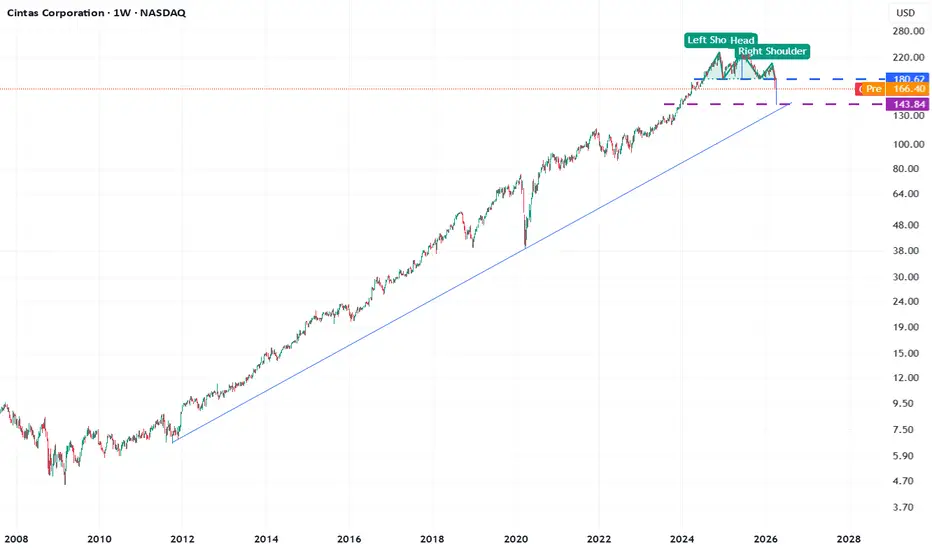
Bearish already breaking down
Looks like support is back at H&S target and long term up trendline
Reasons to be bearish
1. Premium valuation (biggest risk)
CTAS trades at ~34–42x earnings, well above market averages.
Metrics like:
Price-to-book ~13x
EV/Sales ~6x (vs ~2x sector)
➡️ This means:
The stock is priced for near-perfect execution
Any disappointment → sharp downside
2. Growth expectations already “priced in”
Analysts expect steady growth (~8–11% revenue/EPS).
➡️ Risk:
If growth slows even slightly → valuation compresses
Hard to outperform when expectations are already high
3. Earnings sensitivity (near-term catalyst risk)
Stock is currently under scrutiny due to recent earnings releases and guidance updates.
➡️ If:
margins slip
guidance weakens
→ stock likely reacts negatively
4. Cyclical exposure to business activity
Cintas provides uniforms, cleaning, and workplace services.
➡️ Highly linked to:
employment levels
business activity
hospitality / airlines / industrial demand
If the economy slows → demand drops.
5. Evidence of “lumpy” revenue segments
Uniform direct sales have already shown declines and unpredictability.
➡️ This segment:
can swing results unexpectedly
has previously triggered sharp stock drops (~10%)
6. Pricing power may weaken
Management has warned price increases are getting harder as inflation falls.
➡️ Risk:
Slower pricing growth → margin pressure
7. M&A execution risk (UniFirst deal)
Ongoing attempts to acquire UniFirst.
➡️ Risks:
Overpaying
integration issues
deal falling through → wasted time / costs
8. Slower organic growth vs valuation
Business is stable but not high-growth (~single-digit revenue growth).
➡️ Mismatch:
“steady business” vs “growth stock valuation”
9. Margin pressure from costs
Labour, logistics, and materials costs matter heavily in service businesses
➡️ If costs rise faster than pricing → margins shrink
10. Low dividend yield (less downside support)
Yield is ~0.9–1%
➡️ Investors aren’t paid much to hold during downturns
→ easier for money to rotate out
Bottom line (what matters most for CTAS)
The biggest downside drivers are:
Overvaluation vs moderate growth
Sensitivity to earnings / guidance
Exposure to economic slowdown
Weakening pricing power
Looks like support is back at H&S target and long term up trendline
Reasons to be bearish
1. Premium valuation (biggest risk)
CTAS trades at ~34–42x earnings, well above market averages.
Metrics like:
Price-to-book ~13x
EV/Sales ~6x (vs ~2x sector)
➡️ This means:
The stock is priced for near-perfect execution
Any disappointment → sharp downside
2. Growth expectations already “priced in”
Analysts expect steady growth (~8–11% revenue/EPS).
➡️ Risk:
If growth slows even slightly → valuation compresses
Hard to outperform when expectations are already high
3. Earnings sensitivity (near-term catalyst risk)
Stock is currently under scrutiny due to recent earnings releases and guidance updates.
➡️ If:
margins slip
guidance weakens
→ stock likely reacts negatively
4. Cyclical exposure to business activity
Cintas provides uniforms, cleaning, and workplace services.
➡️ Highly linked to:
employment levels
business activity
hospitality / airlines / industrial demand
If the economy slows → demand drops.
5. Evidence of “lumpy” revenue segments
Uniform direct sales have already shown declines and unpredictability.
➡️ This segment:
can swing results unexpectedly
has previously triggered sharp stock drops (~10%)
6. Pricing power may weaken
Management has warned price increases are getting harder as inflation falls.
➡️ Risk:
Slower pricing growth → margin pressure
7. M&A execution risk (UniFirst deal)
Ongoing attempts to acquire UniFirst.
➡️ Risks:
Overpaying
integration issues
deal falling through → wasted time / costs
8. Slower organic growth vs valuation
Business is stable but not high-growth (~single-digit revenue growth).
➡️ Mismatch:
“steady business” vs “growth stock valuation”
9. Margin pressure from costs
Labour, logistics, and materials costs matter heavily in service businesses
➡️ If costs rise faster than pricing → margins shrink
10. Low dividend yield (less downside support)
Yield is ~0.9–1%
➡️ Investors aren’t paid much to hold during downturns
→ easier for money to rotate out
Bottom line (what matters most for CTAS)
The biggest downside drivers are:
Overvaluation vs moderate growth
Sensitivity to earnings / guidance
Exposure to economic slowdown
Weakening pricing power

Clause de non-responsabilité
Les informations et publications ne sont pas destinées à être, et ne constituent pas, des conseils ou recommandations financiers, d'investissement, de trading ou autres fournis ou approuvés par TradingView. Pour en savoir plus, consultez les Conditions d'utilisation.
Clause de non-responsabilité
Les informations et publications ne sont pas destinées à être, et ne constituent pas, des conseils ou recommandations financiers, d'investissement, de trading ou autres fournis ou approuvés par TradingView. Pour en savoir plus, consultez les Conditions d'utilisation.