
The Macro Picture 🗺️
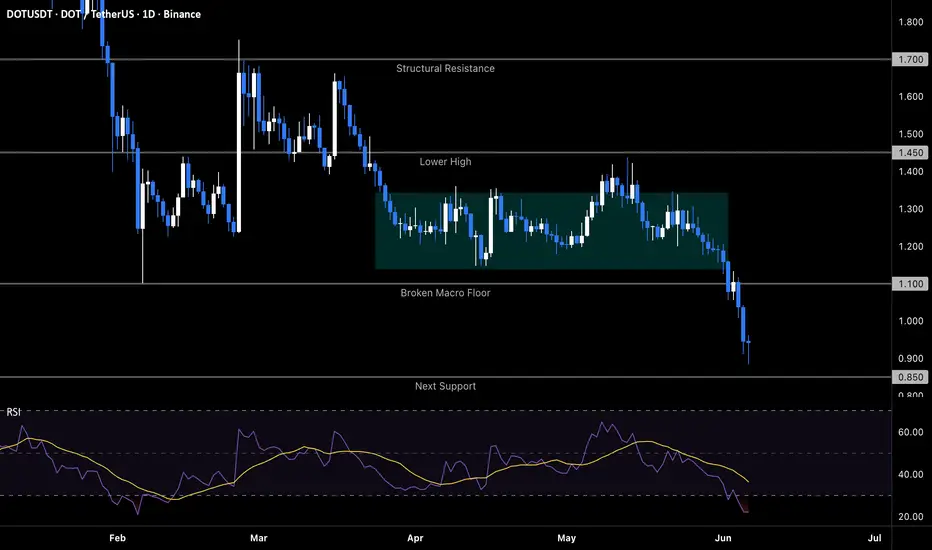
DOT broke the $1.10 macro floor cleanly last week — the multi-month range that held since the February capitulation has now failed, flipping the structural read from "compressing accumulation" to "post-breakdown trend." Price sits at $0.95 inside a fresh capitulation pocket with RSI pressed near 22, the deepest oversold print since February. The broken floor at $1.10 now sits as overhead supply, while the failed range above it ($1.20–$1.35) becomes a wall of trapped buyers who need price to reclaim before they can exit at breakeven. This is the kind of regime shift that demands a structural reset before any meaningful recovery can be priced in.
The Setup ⚙️
The Breakdown: The $1.10 macro floor that defended price for four months failed on the late-May test, with sellers driving a clean impulse leg into the $0.90s. The level didn't sweep and reverse — it gave way, confirming the broader trend rather than resetting it.
The Supply Flip: The $1.05–$1.15 band is now the first overhead test. Any RSI-driven reactive bounce has to fade or reclaim this zone, and that reaction will decide whether the breakdown extends or stalls into a new compressed range.
The Capitulation Pocket: The $0.85–$0.95 zone is where price is now searching for a structural low. RSI deep in the red below 25 sets up the mechanical conditions for a reactive bounce, but bounces inside trending breakdowns tend to get sold into supply rather than build reversals.
The Roadmap: Primary target sits at $0.85 — the next support
shelf where the impulse leg can find a floor and the capitulation pocket can complete. Invalidation: a sustained 1D close back above $1.15 would invalidate this continuation thesis and signal buyers reclaimed the broken floor, opening the path back into the failed range above.
DOT broke the $1.10 macro floor cleanly last week — the multi-month range that held since the February capitulation has now failed, flipping the structural read from "compressing accumulation" to "post-breakdown trend." Price sits at $0.95 inside a fresh capitulation pocket with RSI pressed near 22, the deepest oversold print since February. The broken floor at $1.10 now sits as overhead supply, while the failed range above it ($1.20–$1.35) becomes a wall of trapped buyers who need price to reclaim before they can exit at breakeven. This is the kind of regime shift that demands a structural reset before any meaningful recovery can be priced in.
The Setup ⚙️
The Breakdown: The $1.10 macro floor that defended price for four months failed on the late-May test, with sellers driving a clean impulse leg into the $0.90s. The level didn't sweep and reverse — it gave way, confirming the broader trend rather than resetting it.
The Supply Flip: The $1.05–$1.15 band is now the first overhead test. Any RSI-driven reactive bounce has to fade or reclaim this zone, and that reaction will decide whether the breakdown extends or stalls into a new compressed range.
The Capitulation Pocket: The $0.85–$0.95 zone is where price is now searching for a structural low. RSI deep in the red below 25 sets up the mechanical conditions for a reactive bounce, but bounces inside trending breakdowns tend to get sold into supply rather than build reversals.
The Roadmap: Primary target sits at $0.85 — the next support
shelf where the impulse leg can find a floor and the capitulation pocket can complete. Invalidation: a sustained 1D close back above $1.15 would invalidate this continuation thesis and signal buyers reclaimed the broken floor, opening the path back into the failed range above.

📈 Stop guessing your settings — backtest & optimize with QuantPilot
🎁 Free to start
🎁 Free to start
Clause de non-responsabilité
Les informations et publications ne sont pas destinées à être, et ne constituent pas, des conseils ou recommandations financiers, d'investissement, de trading ou autres fournis ou approuvés par TradingView. Pour en savoir plus, consultez les Conditions d'utilisation.
📈 Stop guessing your settings — backtest & optimize with QuantPilot
🎁 Free to start
🎁 Free to start
Clause de non-responsabilité
Les informations et publications ne sont pas destinées à être, et ne constituent pas, des conseils ou recommandations financiers, d'investissement, de trading ou autres fournis ou approuvés par TradingView. Pour en savoir plus, consultez les Conditions d'utilisation.