
The geopolitical situation since the end of February has completely reshaped expectations regarding the monetary policy of the U.S. Federal Reserve (Fed). The disruption of the Strait of Hormuz, the sharp rise in oil prices, natural gas, urea fertilizer, and industrial metals, along with the rebound in headline inflation, have led markets to shift from expecting cuts in the federal funds rate to anticipating rate hikes.
The U.S. 2-year Treasury yield is currently well above the Fed's policy rate, meaning the market believes the federal funds rate should be higher than its current level of 3.75%. However, the Fed has changed leadership in the meantime. Kevin Warsh is now the Chairman of the Fed, although Jerome Powell remains a voting member of the FOMC.
The chart below presents market expectations regarding the future path of Fed interest rates. These expectations have been dramatically altered since the end of February.

Despite these new market expectations, largely driven by the persistence of geopolitical tensions in the Middle East and therefore potentially reversible, I believe it is unlikely that Kevin Warsh's Fed will raise the federal funds rate this year, except in an extreme scenario.
Here are the reasons supporting this view:
First, the U.S. policy rate is already in restrictive territory. With the federal funds rate at 3.75%, monetary policy remains above most estimates of the neutral rate, generally considered to be between 2.5% and 3%. In other words, the Fed is already exerting a restraining effect on the economy and does not necessarily need to raise rates further to maintain restrictive financial conditions.
Second, underlying U.S. inflation remains relatively contained. While higher oil prices mechanically boost headline inflation, the Fed places greater emphasis on core inflation, which excludes food and energy. As long as core inflation remains under control, a preemptive rate hike appears difficult to justify.
The histogram below shows U.S. core inflation according to the CPI measure. Note that all economic data are available directly on TradingView.

Furthermore, U.S. bond yields have risen sharply in recent months. Long-term interest rates are already exerting significant pressure on credit markets, real estate, and investment activity. Part of the monetary tightening process is therefore being carried out directly by the market itself.
Finally, Kevin Warsh appears to favor reducing the Fed's balance sheet rather than raising interest rates again. Continuing quantitative tightening (QT) allows liquidity to be gradually withdrawn from the financial system and monetary conditions to be tightened without altering the policy rate. This approach seems more consistent in an environment where some liquidity pressures still persist in U.S. money markets.
Unless there is a sustained deterioration in core inflation, a wage-price spiral, or a loss of confidence in inflation expectations, the most likely scenario remains that the federal funds rate will stay at its current level for several more months.
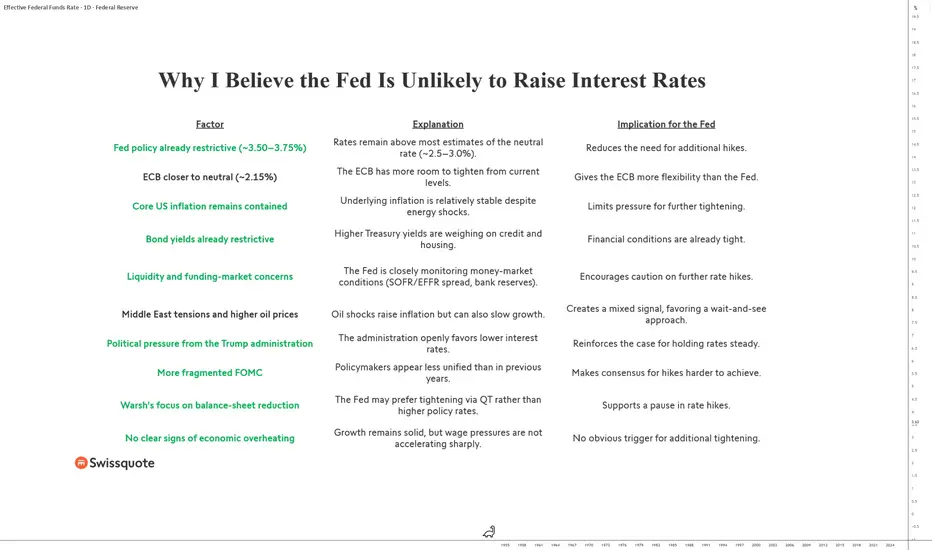
The table below outlines the reasons why it is unlikely that the Fed, under the leadership of Kevin Warsh, will raise U.S. federal funds rates in the near term.

DISCLAIMER:
This content is intended for individuals who are familiar with financial markets and instruments and is for information purposes only. The presented idea (including market commentary, market data and observations) is not a work product of any research department of Swissquote or its affiliates. This material is intended to highlight market action and does not constitute investment, legal or tax advice. If you are a retail investor or lack experience in trading complex financial products, it is advisable to seek professional advice from licensed advisor before making any financial decisions.
This content is not intended to manipulate the market or encourage any specific financial behavior.
Swissquote makes no representation or warranty as to the quality, completeness, accuracy, comprehensiveness or non-infringement of such content. The views expressed are those of the consultant and are provided for educational purposes only. Any information provided relating to a product or market should not be construed as recommending an investment strategy or transaction. Past performance is not a guarantee of future results.
Swissquote and its employees and representatives shall in no event be held liable for any damages or losses arising directly or indirectly from decisions made on the basis of this content.
The use of any third-party brands or trademarks is for information only and does not imply endorsement by Swissquote, or that the trademark owner has authorised Swissquote to promote its products or services.
Swissquote is the marketing brand for the activities of Swissquote Bank Ltd (Switzerland) regulated by FINMA, Swissquote Capital Markets Limited regulated by CySEC (Cyprus), Swissquote Bank Europe SA (Luxembourg) regulated by the CSSF, Swissquote Ltd (UK) regulated by the FCA, Swissquote Financial Services (Malta) Ltd regulated by the Malta Financial Services Authority, Swissquote MEA Ltd. (UAE) regulated by the Dubai Financial Services Authority, Swissquote Pte Ltd (Singapore) regulated by the Monetary Authority of Singapore, Swissquote Asia Limited (Hong Kong) licensed by the Hong Kong Securities and Futures Commission (SFC) and Swissquote South Africa (Pty) Ltd supervised by the FSCA.
Products and services of Swissquote are only intended for those permitted to receive them under local law.
All investments carry a degree of risk. The risk of loss in trading or holding financial instruments can be substantial. The value of financial instruments, including but not limited to stocks, bonds, cryptocurrencies, and other assets, can fluctuate both upwards and downwards. There is a significant risk of financial loss when buying, selling, holding, staking, or investing in these instruments. SQBE makes no recommendations regarding any specific investment, transaction, or the use of any particular investment strategy.
CFDs are complex instruments and come with a high risk of losing money rapidly due to leverage. The vast majority of retail client accounts suffer capital losses when trading in CFDs. You should consider whether you understand how CFDs work and whether you can afford to take the high risk of losing your money.
Digital Assets are unregulated in most countries and consumer protection rules may not apply. As highly volatile speculative investments, Digital Assets are not suitable for investors without a high-risk tolerance. Make sure you understand each Digital Asset before you trade.
Cryptocurrencies are not considered legal tender in some jurisdictions and are subject to regulatory uncertainties.
The use of Internet-based systems can involve high risks, including, but not limited to, fraud, cyber-attacks, network and communication failures, as well as identity theft and phishing attacks related to crypto-assets.
The U.S. 2-year Treasury yield is currently well above the Fed's policy rate, meaning the market believes the federal funds rate should be higher than its current level of 3.75%. However, the Fed has changed leadership in the meantime. Kevin Warsh is now the Chairman of the Fed, although Jerome Powell remains a voting member of the FOMC.
The chart below presents market expectations regarding the future path of Fed interest rates. These expectations have been dramatically altered since the end of February.
Despite these new market expectations, largely driven by the persistence of geopolitical tensions in the Middle East and therefore potentially reversible, I believe it is unlikely that Kevin Warsh's Fed will raise the federal funds rate this year, except in an extreme scenario.
Here are the reasons supporting this view:
First, the U.S. policy rate is already in restrictive territory. With the federal funds rate at 3.75%, monetary policy remains above most estimates of the neutral rate, generally considered to be between 2.5% and 3%. In other words, the Fed is already exerting a restraining effect on the economy and does not necessarily need to raise rates further to maintain restrictive financial conditions.
Second, underlying U.S. inflation remains relatively contained. While higher oil prices mechanically boost headline inflation, the Fed places greater emphasis on core inflation, which excludes food and energy. As long as core inflation remains under control, a preemptive rate hike appears difficult to justify.
The histogram below shows U.S. core inflation according to the CPI measure. Note that all economic data are available directly on TradingView.
Furthermore, U.S. bond yields have risen sharply in recent months. Long-term interest rates are already exerting significant pressure on credit markets, real estate, and investment activity. Part of the monetary tightening process is therefore being carried out directly by the market itself.
Finally, Kevin Warsh appears to favor reducing the Fed's balance sheet rather than raising interest rates again. Continuing quantitative tightening (QT) allows liquidity to be gradually withdrawn from the financial system and monetary conditions to be tightened without altering the policy rate. This approach seems more consistent in an environment where some liquidity pressures still persist in U.S. money markets.
Unless there is a sustained deterioration in core inflation, a wage-price spiral, or a loss of confidence in inflation expectations, the most likely scenario remains that the federal funds rate will stay at its current level for several more months.
The table below outlines the reasons why it is unlikely that the Fed, under the leadership of Kevin Warsh, will raise U.S. federal funds rates in the near term.
DISCLAIMER:
This content is intended for individuals who are familiar with financial markets and instruments and is for information purposes only. The presented idea (including market commentary, market data and observations) is not a work product of any research department of Swissquote or its affiliates. This material is intended to highlight market action and does not constitute investment, legal or tax advice. If you are a retail investor or lack experience in trading complex financial products, it is advisable to seek professional advice from licensed advisor before making any financial decisions.
This content is not intended to manipulate the market or encourage any specific financial behavior.
Swissquote makes no representation or warranty as to the quality, completeness, accuracy, comprehensiveness or non-infringement of such content. The views expressed are those of the consultant and are provided for educational purposes only. Any information provided relating to a product or market should not be construed as recommending an investment strategy or transaction. Past performance is not a guarantee of future results.
Swissquote and its employees and representatives shall in no event be held liable for any damages or losses arising directly or indirectly from decisions made on the basis of this content.
The use of any third-party brands or trademarks is for information only and does not imply endorsement by Swissquote, or that the trademark owner has authorised Swissquote to promote its products or services.
Swissquote is the marketing brand for the activities of Swissquote Bank Ltd (Switzerland) regulated by FINMA, Swissquote Capital Markets Limited regulated by CySEC (Cyprus), Swissquote Bank Europe SA (Luxembourg) regulated by the CSSF, Swissquote Ltd (UK) regulated by the FCA, Swissquote Financial Services (Malta) Ltd regulated by the Malta Financial Services Authority, Swissquote MEA Ltd. (UAE) regulated by the Dubai Financial Services Authority, Swissquote Pte Ltd (Singapore) regulated by the Monetary Authority of Singapore, Swissquote Asia Limited (Hong Kong) licensed by the Hong Kong Securities and Futures Commission (SFC) and Swissquote South Africa (Pty) Ltd supervised by the FSCA.
Products and services of Swissquote are only intended for those permitted to receive them under local law.
All investments carry a degree of risk. The risk of loss in trading or holding financial instruments can be substantial. The value of financial instruments, including but not limited to stocks, bonds, cryptocurrencies, and other assets, can fluctuate both upwards and downwards. There is a significant risk of financial loss when buying, selling, holding, staking, or investing in these instruments. SQBE makes no recommendations regarding any specific investment, transaction, or the use of any particular investment strategy.
CFDs are complex instruments and come with a high risk of losing money rapidly due to leverage. The vast majority of retail client accounts suffer capital losses when trading in CFDs. You should consider whether you understand how CFDs work and whether you can afford to take the high risk of losing your money.
Digital Assets are unregulated in most countries and consumer protection rules may not apply. As highly volatile speculative investments, Digital Assets are not suitable for investors without a high-risk tolerance. Make sure you understand each Digital Asset before you trade.
Cryptocurrencies are not considered legal tender in some jurisdictions and are subject to regulatory uncertainties.
The use of Internet-based systems can involve high risks, including, but not limited to, fraud, cyber-attacks, network and communication failures, as well as identity theft and phishing attacks related to crypto-assets.

This content is written by Vincent Ganne for Swissquote.
This content is intended for individuals who are familiar with financial markets and instruments and is for information purposes only and does not constitute investment, legal or tax advice.
This content is intended for individuals who are familiar with financial markets and instruments and is for information purposes only and does not constitute investment, legal or tax advice.
Clause de non-responsabilité
Les informations et publications ne sont pas destinées à être, et ne constituent pas, des conseils ou recommandations financiers, d'investissement, de trading ou autres fournis ou approuvés par TradingView. Pour en savoir plus, consultez les Conditions d'utilisation.
This content is written by Vincent Ganne for Swissquote.
This content is intended for individuals who are familiar with financial markets and instruments and is for information purposes only and does not constitute investment, legal or tax advice.
This content is intended for individuals who are familiar with financial markets and instruments and is for information purposes only and does not constitute investment, legal or tax advice.
Clause de non-responsabilité
Les informations et publications ne sont pas destinées à être, et ne constituent pas, des conseils ou recommandations financiers, d'investissement, de trading ou autres fournis ou approuvés par TradingView. Pour en savoir plus, consultez les Conditions d'utilisation.