

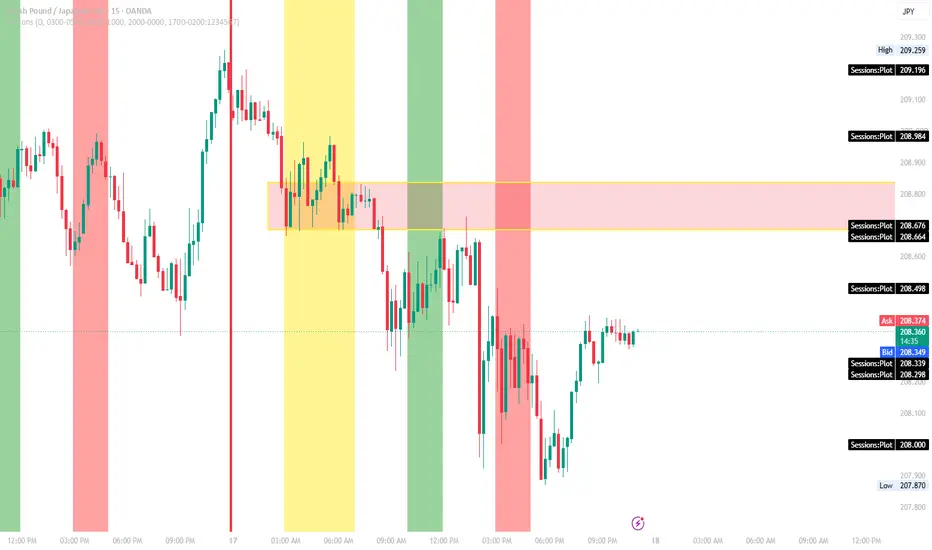
If ATR tells us that a market has already used, for example, 70% of its average movement during a specific period, we should not automatically expect the market to continue moving another large distance without a reason.
This applies to GBPJPY and to markets in general.
The important point is that **RR should be related to the amount of movement the market is realistically capable of producing during a specific period**, rather than using a fixed RR such as 1:2 or 1:3 for every trade.
For example, if the average movement of a market during a certain period is 100 pips and price has already moved 70 pips, then a significant portion of the expected range has already been consumed. The remaining realistic upside or downside may therefore be smaller.
However, this raises an important question:
**Why do some trades achieve RR of 1:3, 1:5, or even higher?**
Is it because the market had not yet consumed most of its ATR? Or can certain conditions—such as a strong breakout, increased volatility, a liquidity expansion, or major news—cause the market to move significantly beyond its normal ATR?
So perhaps the better question is not:
**"What fixed RR should I use?"**
but rather:
**"How much movement is realistically available in the market during this specific period, and what conditions could cause that range to expand?"**
In other words, RR should adapt to **ATR, volatility, the range already consumed, market structure, and the available price range**.
This could explain why a 1:2 target may sometimes be realistic, while under different market conditions a trade can run to 1:3, 1:5, or much further.
This applies to GBPJPY and to markets in general.
The important point is that **RR should be related to the amount of movement the market is realistically capable of producing during a specific period**, rather than using a fixed RR such as 1:2 or 1:3 for every trade.
For example, if the average movement of a market during a certain period is 100 pips and price has already moved 70 pips, then a significant portion of the expected range has already been consumed. The remaining realistic upside or downside may therefore be smaller.
However, this raises an important question:
**Why do some trades achieve RR of 1:3, 1:5, or even higher?**
Is it because the market had not yet consumed most of its ATR? Or can certain conditions—such as a strong breakout, increased volatility, a liquidity expansion, or major news—cause the market to move significantly beyond its normal ATR?
So perhaps the better question is not:
**"What fixed RR should I use?"**
but rather:
**"How much movement is realistically available in the market during this specific period, and what conditions could cause that range to expand?"**
In other words, RR should adapt to **ATR, volatility, the range already consumed, market structure, and the available price range**.
This could explain why a 1:2 target may sometimes be realistic, while under different market conditions a trade can run to 1:3, 1:5, or much further.

Clause de non-responsabilité
Les informations et publications ne sont pas destinées à être, et ne constituent pas, des conseils ou recommandations financiers, d'investissement, de trading ou autres fournis ou approuvés par TradingView. Pour en savoir plus, consultez les Conditions d'utilisation.
Clause de non-responsabilité
Les informations et publications ne sont pas destinées à être, et ne constituent pas, des conseils ou recommandations financiers, d'investissement, de trading ou autres fournis ou approuvés par TradingView. Pour en savoir plus, consultez les Conditions d'utilisation.