

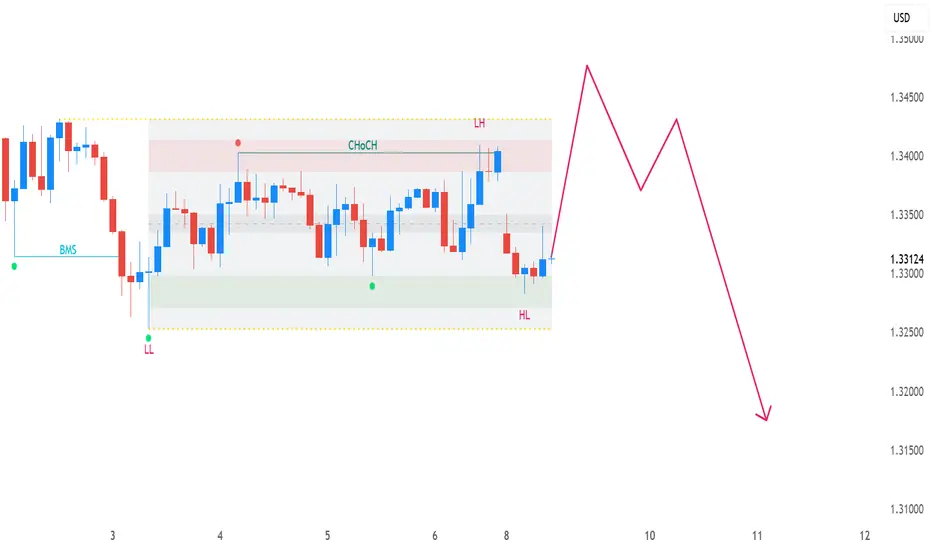
GBPUSD is currently trading within a well-defined consolidation phase after an earlier impulsive move that established a clear structural shift in market behavior. The chart shows that price initially formed a significant downside expansion before liquidity was absorbed at lower levels, allowing buyers to gradually regain control. This transition created a noticeable change in order flow, signaling that market participants were repositioning after the earlier bearish pressure.
Following this transition, price began to oscillate inside a compressed range where both buyers and sellers actively interacted. The repeated reactions inside this zone indicate that the market is balancing liquidity, with institutions likely accumulating positions while waiting for a catalyst to drive the next directional move. The presence of alternating higher and lower intraday swings reflects a temporary equilibrium between demand and supply.
As the latest candles approach the upper boundary of the consolidation area, momentum appears to be slowing. This behavior often occurs when the market is testing liquidity pockets before deciding on a broader directional move. The projected path on the chart suggests a potential volatility expansion where price may first sweep nearby liquidity clusters before initiating a stronger directional leg.
From a broader perspective, macro sentiment around the US dollar and the British pound continues to influence flows in this pair. Expectations surrounding interest-rate outlooks, global risk sentiment, and institutional positioning remain key drivers that can trigger sudden momentum shifts. When markets transition from consolidation to expansion, these macro catalysts frequently accelerate price movement as liquidity gets redistributed.
Overall, the current structure reflects a market preparing for its next impulsive phase. Traders should closely monitor how price behaves around recent swing areas, as liquidity interaction in these zones will likely determine whether the pair experiences a short-term continuation move or a deeper corrective expansion.
Following this transition, price began to oscillate inside a compressed range where both buyers and sellers actively interacted. The repeated reactions inside this zone indicate that the market is balancing liquidity, with institutions likely accumulating positions while waiting for a catalyst to drive the next directional move. The presence of alternating higher and lower intraday swings reflects a temporary equilibrium between demand and supply.
As the latest candles approach the upper boundary of the consolidation area, momentum appears to be slowing. This behavior often occurs when the market is testing liquidity pockets before deciding on a broader directional move. The projected path on the chart suggests a potential volatility expansion where price may first sweep nearby liquidity clusters before initiating a stronger directional leg.
From a broader perspective, macro sentiment around the US dollar and the British pound continues to influence flows in this pair. Expectations surrounding interest-rate outlooks, global risk sentiment, and institutional positioning remain key drivers that can trigger sudden momentum shifts. When markets transition from consolidation to expansion, these macro catalysts frequently accelerate price movement as liquidity gets redistributed.
Overall, the current structure reflects a market preparing for its next impulsive phase. Traders should closely monitor how price behaves around recent swing areas, as liquidity interaction in these zones will likely determine whether the pair experiences a short-term continuation move or a deeper corrective expansion.
Transaction en cours

Clause de non-responsabilité
Les informations et publications ne sont pas destinées à être, et ne constituent pas, des conseils ou recommandations financiers, d'investissement, de trading ou autres fournis ou approuvés par TradingView. Pour en savoir plus, consultez les Conditions d'utilisation.
Clause de non-responsabilité
Les informations et publications ne sont pas destinées à être, et ne constituent pas, des conseils ou recommandations financiers, d'investissement, de trading ou autres fournis ou approuvés par TradingView. Pour en savoir plus, consultez les Conditions d'utilisation.