

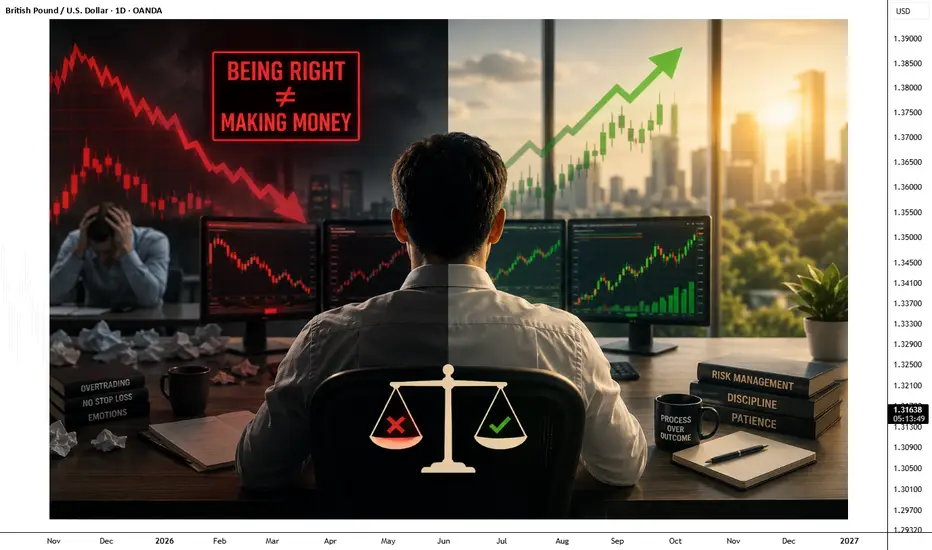
Many traders enter the market believing that success comes from predicting the direction correctly. They think that if they can identify whether the price will go up or down, profits will automatically follow. But the market does not reward being right. It rewards managing risk, controlling emotions, and making decisions that create positive outcomes over time.
A trader can be right about the market direction and still lose money. A trader can predict a stock will fall, enter too early, use a large position size, and get stopped out before the actual move happens. The analysis was correct, but the execution was wrong.
The Difference Between Prediction and Profit
Trading is not a game of proving who has the best prediction. It is a game of probabilities. Professional traders understand that even the best setups can fail. Their goal is not to win every trade; their goal is to make sure their winning trades are larger than their losing trades.
A trader who wins 40% of the time can still make money if their risk management is strong. Meanwhile, a trader who wins 80% of the time can lose everything if they take unnecessary risks.
Being Right With Bad Risk Management Still Fails
Imagine a trader buys a stock at $100 because they believe it will reach $120. Their analysis is correct, and the stock eventually reaches the target. But before moving higher, the price drops to $90. If the trader used excessive leverage or no stop loss, they may have already been forced out of the trade. The market moved according to their idea, but they were not able to survive the journey.
The market does not care about your prediction. It only cares about your position size and your ability to handle uncertainty.
The Ego Trap of Being Right
Many traders become emotionally attached to their analysis. When the market moves against them, they refuse to accept that their timing was wrong. They hold losing positions because they want the market to prove them right.
This creates a dangerous mindset where protecting the ego becomes more important than protecting the account. Successful traders focus less on being right and more on responding correctly to what the market shows them.
Execution Creates Results
Two traders can have the same strategy, the same entry, and the same market view. One can make money while the other loses.
The difference is often in execution. One trader follows the plan, respects the stop loss, and takes profits according to their system. The other trader changes decisions based on fear, greed, or hope. Trading success is not created by finding perfect analysis. It is created by consistently executing a good process.
The Real Goal of a Trader
The goal is not to predict every move. The goal is to protect capital when you are wrong and maximize opportunities when you are right. A professional trader accepts that losses are part of the business. They do not measure themselves by how often they are correct. They measure themselves by whether their decisions produce results over hundreds of trades.
In the market, being right feels good, but being profitable is what matters. The best traders are not those who always predict the future. They are those who know how to manage themselves when the future is uncertain.
By BrightRally_Research on TradingView
A trader can be right about the market direction and still lose money. A trader can predict a stock will fall, enter too early, use a large position size, and get stopped out before the actual move happens. The analysis was correct, but the execution was wrong.
The Difference Between Prediction and Profit
Trading is not a game of proving who has the best prediction. It is a game of probabilities. Professional traders understand that even the best setups can fail. Their goal is not to win every trade; their goal is to make sure their winning trades are larger than their losing trades.
A trader who wins 40% of the time can still make money if their risk management is strong. Meanwhile, a trader who wins 80% of the time can lose everything if they take unnecessary risks.
Being Right With Bad Risk Management Still Fails
Imagine a trader buys a stock at $100 because they believe it will reach $120. Their analysis is correct, and the stock eventually reaches the target. But before moving higher, the price drops to $90. If the trader used excessive leverage or no stop loss, they may have already been forced out of the trade. The market moved according to their idea, but they were not able to survive the journey.
The market does not care about your prediction. It only cares about your position size and your ability to handle uncertainty.
The Ego Trap of Being Right
Many traders become emotionally attached to their analysis. When the market moves against them, they refuse to accept that their timing was wrong. They hold losing positions because they want the market to prove them right.
This creates a dangerous mindset where protecting the ego becomes more important than protecting the account. Successful traders focus less on being right and more on responding correctly to what the market shows them.
Execution Creates Results
Two traders can have the same strategy, the same entry, and the same market view. One can make money while the other loses.
The difference is often in execution. One trader follows the plan, respects the stop loss, and takes profits according to their system. The other trader changes decisions based on fear, greed, or hope. Trading success is not created by finding perfect analysis. It is created by consistently executing a good process.
The Real Goal of a Trader
The goal is not to predict every move. The goal is to protect capital when you are wrong and maximize opportunities when you are right. A professional trader accepts that losses are part of the business. They do not measure themselves by how often they are correct. They measure themselves by whether their decisions produce results over hundreds of trades.
In the market, being right feels good, but being profitable is what matters. The best traders are not those who always predict the future. They are those who know how to manage themselves when the future is uncertain.
By BrightRally_Research on TradingView

Publications connexes
Clause de non-responsabilité
Les informations et publications ne sont pas destinées à être, et ne constituent pas, des conseils ou recommandations financiers, d'investissement, de trading ou autres fournis ou approuvés par TradingView. Pour en savoir plus, consultez les Conditions d'utilisation.
Publications connexes
Clause de non-responsabilité
Les informations et publications ne sont pas destinées à être, et ne constituent pas, des conseils ou recommandations financiers, d'investissement, de trading ou autres fournis ou approuvés par TradingView. Pour en savoir plus, consultez les Conditions d'utilisation.