
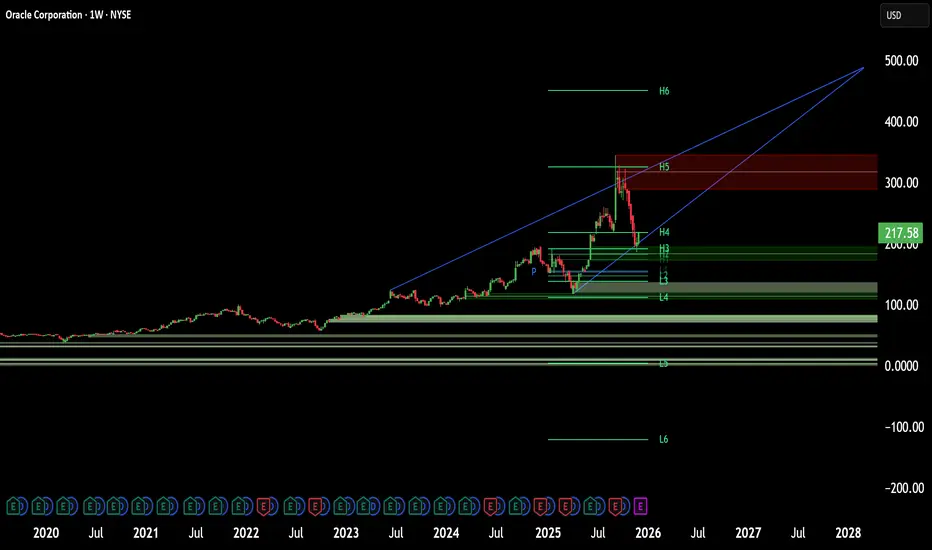
Oracle Corporation (ORCL) stands at a defining juncture where aggressive cloud expansion collides with the physical limits of infrastructure scaling. Despite a strategic pivot that has positioned Oracle Cloud Infrastructure (OCI) as a primary engine for artificial intelligence workloads, the stock has retreated approximately 35% from its September peak. This volatility reflects a market grappling with a dual narrative: the immense promise of a $300 billion AI pipeline and the operational fragility of concentrating heavily on a single client, OpenAI.
Geopolitics and Geostrategy: The Sovereign Advantage
Oracle has effectively weaponized data sovereignty as a competitive moat. Unlike hyperscale rivals often viewed with skepticism in Europe and Asia, Oracle’s dual-region sovereign cloud strategy allows governments to retain strict legal control over data residency. This approach insulates a portion of Oracle’s revenue from protectionist policies and US-China trade tensions, positioning OCI as the "neutral" vendor of choice for state-level actors requiring air-gapped security for sensitive workloads.
Industry Trends and Macroeconomics: The Capacity Wall
The macro environment presents a paradox for Oracle. High interest rates have inflated the cost of debt just as the company accelerates capital expenditures (CapEx) to build AI data centers. Simultaneously, the industry faces a hard physical ceiling: power availability. In key markets like Northern Virginia and Silicon Valley, grid connections face multi-year delays. Oracle’s ability to secure gigawatt-scale power for its "Stargate" class projects will be the primary determinant of whether it can convert its record bookings into recognized revenue before 2027.
Business Models: The OpenAI Concentration Risk
Oracle’s shift from license-based legacy software to consumption-based cloud revenue is accelerating, but the quality of this revenue is under scrutiny. Recent disclosures reveal that a significant percentage of the company’s Remaining Performance Obligations (RPO) is tied to OpenAI’s massive infrastructure demands. While this validates OCI’s technical prowess, it introduces binary counterparty risk. If OpenAI faces regulatory headwinds or funding slowdowns, Oracle’s growth narrative could face an abrupt repricing.
Technology, Cyber, and Patent Analysis
Technologically, Oracle differentiates itself through automation. Its Autonomous Database utilizes machine learning to self-patch and self-tune, theoretically reducing the cyber attack surface by eliminating human error—the leading cause of data breaches. Patent analysis suggests Oracle is aggressively protecting this "self-driving" database architecture, aiming to lock in enterprise clients who prioritize security over the raw compute cost advantages offered by generic cloud providers.
Management and Leadership: The Aggressive Pivot
Under the stewardship of Larry Ellison and Safra Catz, Oracle’s culture remains unapologetically aggressive. The leadership has demonstrated a willingness to sacrifice short-term margins for long-term capacity, a strategy reminiscent of Amazon’s early AWS days. However, this high-stakes bet requires flawless execution in supply chain management, particularly in securing Nvidia GPUs amidst global shortages.
Stock Performance and Technical Status
Technically, ORCL is testing critical support zones after its sharp 35% correction. The sell-off was triggered by the realization that bookings growth does not equal immediate cash flow. Investors are currently demanding proof of "broad-based demand"—evidence that OCI is winning enterprise clients beyond the headline-grabbing AI labs. Until this diversification is proven, the stock remains vulnerable to volatility.
Geopolitics and Geostrategy: The Sovereign Advantage
Oracle has effectively weaponized data sovereignty as a competitive moat. Unlike hyperscale rivals often viewed with skepticism in Europe and Asia, Oracle’s dual-region sovereign cloud strategy allows governments to retain strict legal control over data residency. This approach insulates a portion of Oracle’s revenue from protectionist policies and US-China trade tensions, positioning OCI as the "neutral" vendor of choice for state-level actors requiring air-gapped security for sensitive workloads.
Industry Trends and Macroeconomics: The Capacity Wall
The macro environment presents a paradox for Oracle. High interest rates have inflated the cost of debt just as the company accelerates capital expenditures (CapEx) to build AI data centers. Simultaneously, the industry faces a hard physical ceiling: power availability. In key markets like Northern Virginia and Silicon Valley, grid connections face multi-year delays. Oracle’s ability to secure gigawatt-scale power for its "Stargate" class projects will be the primary determinant of whether it can convert its record bookings into recognized revenue before 2027.
Business Models: The OpenAI Concentration Risk
Oracle’s shift from license-based legacy software to consumption-based cloud revenue is accelerating, but the quality of this revenue is under scrutiny. Recent disclosures reveal that a significant percentage of the company’s Remaining Performance Obligations (RPO) is tied to OpenAI’s massive infrastructure demands. While this validates OCI’s technical prowess, it introduces binary counterparty risk. If OpenAI faces regulatory headwinds or funding slowdowns, Oracle’s growth narrative could face an abrupt repricing.
Technology, Cyber, and Patent Analysis
Technologically, Oracle differentiates itself through automation. Its Autonomous Database utilizes machine learning to self-patch and self-tune, theoretically reducing the cyber attack surface by eliminating human error—the leading cause of data breaches. Patent analysis suggests Oracle is aggressively protecting this "self-driving" database architecture, aiming to lock in enterprise clients who prioritize security over the raw compute cost advantages offered by generic cloud providers.
Management and Leadership: The Aggressive Pivot
Under the stewardship of Larry Ellison and Safra Catz, Oracle’s culture remains unapologetically aggressive. The leadership has demonstrated a willingness to sacrifice short-term margins for long-term capacity, a strategy reminiscent of Amazon’s early AWS days. However, this high-stakes bet requires flawless execution in supply chain management, particularly in securing Nvidia GPUs amidst global shortages.
Stock Performance and Technical Status
Technically, ORCL is testing critical support zones after its sharp 35% correction. The sell-off was triggered by the realization that bookings growth does not equal immediate cash flow. Investors are currently demanding proof of "broad-based demand"—evidence that OCI is winning enterprise clients beyond the headline-grabbing AI labs. Until this diversification is proven, the stock remains vulnerable to volatility.

Clause de non-responsabilité
Les informations et publications ne sont pas destinées à être, et ne constituent pas, des conseils ou recommandations financiers, d'investissement, de trading ou autres fournis ou approuvés par TradingView. Pour en savoir plus, consultez les Conditions d'utilisation.
Clause de non-responsabilité
Les informations et publications ne sont pas destinées à être, et ne constituent pas, des conseils ou recommandations financiers, d'investissement, de trading ou autres fournis ou approuvés par TradingView. Pour en savoir plus, consultez les Conditions d'utilisation.