
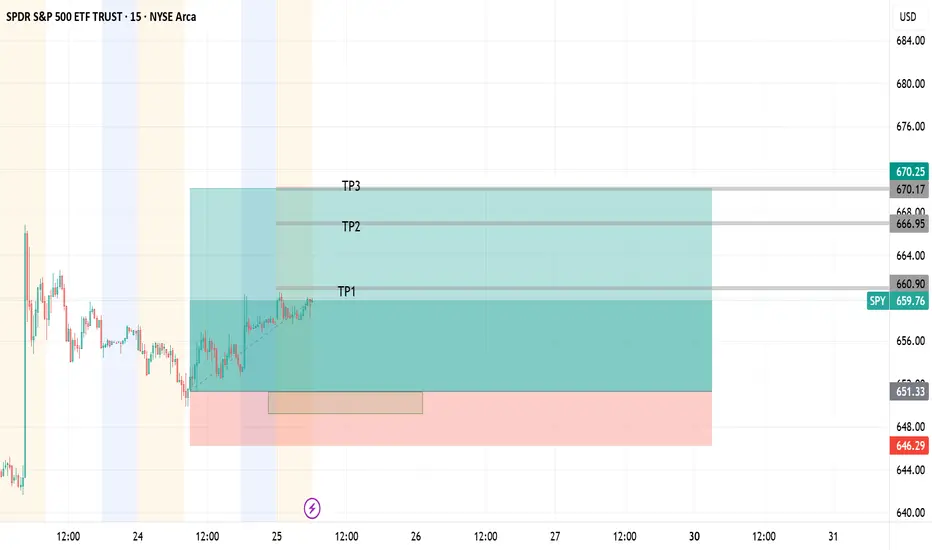
Timeframe: 15 min
Bias: Long
Structure & Context:
After a sharp selloff into the March 20th low, SPY has been building a recovery structure with higher lows forming on the 15-minute chart. Price swept the previous swing low and reversed aggressively, leaving behind a well-defined demand zone (order block) in the 649–651 area. This zone aligns with the prior accumulation range and has not been retested yet — making it a fresh level of interest.
Why I'm looking long here:
Liquidity sweep — price dipped below the equal lows near 644 before reversing sharply, suggesting sell-side liquidity was grabbed by institutional players.
Bullish displacement — the move off the lows was impulsive with large-bodied candles, indicating genuine buying pressure rather than a dead-cat bounce.
Demand zone confluence — the 649–651 entry zone sits at the origin of the displacement move and overlaps with a prior consolidation range, adding confluence.
Market context — broader indices are stabilizing after the recent pullback, and SPY is holding above key daily support.
Trade Plan:
Entry Zone: 649–651 (on a retest pullback into the demand zone)
Stop Loss: 648 (below the order block low — invalidates the demand zone)
TP1: 660 (prior resistance / supply pocket)
TP2: 668 (next structural resistance level)
TP3: 671 (extended target near the upper range)
Risk-to-Reward:
With entry around 650 and SL at 648, that's roughly 2 points of risk.
TP1 gives ~5:1 R:R
TP2 gives ~9:1 R:R
TP3 gives ~10.5:1 R:R
I'll be scaling out at each target — 50% at TP1, 30% at TP2, and letting the remaining 20% ride to TP3 with stop moved to breakeven after TP1.
Invalidation:
A clean break and close below 648 on the 15-min timeframe invalidates this setup. If price breaks back below the demand zone with volume, I'm flat — no averaging down.
Manage your risk. This is my analysis, not financial advice.

Clause de non-responsabilité
Les informations et publications ne sont pas destinées à être, et ne constituent pas, des conseils ou recommandations financiers, d'investissement, de trading ou autres fournis ou approuvés par TradingView. Pour en savoir plus, consultez les Conditions d'utilisation.
Clause de non-responsabilité
Les informations et publications ne sont pas destinées à être, et ne constituent pas, des conseils ou recommandations financiers, d'investissement, de trading ou autres fournis ou approuvés par TradingView. Pour en savoir plus, consultez les Conditions d'utilisation.