
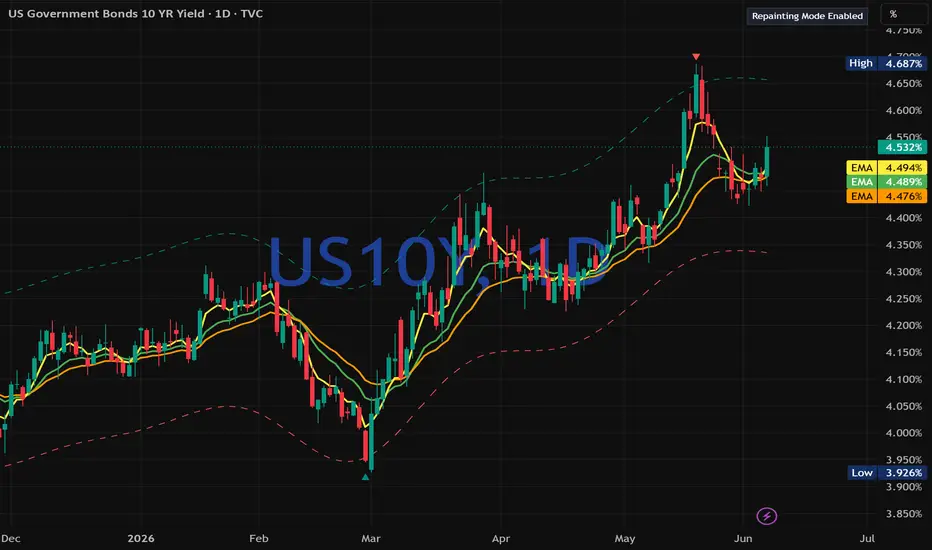
Think of Treasury yields as the market's prediction of where interest rates are headed.
### Before NFP
The market was thinking:
"The economy may be slowing, so the Fed could cut rates soon."
If rates are expected to fall:
* Existing bonds with higher rates become more valuable.
* Investors buy bonds.
* **Bond prices rise.**
* **Yields fall.**
### After Strong NFP
The jobs report said:
> "The economy is still strong."
Now traders think:
* Fed may cut rates later than expected.
* Interest rates could stay higher for longer.
* New bonds issued in the future may offer higher yields.
So investors don't want to pay as much for today's bonds.
### What happens mathematically?
Suppose a bond pays **$40/year**.
If investors pay **$1,000** for it:
Yield = 40/1000 = 4%
If investors sell it and the price drops to **$950**:
Yield = 40/950 =approx 4.21%
The payment didn't change.
The **price fell**, so the **yield rose**.
### Why stocks care
The 10-year Treasury is the "gravity setting" for markets.
If the 10-year yield rises:
* Borrowing gets more expensive.
* Future earnings are worth less today.
* Growth stocks like tech often get pressured.
If the 10-year yield falls:
* Money becomes cheaper.
* Growth stocks usually get a boost.
### The shortcut for your daily trading
When you see:
**Strong NFP / Strong CPI / Strong Retail Sales**
➡️ Higher growth expectations
➡️ Fewer Fed cuts expected
➡️ Bond prices ↓
➡️ Treasury yields ↑
➡️ USD ↑
That chain reaction is one of the most important things to watch for SPY, QQQ, and options trading. 📊
### Before NFP
The market was thinking:
"The economy may be slowing, so the Fed could cut rates soon."
If rates are expected to fall:
* Existing bonds with higher rates become more valuable.
* Investors buy bonds.
* **Bond prices rise.**
* **Yields fall.**
### After Strong NFP
The jobs report said:
> "The economy is still strong."
Now traders think:
* Fed may cut rates later than expected.
* Interest rates could stay higher for longer.
* New bonds issued in the future may offer higher yields.
So investors don't want to pay as much for today's bonds.
### What happens mathematically?
Suppose a bond pays **$40/year**.
If investors pay **$1,000** for it:
Yield = 40/1000 = 4%
If investors sell it and the price drops to **$950**:
Yield = 40/950 =approx 4.21%
The payment didn't change.
The **price fell**, so the **yield rose**.
### Why stocks care
The 10-year Treasury is the "gravity setting" for markets.
If the 10-year yield rises:
* Borrowing gets more expensive.
* Future earnings are worth less today.
* Growth stocks like tech often get pressured.
If the 10-year yield falls:
* Money becomes cheaper.
* Growth stocks usually get a boost.
### The shortcut for your daily trading
When you see:
**Strong NFP / Strong CPI / Strong Retail Sales**
➡️ Higher growth expectations
➡️ Fewer Fed cuts expected
➡️ Bond prices ↓
➡️ Treasury yields ↑
➡️ USD ↑
That chain reaction is one of the most important things to watch for SPY, QQQ, and options trading. 📊

Clause de non-responsabilité
Les informations et publications ne sont pas destinées à être, et ne constituent pas, des conseils ou recommandations financiers, d'investissement, de trading ou autres fournis ou approuvés par TradingView. Pour en savoir plus, consultez les Conditions d'utilisation.
Clause de non-responsabilité
Les informations et publications ne sont pas destinées à être, et ne constituent pas, des conseils ou recommandations financiers, d'investissement, de trading ou autres fournis ou approuvés par TradingView. Pour en savoir plus, consultez les Conditions d'utilisation.